Four main conclusions from the Washington Ukraine discussions
News Mania Desk / Piyal Chatterjee / 19th August 2025

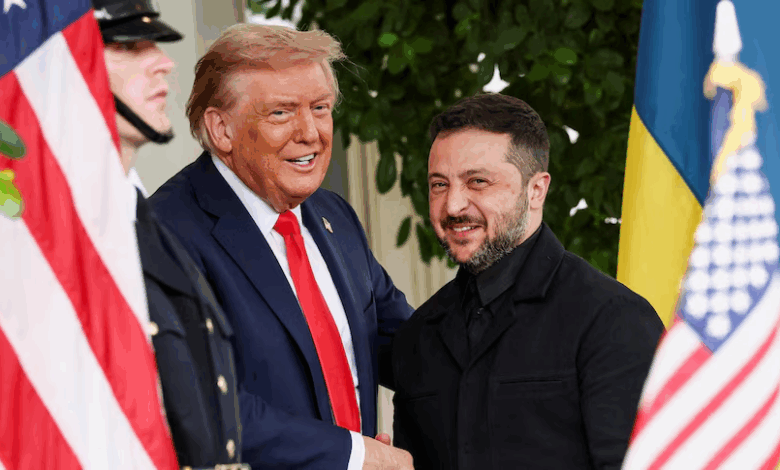
On Monday, President Volodymyr Zelensky made his way back to the White House for further negotiations with US President Donald Trump to put an end to the conflict in Ukraine.
Days after Trump visited Russian President Vladimir Putin in Alaska for a summit that ended without a ceasefire, a number of European leaders also took flights to Washington to attend the conference.
By Monday night, there were no firm promises of security guarantees or progress on a peace agreement, despite Trump’s hopeful remarks and some more ambivalent evaluations from his European allies.
Is a meeting between Putin and Zelensky imminent?
Trump said on Truth Social after the summit that he had contacted Putin to start setting up negotiations between Zelensky and the Russian leader. Trump stated that after such a bilateral, the US president would join them in a trilateral at a place to be decided.
After the fact, a Putin advisor said that Trump and Putin had a 40-minute phone conversation on Monday. A hot mic recorded conversations between US President Trump and French President Emmanuel Macron prior to European leaders meeting with Trump in the White House’s East Room.
“I think he wants to make a deal. I think he wants to make a deal for me. You understand that? As crazy as that sounds,” Trump told Macron, appearing to refer to Putin. For the first time since Russia’s full-scale invasion started in February 2022, it is unclear how easy it will be to bring two such acrimonious adversaries together at the negotiating table.
Zelensky had been pressing for a meeting with Putin for months, but this was probably an attempt to demonstrate that Russia is not sincere in its desire for peace because he thought the Kremlin had no interest in the meeting. A Putin-Zelensky sit-down has been consistently rejected by Moscow.
It was “worthwhile” to “explore the possibility of raising the level of representatives” from the Russian and Ukrainian delegations in negotiations, according to a noncommittal statement made by Kremlin advisor Yuri Ushakov on Monday night.
- Europeans push back as Trump backs away from ceasefire
Trump seemed to dismiss the need for any ceasefire before negotiations to end the war can take place.
In the past, that has been a key demand of Ukraine, which made clear it sees an end to the fighting as a prerequisite for further talks with Russia and, ultimately, for a longer-term settlement.
A ceasefire could also be marginally easier to agree than a full peace deal, which would take many months of negotiations, during which Russia’s assault on Ukraine would probably continue.
“I don’t know that it’s necessary,” Trump said of a ceasefire.
But the European leaders appeared to push back, with the strongest rebuttal coming from German Chancellor Friedrich Merz.
“I can’t imagine that the next meeting would take place without a ceasefire,” Merz said. “So, let’s work on that and let’s try to put pressure on Russia.”
When asked to speak, Zelensky did not reiterate his previous calls for a ceasefire to be put in place.
- Trump makes references to security assurances
Without indicating the scope of any aid, Trump assured Zelensky that the US will contribute to ensuring Ukraine’s security in any agreement to stop the conflict.The president of the United States did not provide boots on the ground. Trump did not, however, rule out the possibility of any American military presence in Ukraine when questioned by reporters about US security guarantees for the nation.
He said Europe was the “first line of defence”, but that “we’ll be involved”.
“We’ll give them good protection,” the president said at one point.
Regarding security guarantees, which are typically regarded as essential to any kind of agreement with Russia, this is the most forceful statement Trump has ever made. He added that Putin had agreed to include security assurances for Ukraine in any peace agreement during the summit in Alaska last week.
Zelensky stated at a press briefing following Monday’s meetings that a $90 billion (£67 billion) arms contract between the United States and Ukraine would be a component of the security assurance.
“And other things I will not disclose” are among the US weapons that Ukraine does not possess, he claimed, including aviation and anti-missile systems.
- Zelensky launches charm offensive
Given his acrimonious last visit to the Oval Office in February, the Ukrainian president went to considerable lengths to charm his American hosts – including a flurry of six “thank yous” within the first few minutes of the meeting.
The last time he was at the White House, Zelensky was scolded by Vice-President JD Vance for a perceived lack of gratitude for US support for Ukraine.
This time, Zelenksy was wearing a dark suit rather than his traditional military garb, which drew a gibe from Trump last time that his guest was “all dressed up today”.
Zelensky also sought to forge family ties during the meeting, handing his host a letter from Ukrainian First Lady Olena Zelenska to be delivered to US First Lady Melania Trump.
“It’s not to you – [it’s] to your wife,” he told Trump.
European leaders dialled up the flattery with Trump ahead of their multilateral meeting, heaping praise on him for his work in bringing them around the table.
“I really want to thank you for your leadership,” said Nato chief Mark Rutte.
Italian PM Giorgia Meloni said while there had previously been no sign that Russia wanted to move towards peace “something had changed” thanks to Trump.
Despite the warm tones, the Europeans tried to convey that they, too, feel exposed to any future Russian aggression.
French President Emmanuel Macron told fellow leaders somberly: “When we talk about security guarantees, we’re also talking about the matter of the security of the European continent.”