History of the Camera: What Was the Inception of Photography?
News Mania Desk / Piyal Chatterjee / 17th August 2025

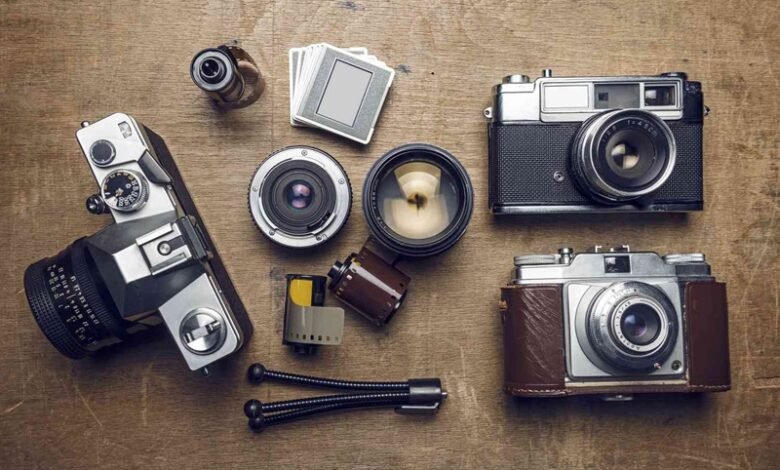
Cameras are something we take for granted. Every laptop, tablet, and smartphone has one, after all. They can produce excellent photos and films with little work on our part, and they are occasionally reasonably priced. Cameras can be enormous or little, digital or analog, fully automated or painfully manual, and everything in between these days. That wasn’t always the case, though. The history of the camera, which predates the digital world’s explosion, is more about the idea of photography than its mechanical aspects.
A camera is a device that uses light to capture still or moving images. Light gives everything around us a particular appearance. We wouldn’t have contrast, highlights, shadows, or colors without it. A camera exploits this by fusing chemistry and electronics, optics and mechanics, so that light is imprinted on a substance that is sensitive to light.

The cameras of today were very different from those of the past. However, each demonstrated a concept and advanced photography toward its current state as an artistic way of documenting the world. Each phase of the camera’s timeline teaches us something important about curiosity, perseverance, and original perspectives on the world.
The initial stage in perceiving the world as a collection of images is the camera obscura, which translates to “the dark room.” A tiny hole (also known as a pinhole camera) or lens on one side of a dark room or box allows light to enter and projects an image onto the wall across from it. Around the middle of the 16th century, it was used for pleasure, as a tool for drawing and painting, and as a means of researching celestial events or indirectly seeing eclipses. One of the earliest attempts to comprehend and utilize the reflection and refraction characteristics of light was the camera obscura.
But the picture that a camera obscura projected was fleeting. Other than the operator sketching the projection’s contours on the wall, nothing was recorded. It did, however, have a much to offer the fields of philosophy, painting, architecture, and map design. Even now, teachers still employ camera obscura in their lessons.
Before Joseph Nicéphore Niépce used a camera obscura to take the first photograph in 1816, it wasn’t truly a camera. Niépce succeeded in capturing the image that the camera obscura projected. He combined pewter with a semi-solid oil known as “Bitumen of Judea” or “Asphalt of Syria,” which is light-sensitive. The end effect was an image that would last long after the camera obscura was shut down. He gave his technique the name heliography, which means “sun drawing.”
Although we don’t have his original photograph, we do have one from 1826 that was shot in Le Gras, France. The photograph was taken using a multi-day exposure duration in Niépce’s method. As a result, his only subject would be a landscape. Right now, choosing the subject matter was less important to people than taking pictures, but that will soon change. Although Niépce experimented with other materials, including distillate of lavender oil, it appears that he was certain that silver was a wise choice. In 1829, he joined Louis Daguerre as a collaborator and carried on the camera’s legacy to the following phase.
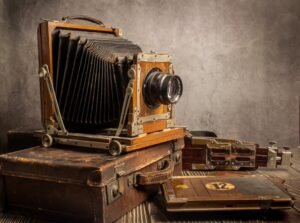
Louis Daguerre carried on, made improvements, and ultimately altered Niépce’s method entirely. He introduced the daguerreotype, a new photographic technique that bears his name, in 1839. A silver-plated copper with a mirror finish that has been treated with chemicals that make its surface light-sensitive is needed for the daguerreotype. For a predetermined amount of time—which could be as little as a few seconds—the plate is exposed to light inside a black box. After that, it is fumed with mercury vapor, chemically treated to make it light-insensitive, cleaned, dried, and placed inside a glass enclosure for protection. The daguerreotype is portable, takes less exposure time, and yields far superior image quality than heliography. Therefore, Louis Daguerre’s work was not just about photographing landscapes. He could take pictures of street scenes, still lifes, and individuals. As a result, his method quickly gained popularity. The daguerreotype was given to the world as a gift when the French government purchased the rights.
There is considerable disagreement here. The first camera was created by Niépce’s heliography technology, albeit it was mostly an experimental one. Daguerre’s daguerreotype was superior, more useful, and more widely used. It wasn’t for everyone, though. However, Alphonse Giroux created the first camera to use shelf-mounted plates in 1839, shortly after the daguerreotype was introduced. Additionally, a lot of people contend that this was the first photographic camera.
Using standardized plates that were available in various sizes, Giroux invented a daguerreotype camera. It cost about $7,000 in today’s currency and had an exposure time of five to thirty minutes. Although it wasn’t inexpensive, it was available.
Henry Fox Talbot also showed what was referred to as “a film” in 1839. He utilized writing paper soaked in table salt and coated in silver nitrate in place of daguerreotype plates. The calotype process failed to attract public interest, and the images were less sharp than those produced by a daguerreotype. It was, however, the first reference to a photographic film and the first step toward the use of paper rather than plates.
Which was the original photographic camera, then? One that utilizes film, one that is portable and can record any still image, one that is available to more than a few individuals, or one that can record an image? They are all significant in the history of the camera and are the first in certain ways.
The image faded quickly, which was another problem with the daguerreotype in addition to its minute exposure time and costly equipment. You can’t expect a family member’s portrait to last a lifetime. As a result, American Alexander Simon Wolcott introduced a lensless daguerreotype camera in 1840. Rather, it was referred to as a mirror camera since it had a concave reflecting mirror.

Wolcott created a positive image by using the mirror to reflect light onto a light-sensitive plate. Later, he and his collaborator Johnson developed a lighting technique that reflected light inside the studio using exterior mirrors and enhanced the photo-sensitive plate by employing a mixture of bromide and chloride that sped up the process.
Photography was still in its infancy at the close of the 1800s. The procedure of taking pictures was challenging and required a lot of chemicals. Additionally, because the chemicals would dry out and destroy the exposure, processing had to be done quickly after the shot was taken. Without the right training, taking pictures was impossible.
However, Richard Leach Maddox discovered a method in 1871 to speed up and improve the quality of the developing process. Maddox began experimenting with a gelatin emulsion after being impacted by the chemical mist used in the developing process. It was a total triumph. To begin with, there were no preparations needed for the gelatin dry plates. Anyone may purchase them from the store and start using them right away.
Wolcott and Johnson’s next logical move was to build the first portrait studio in the world in New York City. They later opened branches in Washington, D.C., and England. Commercial photography began with the invention of the mirror camera.
Photography was still in its infancy at the close of the 1800s. The procedure of taking pictures was challenging and required a lot of chemicals. Additionally, because the chemicals would dry out and destroy the exposure, processing had to be done quickly after the shot was taken. Without the right training, taking pictures was impossible.
However, Richard Leach Maddox discovered a method in 1871 to speed up and improve the quality of the developing process. Maddox began experimenting with a gelatin emulsion after being impacted by the chemical mist used in the developing process. It was a total triumph. To begin with, there were no preparations needed for the gelatin dry plates. Anyone may purchase them from the store and start using them right away. They could then be produced in smaller sizes, supported faster exposure durations, and weren’t required to be developed right away. Charles Harper Bennett reduced the exposure time to 1/25 seconds and produced the first gelatin dry plates for commercial use by 1878.
Even simpler and less costly than the first model, the Kodak Brownie was introduced by Kodak in 1900. Everyone had the opportunity to capture their experiences, not only those of their families. People began taking pictures of everything that caught their attention, including events, trips, and destinations. Oskar Barnack, a German inventor and photographer, and Leica are responsible for the invention of the 35mm film. The inventor was working on the 35mm motion picture film in 1913 with the goal of using it for photography as well. The 35mm roll of film, which measures 35 by 24 mm and comes in a protective cassette, has a specified number of exposures. It had 36 exposures at first.
An SLR camera that employs an electronic sensor in place of photographic film is known as a digital SLR camera. The Sony Mavica (1981, with a color-striped 2/3″ format CCD sensor with 280K pixels and analog signal processing and recording), the Canon RC-701 (1986, with a 2/3″ format color CCD sensor with 380K pixels), the Nikon E series (1995), and Kodak engineer Steven Sasson (1975, a 4kg camera with a 0.01MP resolution and a 23-second exposure time) are examples of early DSLR attempts. The history of the camera demonstrates how technological advancements and changes in the social and cultural landscape were closely followed by photography. It began as a challenge and ended up becoming an indispensable part of our lives. Our use of technology, comprehension of the news, appreciation of art, and interpersonal interactions are all influenced by photography.