How government schemes tangibly impact waste pickers
News Mania Desk / Piyal Chatterjee / 13th May 2025

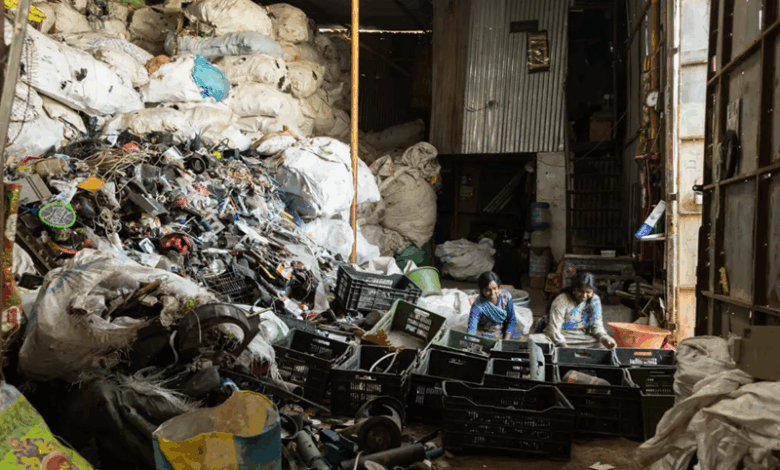
A recent study of waste pickers in Bengaluru showed that every rupee invested in facilitating their access to government benefits produced a return of INR 9.83 for them. The findings strongly indicate that social security programs, which offer a safety net for those economically or socially at risk, deliver real benefits for marginalized groups.
Studies show that waste pickers need around INR 40,000 monthly to sustain a family of four, considering expenses for education, housing, and essential requirements. Nonetheless, Hasiru Dala’s research indicates that over 60 percent of them make less than INR 10,000. Many lack job security or connection to a formal financial institution. They are frequently forced to close their income gap with loans, getting trapped in an endless cycle of repaying debt at exorbitant interest rates. This confines them in poverty across generations. They likewise lack access to fundamental essential services like healthcare and education.
Government social security programs are crucial for closing this income disparity. Essential entitlements—like access to rations, healthcare cards, medications, educational scholarships, housing, pensions, and transportation—are vital for the waste picker community. Nonetheless, these programs frequently remain inaccessible to the very individuals they intend to assist. In Karnataka, there are 108 social security schemes provided to marginalized groups by central, state, and local government entities, with waste pickers qualifying for 94 of these programs. Nonetheless, entry to these programs depends on possessing current ‘Know Your Customer’ (KYC) documentation, provided by different government agencies.
Why is it challenging for waste pickers to access social security schemes?
Insufficient documentation: Waste pickers need identification (ID) cards such as Aadhaar cards, PAN cards, birth certificates, income certificates, and voter IDs to access government schemes. For waste pickers, typically from Scheduled Caste (SC) communities, a caste certificate acts as an essential key to gaining specific entitlements. To be eligible for certain benefits, widows need the death certificate of their spouse. Numerous waste pickers lack birth certificates, hindering them from acquiring Aadhaar cards, which are essential for accessing various government programs. Age certificates are no longer permitted as a substitute for these.
Limited literacy skills: Securing documentation with precise information on the card presents a major challenge for individuals who may struggle to read. Upon receiving their cards, waste pickers might be unaware that their documents contain errors. Frequently, the names or spellings on the voter ID and Aadhaar differ.
Digital divide: The transition to digital methods has introduced its own range of difficulties. Numerous waste pickers do not have access to mobile phones required for one-time passwords (OTPs). A single mobile number can frequently be shared among four individuals. This leads to a reliance on cyber cafes, which can be manipulative. Regular alterations in mobile numbers—often resulting from intimidation by loan sharks or financial concerns—add to the complexity of the situation.
Procedural obstacles: Waste pickers struggle to maneuver through the system for necessary certificates. Daily-wage earners find it challenging to go to government offices repeatedly during work hours and wait in long lines. Waste pickers also encounter bureaucratic inefficiencies and postponements. In Karnataka, a person can request income certificates online but must go to the Revenue Department to pick it up. Once more, the Aadhaar card is issued by the central government, whereas caste certificates are granted by the Revenue Department.
Advantages of utilizing social security
By employing mobile technology—applications and online platforms—to obtain and oversee social security benefits and services, Hasiru Dala assisted waste pickers in acquiring PAN cards, Aadhaar cards, bank accounts, Voter IDs, ration cards, health IDs, e-shram cards, and more. This mobile social security (MSS) program—implemented as part of Saamuhika Shakti’s efforts to tackle the deficiencies in access to crucial livelihood services—enabled waste pickers to benefit from over 49 government schemes. During the last four years, the team focused on MSS scheme access has traversed eight zones in Bengaluru and its rural regions, facilitating 7,992 successful applications for over 2,500 people.
Through social security, waste pickers can receive food rations, pensions for elderly or disabled individuals, subsidized or complimentary electricity (via the Gruha Jyothi scheme), health insurance (as part of the Pradhan Mantri Jan Arogya Yojana), medical care, and additional benefits. For example, the Shakti Scheme launched by the Karnataka Government provides complimentary tickets for women on government buses and allows a waste collector to save INR 100 daily on public transportation, amounting to INR 3,000 monthly.
Food security: The National Food Security Act of 2013 allows numerous individuals to obtain crucial supplies like rice. Over half of the waste pickers in Karnataka lack ration cards. The contrast between individuals with ration cards and those without was particularly pronounced during the COVID-19 lockdown. In certain communities, the degree of malnourishment was so critical that state governments needed to be notified for the emergency.
Healthcare: Social security programs enhance access to healthcare by facilitating enrollment in health insurance initiatives and plans. This eases access to secondary and tertiary healthcare, which is essential for waste pickers. Nevertheless, migrants frequently find primary healthcare centres (PHCs) difficult to access and instead depend on local pharmacies.
The analysis puts a number on the outcomes of social security and dispels many assumptions in the social sector. There is a belief that social security funds do not always reach the intended recipients. Funders wonder whether it’s worth spending money to facilitate access to these entitlements. We also tend to measure social security entitlement in terms of state money unlocked. With insurance, the money is believed to be unlocked for the insured and insurance companies, and with educational scholarships, directly for the students. This shows the substantial impact of access to entitlements in creating a safety net for marginalised communities.