Early Life and Background
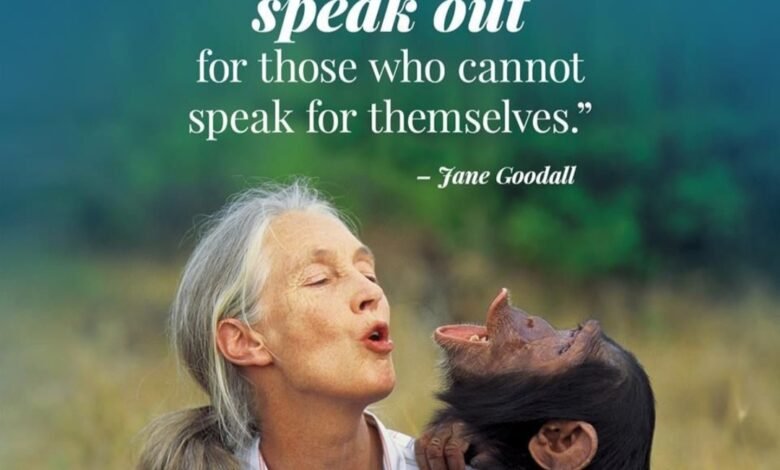
Birth and childhood: Jane Goodall was born on April 3, 1934, in London, England. From a young age she had a deep fascination with animals, nature, and the wild — inspired by books such as Tarzan of the Apes, Dr. Dolittle, and others. She grew up in Bournemouth on England’s south coast. Her early years were shaped by a sense of wonder for the natural world.
Education & early path to Africa: Although she did not attend university in the usual way, she was determined to go to Africa. She worked and saved money, traveling to Kenya in 1957. There she met anthropologist Louis Leakey, who recognised her interest and potential, and encouraged her to study wild chimpanzees.
Scientific Work with Chimpanzees
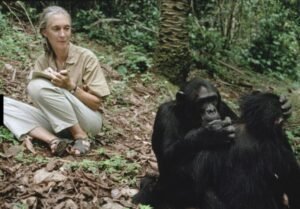
Gombe Stream Research: In 1960, Jane Goodall began her pioneering fieldwork in Gombe Stream National Park, in what is now Tanzania. She studied chimpanzees in the wild, living among them and observing their behaviour closely.
Major discoveries:
Tool Use: One of her earliest major findings was that chimpanzees will fashion tools (for example, modifying twigs to fish for termites). This challenged the long-standing belief that tool‐making was a uniquely human trait.
Emotional and social complexity: She documented that chimpanzees have distinct personalities, strong mother-infant bonds, complex social relationships, and experience emotions such as grief, joy, fear, and empathy.
Behaviour once thought uniquely human: Beyond tool use, her observations included chimpanzee hunting and meat eating, primitive “warfare” between groups, altruistic behaviour, and caregiving of orphaned infants.
Methodological innovations and controversies: Goodall’s approach was immersive. She gave individual chimpanzees names rather than numbers, tried to win their trust, sometimes fed them, etc. Some of her practices were criticized (e.g. feeding chimps which might alter their behaviour), but her overall approach broadened how ethology and primatology viewed non-human animals.
Academic recognition: Although she did not have a formal undergraduate degree, she was awarded a PhD in ethology from Cambridge University for her work.
Broader Impact, Institutions & Activism
Jane Goodall Institute (JGI): In 1977, she founded the Jane Goodall Institute, an organization to continue and expand her conservation work, both in preserving chimpanzee habitats and in community-based conservation efforts.
Roots & Shoots programme: In 1991, she established Roots & Shoots, a youth-led program in which young people in many countries engage in projects for the environment, conservation, and humanitarian causes. The program has grown to many dozens of countries.
Science communication & public engagement: Goodall was remarkable in bridging science and public advocacy. Through books, documentaries, and lectures she brought knowledge of chimpanzee behaviour and the threats to wildlife into the general public consciousness. Her work with National Geographic helped make chimpanzee studies widely known.
Environmental, animal welfare, and humanitarian advocacy: As her career developed, she increasingly focused on environmental protection, the welfare of animals, and the interconnectedness of ecosystems. She spoke often about deforestation, wildlife trade, climate change, and human responsibility for the natural world. She used her platform to advocate not only for chimpanzees but for broader planetary and species concerns.
Jane Goodall Institute USA
Honours and recognition:
She was appointed a Dame Commander of the Order of the British Empire (DBE) in 2003. She served as a United Nations Messenger of Peace, beginning in 2002. In 2025 she was awarded the U.S. Presidential Medal of Freedom. Other awards and recognitions from various countries and institutions have celebrated her contribution to science, conservation, and public life.
Later Life & Death
Continuing work in her later years: Even into advanced age, Goodall remained active. Her institute reports that she was travelling nearly 300 days a year until close to her death, speaking publicly, meeting with youth groups, and advocating for conservation and environmental action.
Message of hope amid crisis: While deeply concerned about climate change, biodiversity loss, deforestation, human-driven harms, she often balanced her warnings with messages of hope, emphasizing that individual action, young people, and communities can still make a difference.
Passing: Jane Goodall died on October 1, 2025, at age 91. She passed away of natural causes in California while on a speaking tour.
Legacy
Scientific legacy: Her observations redefined assumptions about animal behaviour, cognition, tool use, and the emotional lives of non-human primates. She influenced the development of ethology, primatology, behavioural ecology, and conservation biology. Future generations of researchers have built on her work.
Cultural impact: Goodall made chimpanzees familiar to people who had never encountered the wild, through media, books, documentaries. She inspired many to care about nature and animals in a more empathetic way.
Educational & youth engagement: Through Roots & Shoots and her many speeches and writings, she inspired young people globally to consider environmental stewardship and to believe in their ability to effect change.
Conservation and environmental protection: Her advocacy helped raise awareness of the fragility of ecosystems, the ethical dimensions of human interactions with animals, and the importance of preserving biodiversity. Her institute’s work continues to protect chimpanzee habitat and work with communities.
Humanitarian stance: She often highlighted the connection between environmental well-being and human well-being, stressing that protecting nature is also about securing healthier lives, more sustainable livelihoods, and moral responsibility.
Conclusion
Jane Goodall’s life was one of pioneering achievement, fearless exploration, and enduring commitment. From her early years in England through decades in Africa, she pushed boundaries — scientific, societal, institutional — and reshaped how humanity sees animals, nature, and our own place in the biosphere. In her passing, the world loses not only a great scientist but a powerful moral voice and advocate for compassion.
Her work remains alive: in the forests she helped protect, in the young people she inspired, in the ongoing research at Gombe, in the global movement for environmental and animal welfare. Though she is gone, her legacy continues to influence science, conservation policy, and public consciousness.