Kabindra Purkayastha: A Son’s Humble Tribute to His Father’s Friend
By Ratnajyoti Dutta

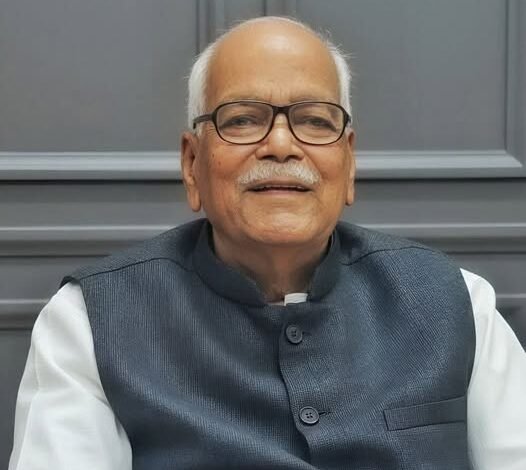
NEW DELHI – January 07, 2026- I grieve the passing of Kabindra Purkayastha, my father’s lifelong friend and a towering presence in our lives. He passed away on Jan 7 at the age of 94, just a few weeks after celebrating his birthday. His loss feels intensely personal, leaving behind a silence filled with memories.
A former Union Minister of Communications, Purkayastha ji stood among the earliest and strongest architects of the Bharatiya Janata Party (BJP) in the Northeast. He resigned as headmaster of a high school in southern Assam to answer a larger public calling.
For nearly a decade, Purkayastha ji endured repeated electoral defeats with patience and unshaken conviction before winning his first Lok Sabha election from Silchar in 1991, amid the Ram Janmabhoomi movement. Over the two and a half decades since 1991, he represented Silchar three times at Lok Sabha and also served as Minister of State for Communications in the Atal Bihari Vajpayee–led 13-month long NDA government that laid foundations that continue to shape governance under Prime Minister Narendra Modi.
For Assam, and especially the Barak Valley in Southern Assam, Purkayastha ji became the most enduring reference point of the right-wing nationalist movement. He often spoke of how Guruji M. S. Golwalkar, then Sarsanghchalak of the Rashtriya Swayamsevak Sangh (RSS), shaped his nationalistic outlook during a month-long Officers’ Training Camp (OTC) in the early 1950s. I first heard this recollection at our home at a village near Silchar, when Purkayastha ji visited my father—his batch-mate from the 1951 OTC in Nagpur.
From him, I learned that the RSS training camps in those years were rigorous, month-long engagements that left a lasting imprint on discipline, thought, and service. Those conversations carried the quiet authority of shared sacrifice and unwavering belief.
My interactions with Purkayastha ji continued over the years—during his third term in the old Parliament House and later in the Lok Sabha library during brief recesses. In those days, I used to cover Indian parliament as a correspondent of an international news agency – Reuters.
Our conversations moved easily from ideology and public policy to his gentle, almost paternal concern for my father’s health. In those moments, the seasoned public figure gave way to a deeply humane man.
One visit remains etched in my memory. Purkayastha ji came to our Noida Extension home to see my ailing father during his last days. The moment my father recognised him, his eyes brightened in a way illness had long dimmed. That silent exchange between two old school friends spoke volumes about loyalty forged over a lifetime. My father, late Radhapada Dutta—a respected social worker from Assam—drew deep comfort from his presence. I believe Purkayastha ji too felt that gratitude reflected back at him.
Beyond politics, Purkayastha ji remained, at heart, a teacher. He guided, mentored, and protected generations of young party workers and colleagues. His obituary tribute to my father in a leading Barak Valley based daily revealed the depth of his affection for his ideological friend. Through those words, Purkayastha ji extended his blessings to me—not as a public gesture, but as one friend’s son embraced by another.
With his passing, we have lost more than a politician. We have lost a guardian and a well-wisher whose counsel, compassion, and quiet strength will continue to accompany us. His life stands as a reminder that public service, when anchored in humanity, leaves an imprint far deeper than power or position.
(The writer is a Delhi-based senior journalist.)