Markets dive after Trump hits more countries with steep tariffs
News Mania Desk / Piyal Chatterjee / 2nd August 2025

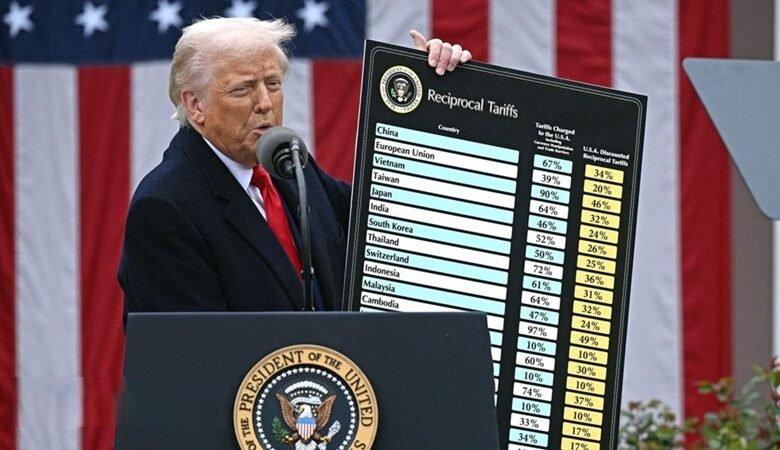
U.S. President Donald Trump’s recent round of tariffs on exports from numerous trading partners caused global stock markets to plummet on Friday, prompting countries and businesses to rush for improved agreements. As Trump forges ahead with efforts to reshape the global economy with the highest tariffs since the early 1930s, Switzerland, “stunned” by 39% tariffs, requested further discussions, as did India, facing a 25% rate.
The new duties feature a 35% tariff on various items from Canada, 50% for Brazil, and 20% for Taiwan, which indicated that its rate was “temporary” and anticipated a reduction. The presidential directive introduces a new schedule featuring increased import duty rates ranging from 10% to 41%, effective in one week for 69 trading partners, raising the U.S. effective tariff rate to approximately 18%, up from 2.3% in the previous year, as per analysts at Capital Economics. U.S. equities stumbled.
The Dow Jones Industrial Average closed lower by 1.23% at 43,588.58, the S&P 500 slid 1.6% to 6,238.01, and the Nasdaq Composite fell 2.24% to 20,650.13. Global stocks fell, as Europe’s STOXX 600 experienced a decline of 1.89% during the day. Markets likewise responded to an unsatisfactory employment report.
Data indicated that U.S. job growth decelerated more than anticipated in July, with the previous month’s figures significantly revised downward, suggesting a deceleration in the labor market. Trump reacted by directing the dismissal of the commissioner of the Labor Department’s Bureau of Labor Statistics, Erika McEntarfer, alleging, without proof, that the employment numbers were “manipulated.”
In the meantime, Canadian negotiators indicated that an agreement with the U.S. might still be several weeks off. Trump’s recent tariffs have added further uncertainty, with many specifics remain ambiguous. “The uncertainty with respect to tariffs … was critical to getting the leverage that we needed to create the circumstance in which the president could create the trade deals we’ve seen over the last few weeks, which have been nothing short of monumental,” Council of Economic Advisers Chair Stephen Miran said on CNBC.
EU officials stated that the European Union, which reached a framework agreement with Trump on Sunday, is still waiting for further orders from Trump to implement the agreed-upon exemptions related to cars and aircraft, noting that the recent executive orders did not address those issues.
Furthermore, it remains uncertain how the administration plans to delineate and enforce the transshipment restrictions, which pose 40% penalties on any exporter considered to have attempted to disguise goods from a higher-tariffed source, like China, as their own merchandise. Trump’s implementation of tariffs coincides with signs that they have started increasing prices. Data from the U.S. Commerce Department published on Thursday indicated that prices for home furnishings and durable household goods rose by 1.3% in June, marking the largest increase since March 2022.