
Nisar’s massive reflector is now operational ; space commissioning is currently taking place.
News Mania Desk / Piyal Chatterjee / 16th August 2025

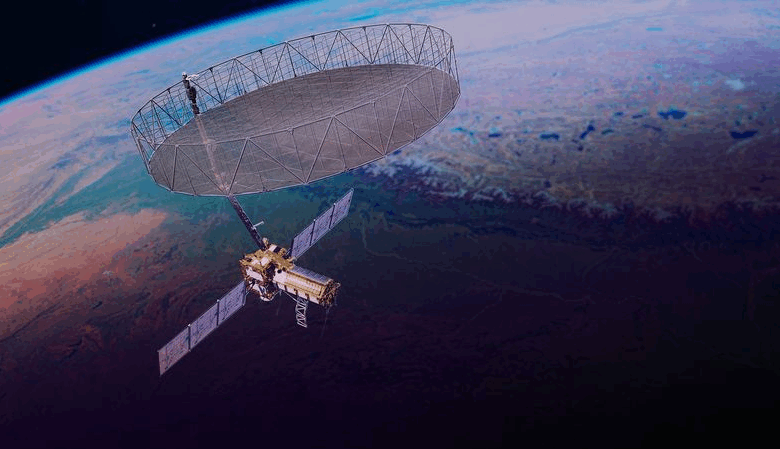
With the successful orbital deployment of its huge radar reflector, the Nasa-Isro Synthetic Aperture Radar (Nisar) project has completed the transition from launch to full mission setup.
In preparation for important commissioning tasks, engineers verified that the eight-meter-wide deployable antenna—one of the biggest of its kind ever launched into space—is now fully extended and locked in place.
In order to capture high-resolution radar photographs of Earth, Nisar’s mission depends on the deployment of the massive reflector, which unfolded like a precisely constructed umbrella.
Together with advanced radar equipment that operate in both L-band (made by NASA) and S-band (contributed by Isro), the reflector allows the spacecraft to track minute changes in forests, coastlines, ice sheets, and land surfaces with previously unheard-of accuracy.
“The reflector is the beating heart of this mission,” mission officials said in a statement. “Its full and safe deployment ensures that Nisar can begin the next phase of testing before science operations commence.”
Nisar, which was co-developed by NASA and the Indian Space Research Organization (Isro), was launched earlier this year from Sriharikota aboard India’s GSLV Mk-II rocket. It represents a turning point in global collaboration for climate and disaster monitoring as the first significant joint Earth research satellite between the two countries.
To commission the spacecraft for routine science operations, engineers on the ground will perform instrument tuning, calibration runs, and system checks over the next few weeks.
When Nisar is completely operational, it will map the entire planet in a methodical manner every 12 days, providing a steady flow of information that is essential for comprehending issues like land subsidence, earthquake faults, glacier melting, and forest health.
According to experts, Nisar’s radar vision will be particularly useful for tracking climate-related changes that affect the entire world, such as stress on agriculture and rising sea levels. With its ability to provide quick, all-weather imaging that can assist in real-time tracking of floods and landslides, the satellite also offers particular potential for disaster management in India.
Now that its massive reflector is visible to the entire universe, Nisar is one step closer to becoming the most sophisticated radar eye on Earth and launching a new age of space-based planetary monitoring.