Politics of Party Switching in Assam is Unprecedented in India-A New Game of Party Switching Ahead of Elections in Assam
Pradip Dutta Roy/1st April 2026

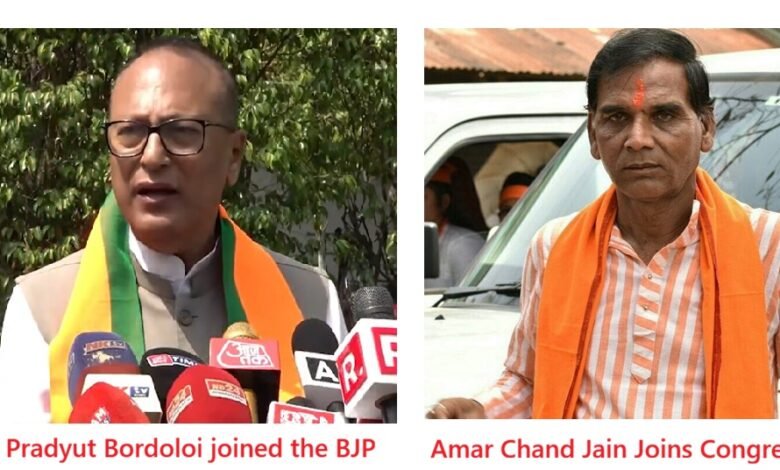
This seems like the game of player transfers or jersey changes in football at the national level. Now, a similar kind of jersey-changing game is being seen in politics as well. Overnight party switching and receiving party nomination the very next day has become an unprecedented event in Assam’s political history. Some leaders had already switched parties earlier and received nominations as per the assurances given to them. But the incident of switching parties overnight and getting a nomination the next day has surprised many.
MP Pradyut Bordoloi resigned from the Congress one day, joined the BJP the next day, and immediately received the party nomination for the Dispur seat. As if in response, long-time BJP leader Amar Chand Jain was declared the Congress candidate from Katigorah. He joined the Congress just a day before the announcement, although discussions had been ongoing for a few days. Many used to criticize Nitish Kumar for party-switching politics, but his JD(U) has only changed alliances a few times for convenience. Nitish himself never left his party nor joined another. However, what Pradyut and Amar Chand have done is truly astonishing.
It appears that the ruling party BJP and the main opposition Congress are now competing to bring defectors into their parties and grant them nominations. Democracy or public service seems secondary here; party politics has become the main focus. Both BJP and Congress seem eager to show that they too can provide tickets to defectors. Neither party wants to fall behind in this competition. That is what it appears to be.
When leaders abandon their principles and suddenly become immersed in the ideology of a party they once despised, it raises doubts about whether they entered politics to serve the public or to serve their own interests. Those who once criticized a party’s ideology switch overnight and start praising the same ideology without hesitation. Congress leaders who used to criticize the BJP start criticizing Congress after joining the BJP. What a strange form of politics this is.
It raises the question: is the sole aim of political leaders to get elected as public representatives? Because a section of leaders seems focused on getting elected by any means. Party ideology holds no value for them. In their pursuit of electoral victory, they can switch to any party. It becomes clear that public service is not their primary objective. One can serve the public even without being elected. But politicians obsessed with becoming representatives fail to understand this. They are willing to go against their own party’s ideology and join another just to get elected. Such tendencies are evident in several recent incidents.
Every election season, some people switch parties, but they are usually ordinary workers or supporters. Due to dissatisfaction or loss of trust in local leaders, they switch parties. Their decisions are driven by local issues, loss of faith in one leader, or attraction to another. If their chosen leader wins, they feel happy; if not, they feel disappointed. Their personal fate is not tied to the result. They neither gain nor lose materially. Their decisions are emotional. Often, when their illusion about a leader breaks, they switch again. For some, party-switching during elections is also a way to gain publicity. The only gain is recognition—people come to know their names. Despite no personal benefit, such workers often remain active, and their switching benefits the party.
Workers may switch parties, but when leaders suddenly switch, it becomes surprising. MP Pradyut Bordoloi, a strong Congress leader, suddenly switched to the BJP. He resigned from Congress one day, joined BJP the next, and immediately received nomination for the Dispur seat. On the other hand, BJP leader Amar Chand Jain from Katigorah resigned from BJP and joined Congress, and Congress gave him the party ticket.
Amar Chand has practiced saffron politics all his life. His sudden switch has surprised many. His long-standing desire was to become an MLA from Katigorah. When BJP did not give him a ticket, he switched camps overnight. Yet, he had criticized Congress all his life. People of Katigorah have not forgotten his past actions, including attempts to incite communal tension over a beef-related issue. Now, after receiving the Congress nomination, he claims he will defeat both Gautam Roy and the current BJP candidate Kamalakhya.
Even within BJP, his past actions show his lack of loyalty. It appears that he used the party as a tool for personal gain. If the party leadership had monitored him properly, his activities would have been noticed earlier. BJP candidate Kamalakhya Dey Purkayastha was earlier in Congress and joined BJP recently, though his inclination toward BJP was visible for the past three years. Hence, the contest between them may not be one-sided but competitive.
Congress MP Pradyut Bordoloi is a very astute politician. A JNU scholar, he was unable to align with the current state Congress leadership. His ideological differences with state president Gaurav Gogoi became severe. To avoid being politically sidelined, he joined BJP and seems relieved. Whether this move benefits him will be known later. But currently, there seems to be disorder within the Congress in the state. This is evident from resignations of leaders like Bhupen Bora, Kamalakhya, and Shashikanta Das. Several others have also left Congress and joined BJP, some of whom have received nominations.
In India, party-switching has become like a game. We have also seen politics of breaking parties to form new ones. CPI split into CPM and CPI(ML). Similarly, Janata Dal split into JD(U), JD(S), RJD, and Lok Janshakti Party. Congress also split in the past, and leaders like Sharad Pawar, P.A. Sangma, and Tariq Anwar formed NCP. Though NCP still exists, in Meghalaya it transformed into NPP. Pranab Mukherjee once formed a separate party but later returned to Congress. Party-switching has existed for a long time, but getting nomination immediately after switching is a new phenomenon.
If such incidents are widely publicized to keep politics heated, it indirectly harms democracy. There should be balance between democratic values, social responsibility, and public service. Those who can change principles overnight raise questions about their accountability to the people. Many politicians who claim to seek election only for public service are actually driven by self-interest. One can contribute to society without being elected. There are many such examples in Indian politics.
(Opinions are personal)
(Author: Former student leader and advocate at Gauhati High Court)