

Photo Credit -Sipra Das /New Delhi- 17th of September, 2024
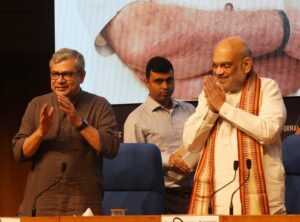
New Delhi, Delhi, 17th of September, 2024 : Union Home Minister and Minister of Cooperation, Shri Amit Shah addressed a press conference in New Delhi today on the important initiatives, decisions and achievements of the first 100 days of the third term of Prime Minister Shri Narendra Modi. On this occasion, Shri Amit Shah released ‘Paving the Path to Viksit Bharat’, a special booklet, and eight flyers depicting the important achievements of the last 100 days under the leadership of Prime Minister Shri Narendra Modi. Union Minister of Information & Broadcasting, Railways and Electronics and Information Technology Shri Ashwini Vaishnaw was also present on the occasion.
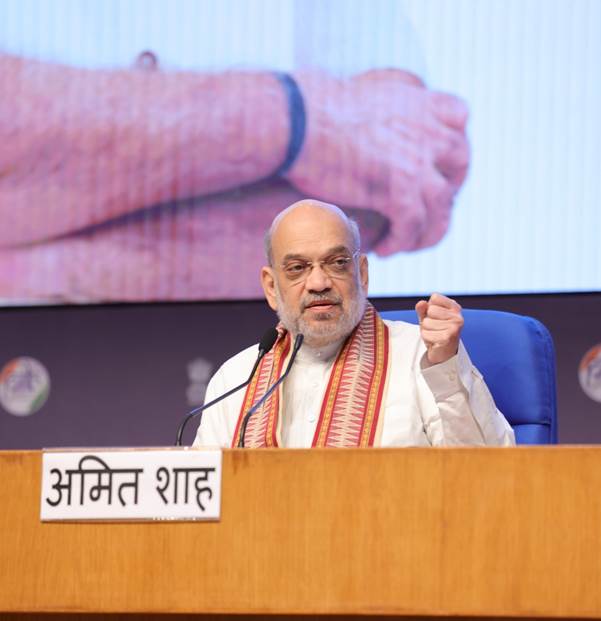
Addressing the media persons, the Union Home Minister and Minister of Cooperation greeted Prime Minister Shri Narendra Modi on his birthday today. He said that Modi ji was born in a poor family, he became the Prime Minister of the world’s largest democracy and 15 different countries of the world have awarded him with the highest honour of their country, which has increased the pride of not only of our Prime Minister but of entire India. Shri Shah said that today 140 crore people of the country are praying to God for the longevity of Prime Minister Modi.
Shri Amit Shah underlined that after running a government dedicated to India’s development, security and welfare of the poor for 10 consecutive years, the people of the country have given us the mandate to form the government for the third time in the 2024 Lok Sabha elections. He said that for the first time after 60 years, a leader is leading the country by becoming the Prime Minister for the third consecutive time. For the first time in 60 years, there is an atmosphere of political stability in the country and the country has sustained itself on its policies. He said that entering the 11th year ensuring that the policies continue to deliver as per the expectations while maintaining the speed and accuracy of their implementation over a period of 10 years is a very difficult and a great achievement.
The Union Home Minister said that under the leadership of Prime Minister Shri Narendra Modi, the government has achieved great success in building a safe India by strengthening the country’s external and internal security and defence system in the last 10 years. He said that PM Modi has done the work of bringing radical changes in education and bringing new education policy by incorporating our ancient educational values, glorifying languages and incorporating modern education. He said that today India has become the most preferred destination for production activities in the whole world. Shri Shah said that many countries of the world want to understand, accept and make our Digital India scheme the basis of their development. He said that we have brought discipline and progress in all 13 parameters of the economy. He said that today the whole world witnesses India’s bright future in the field of space. The Home Minister said that in the last 10 years, for the first time since independence, a robust foreign policy is in place.
Shri Amit Shah said that in the last 10 years of Modi Government, PM Modi has provided houses, toilets, gas connections, drinking water, electricity, per month 5 kg grains and health facilities worth upto Rs 5 lakh to 60 crore poor people of the country. He said that we have set a target that in the next 5 years there will be no person in the country who does not have his own house. Shri Shah said that Modi Government has provided many opportunities for the youth and today the youth of India is ready to compete with the youth of the world.
Union Home Minister said that many schemes have been brought keeping in mind the development and prosperity of our farmers. He said that through these schemes, the food reserves in the country will reach a level of sustainability, and we will be in a position to export, by becoming self-reliant, thereby bringing prosperity to the farmers.
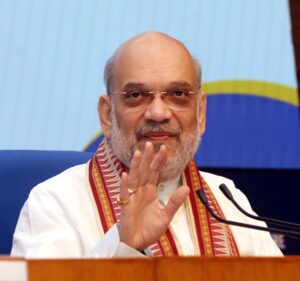
Shri Amit Shah said that the 100 days of Modi 3.0 are going to lay a strong foundation for the creation of a ‘developed India’. These 100 days have been a wonderful coordination of development and poor welfare by involving every section. He said that projects worth about ₹15 lakh crore have been started in the first 100 days of Modi 3.0. Under the leadership of Prime Minister Shri Narendra Modi, the government has maintained the direction, speed and accuracy of implementation of policies for the last 10 years. He said that the Modi government will continue to work with dedication towards security, development and poor welfare.
Shri Amit Shah said that 100 days have been divided into 14 pillars. Under infrastructure, projects worth Rs 3 lakh crore have been started in 100 days. A mega port will be built in Vadhavan, Maharashtra at a cost of Rs 76 thousand crore, which will be included in the top 10 ports of the world from day one. A scheme of connecting 25 thousand unconnected villages by road worth Rs 49 thousand crore was started. It has been decided to expand India’s major routes at a cost of Rs 50,600 crore. Work is being done to promote tourism by upgrading Lal Bahadur Shastri International Airport in Varanasi, Bagdogra in West Bengal, Bihta in Bihar and building new air strips in Agatti and Minicoy. Bengaluru Metro Phase-3, Pune Metro, Thane Integral Ring Metro and many other metro rail projects have also progressed in these 100 days.
Shri Amit Shah said that Rs 20000 crore has been distributed to 9.50 crore farmers under the 17th installment of the Pradhan Mantri Kisan Samman Nidhi Yojana. So far, Rs 3 lakh crore has been distributed to a total of 12 crore 33 lakh farmers. The Minimum Support Price (MSP) of Kharif crops has also been increased and the Narendra Modi government has purchased several times more crops at MSP than the previous government, which shows that the Modi government is dedicated to the interests of farmers.
Ethanol producing units of cooperative sugar mills have been converted into multi-feed Ethanol units to produce Ethanol from Maize. This will now allow Ethanol to be produced not only from sugarcane but also from maize. We have removed the Minimum Export Price (MEP) of onion and Basmati rice. Export duty on onion has been reduced from 40% to 20%.
Union Home Minister said that in these 100 days, many reliefs have been given to the middle class. Under tax relief, there will be no income tax on income up to Rs 7 lakh. The third version of One Rank One Pension (OROP) has been implemented and 3 crore houses have been sanctioned under the Pradhan Mantri Awas Yojana. One crore houses have been sanctioned under the Urban Housing Scheme and 2 crore houses under the Rural Housing Scheme.
So far in 2024, solar energy has reached more than 2.5 lakh households under the Pradhan Mantri Surya Ghar Free Electricity Scheme. Through this unique scheme, not only the electricity bill of middle-class families is reduced, but it also contributes to the fulfillment of the target of usage of solar energy. We have approved PM e-bus services with an assistance of about Rs 3400 crore to create an environment friendly system. Shri Amit Shah said that to provide financial relief to startups and to promote innovation, the angel tax, which was a burden of 31% on startups, has also been abolished.
Under the National Industrial Corridor Development Program, 12 industrial zones will be built which will be linked to major national highways.
The most important decision has been taken for the middle class. The limit of Mudra loan has been increased from Rs. 10 lakh to Rs. 20 lakh, and all those who have successfully repaid their old loans will benefit from it. A credit guarantee scheme has been started for MSMEs under which small traders and small entrepreneurs will be able to get loans without guarantee.
Union Home Minister and Minister of Cooperation said that the empowered youth is the primary prerequisite for the development of any country. We have announced a PM package of Rs. 2 lakh crores, under which 4 crore 10 lakh youth will benefit in the next 5 years. Our government has also decided to provide internship opportunities, allowances and one-time assistance to one crore youth in top companies. Several thousand appointments for Central Government jobs have also been issued.
Shri Shah said that increasing the capital expenditure to Rs 11 lakh 11 thousand crore is a milestone in itself. This will create new employment opportunities for many youth and our infrastructure will also be strengthened. The PLI scheme and the development of 12 industrial zones will also create jobs for the youth. The financial incentives given for startups and MSMEs will also prove to be effective for the youth.
Shri Amit Shah said that under the Deendayal Antyodaya Yojana, more than 90 lakh self-help groups have been formed by organizing more than 10 crore women and under the Lakhpati Didi Yojana, 11 lakh new Lakhpati Didi have been given certificates in 100 days. He said that more than one crore Lakhpati Didi are earning one lakh rupees annually. For these women, an amount of one lakh was considered a dream but today they are living their lives with respect.
Shri Shah said that Paryatan Didi has been linked to self-help groups through Paryatan Mitra and Drone Didi to work as a guide. Along with this, work has also been done to connect the youth with tourism.
Union Home Minister and Minister of Cooperation said that under the Pradhan Mantri Janjatiya Unnat Gram Abhiyan, 63,000 tribal villages will be fully developed. This will improve the economic condition of 5 crore tribals. Under this scheme, the village will be fully equipped with primary needs and basic amenities. 3 lakh new identity cards have been given to the disabled persons of Scheduled Caste in these 100 days.
Home Minister said that Eklavya Model Residential School (EMRS) is being re-introduced with a new dimension. Mr. Shah said that the Waqf Amendment Bill-2024 is committed to the management, protection and prevention of misuse of Waqf properties and it will be introduced in Parliament in the coming days. Shri Amit Shah said that Ayushman Bharat Yojana is a very ambitious program of the Prime Minister and this scheme has has made lives of crores of people easy. Under this, the Narendra Modi government is bearing the cost of treatment up to Rs 5 lakh. He said that as per the promise made in our party’s manifesto, all senior citizens aged 70 years and above will be given free health coverage up to Rs 5 lakh. Poor people above 70 years of age will be given additional coverage of Rs 5 lakh in addition to their own card, which will increase their coverage to Rs 10 lakh. The Home Minister said that 6 crore senior citizens from about 4.5 crore families will benefit from this and there is no income limit to this.

The Union Home Minister said that by adding 75,000 new medical seats, we are moving towards ending dependence on foreign countries for medical education. He said that a target of 3 years has been set for this. Shri Shah said that the first Space Day was celebrated on 23rd August, under which many schemes have been launched to encourage and interest teenagers and youth in the field of space. He added that a national database for disaster management and a Panchayat portal for rural land records have been launched. A semiconductor unit has been set up in Sanand, Gujarat and in the coming 10 years, India will become a major player in the field of semiconductors.
The Home Minister said that three new laws – Bharatiya Nyaya Sanhita (BNS), Bharatiya Nagrik Suraksha Sanhita (BNSS) and Bharatiya Sakshya Adhiniyam (BSA) – have been implemented on 1 July 2024, replacing the more than 150-year-old criminal laws made by the Britishers. These three new laws will not only make our criminal justice accessible to the public in the coming days, but will also make it easier to get justice and will also start delivering justice on time. He exuded confidence that after the full implementation of these laws in 3 years, India’s criminal justice system will be the most modern in the world.
Shri Amit Shah said that by deciding to celebrate 25 June as Samvidhan Hatya Diwas, an attempt has been made to make the coming generations aware so that the country does not have to go through the dark period of Emergency again. He said that today the whole world is waiting with hope on the important visits of Prime Minister Modi to Russia and Ukraine. For the first time, the UNESCO World Heritage Committee organized its important meeting in India and this will greatly benefit many of our heritage sites in the coming days.
The Union Home Minister said that on September 4 this year, a peace agreement was signed with NLFT and ATTF in Tripura after 35 years of conflict. For the first time in the country, a new scheme of Rs 6350 crore was brought for urban flood management. Hydro electronic project in the Northeast was approved with a cost of Rs 4100 crore. The Disaster Management Bill has been introduced in the Lok Sabha in 2024. This bill will meet the needs of urban fund management, fire services, GLOF and prevention of other disasters. Rs 12554 crore has been allocated for this. Mr Shah also said that five new districts have been created in Ladakh. MANAS helpline has been started for narcotics prevention and information. He said that 5000 Cyber Commandos will be trained in the next 5 years and a suspect registry for cybercrime is also being prepared.
Shri Amit Shah said that we have been able to do so much in the first 100 days of the third term of the Modi government. He said that the reason behind this is that all the political parties were busy with the elections, but Prime Minister Modi had given the task to the bureaucracy 6 months before the elections that all the development works that are in the pipeline, they have to be completed for whichever new government comes, so that the pace of development of the country is not hindered. The Home Minister said that it is the result of this thinking that we have been successful in taking development works worth lakhs and crores of rupees a long way within 100 days. He said that through these, not only will the pace of development of the country increase but the country will be safe and prosperous and we will also move forward in the field of education by implementing the new education policy.
News Mania Desk /Photo Credit -Sipra Das (National Consulting Photo Editor)
17th September 2024 , New Delhi