Satellite Images Reveal ‘Blood-Stained Earth’ After Massacre in Sudan’s El Fasher
News Mania Desk / Piyal Chatterjee / 31st October 2025

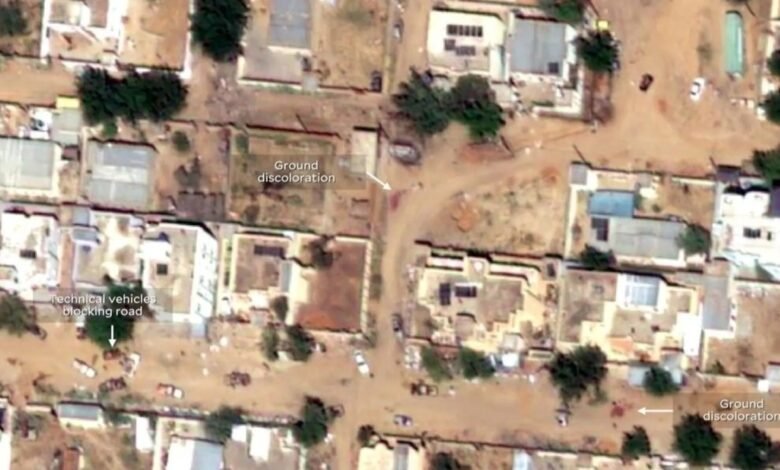
Disturbing new satellite imagery has unveiled the aftermath of an alleged massacre in El Fasher, the capital of North Darfur, Sudan—showing bloodstains so widespread they are visible from space. The images, analysed by the Yale Humanitarian Research Lab (Yale HRL), indicate mass killings likely carried out by the Rapid Support Forces (RSF) following their recent seizure of the city.
The high-resolution photographs, captured on October 27, reveal vast reddish-brown patches spread across sandy terrain, believed to be blood-soaked ground, and hundreds of elongated objects consistent with human bodies. These findings are concentrated in the Daraja Oula neighbourhood, near defensive sand berms built by RSF fighters. According to Yale HRL analysts, the visual evidence aligns with eyewitness accounts describing widespread executions and targeted violence against non-Arab ethnic communities.
The RSF, a powerful paramilitary group that evolved from the notorious Janjaweed militias responsible for atrocities during the 2003 Darfur genocide, reportedly took full control of El Fasher after an 18-month siege against the Sudanese Armed Forces (SAF). Human rights investigators say the group’s actions mirror earlier patterns of ethnic cleansing, this time directed at the Fur, Zaghawa, and Berti communities.
While communication blackouts have made independent verification difficult, humanitarian agencies fear thousands of civilians may have been killed within days. Satellite analysis identified numerous potential mass grave sites and evidence of systematic execution—bodies appearing in clusters near RSF vehicles and along known civilian escape routes.
The massacre follows months of escalating violence in Sudan’s ongoing civil war, which began in April 2023 between the RSF and the SAF for control of the country. The conflict has displaced nearly 10 million people and pushed parts of the nation to the brink of famine.
International organisations, including the United Nations and Amnesty International, have condemned the atrocities and called for urgent investigations into war crimes. Experts say the satellite evidence could become a key element in future accountability efforts, similar to documentation used during the earlier Darfur conflict.
The stark images of El Fasher—showing what analysts describe as “blood visible from orbit”—have shocked observers worldwide, reigniting calls for global intervention. As Sudan’s humanitarian crisis deepens, the massacre in El Fasher stands as one of the gravest reminders yet of the unchecked brutality engulfing the nation.