Sri Maa of Pondicherry and What Her Teachings Mean for Us
Saikat Kumar Basu -24th November 2025

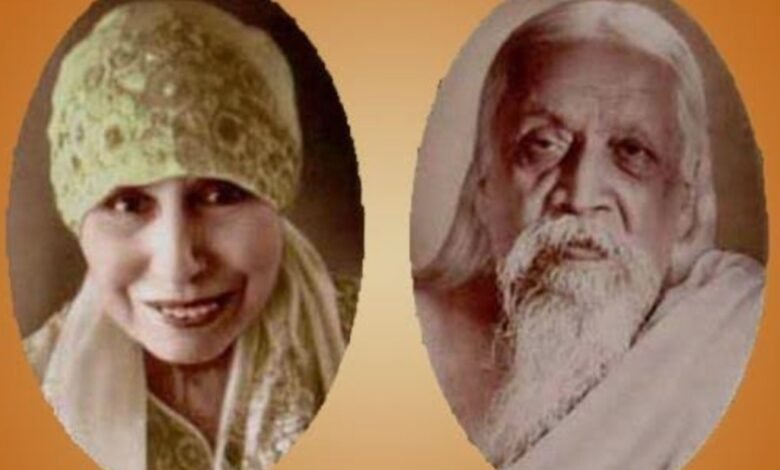
The Divine Mother (Sri Maa), born Mirra Alfassa on February 21, 1878, in Paris, France, was a spiritually gifted child with deep inner experiences from an early age. She was well-educated and talented in art, music, and philosophy. Her early spiritual quest led her to explore various traditions, including Western occultism and Eastern mysticism. In 1914, she first met Sri Aurobindo in Pondicherry, India—an encounter that profoundly changed her life. Recognizing him as her spiritual Master, she saw in him the embodiment of the Divine Consciousness. After returning briefly to France due to World War I, she settled permanently in Pondicherry in 1920, becoming Sri Aurobindo’s closest collaborator.
Under her monumental guidance, the small group of disciples around Sri Aurobindo gradually evolved into the Sri Aurobindo Ashram. After Sri Aurobindo’s retirement from public contact in 1926, The Mother took full charge of the ashram’s day-to-day management and spiritual direction. She organized the ashram into a community of dedicated sadhaks (spiritual seekers) living for the ideal of Integral Yoga, aiming for a divine transformation of human life. The Mother emphasized the integration of spiritual life with practical living—work, education, art, and personal progress were all seen as paths of spiritual realization. In 1952, she established the Sri Aurobindo International Centre of Education to promote a new, holistic system of education.
One of her greatest initiatives was the founding of Auroville in 1968, envisioned as a universal township where people from all over the world could live in peace and harmony, transcending national, religious, and political divisions—dedicated to human unity and spiritual progress. Even after Sri Aurobindo’s passing in 1950, The Mother continued to guide the ashram and its spiritual activities with great strength and compassion. She passed away on November 17, 1973, leaving behind a vast spiritual legacy of writings, letters, and conversations that continue to inspire seekers worldwide. The Mother’s life was a journey of divine realization, service, and transformation. She united Western intellect with Eastern spirituality, creating a living example of the universal spiritual synthesis envisioned by Sri Aurobindo—the transformation of human life into a divine life on earth.
The teachings of Sri Maa focus on the transformation of human consciousness and the realization of a divine life on Earth. Her message is one of inner awakening, selfless service, and divine realization through daily life. She envisioned a spiritualized humanity living in harmony, peace, and truth—an ideal she sought to manifest through the Ashram and through Auroville, the international township dedicated to human unity. The major themes and teachings include:
Integral Yoga: The Mother, along with Sri Aurobindo, taught Integral Yoga, which seeks not liberation from the world but the transformation of life itself into a divine existence. It harmonizes all parts of the being—physical, vital, mental, and spiritual—into the divine consciousness.
Divine Manifestation on Earth: She emphasized that the goal of human evolution is the manifestation of the Divine in material life. Human beings are instruments through which the divine consciousness can express itself in the physical world.
Surrender and Aspiration: According to The Mother, sincere aspiration and complete surrender to the Divine Will are essential for spiritual progress. She urged her followers to give up the ego and allow the Divine to act through them.
Work as Sādhanā (Spiritual Practice): Every action, when done in a spirit of dedication, purity, and selflessness, becomes a means of spiritual growth. She encouraged karma yoga—work not for personal gain but as an offering to the Divine.
Education and the Growth of the Soul: The Mother believed that education should focus on integral development—physical, emotional, mental, and spiritual—and help each child discover their inner truth and purpose.
Psychic and Supramental Transformation: She taught that humans must move beyond mental consciousness to psychic (soul) and supramental consciousness, leading to divine transformation of body and mind.
Universal Love and Oneness: The Mother stressed unity among all beings, transcending religion, nationality, or creed. True spirituality, she said, lies in universal love and service to humanity.
Divine Grace: She assured that divine grace is always present to help those who sincerely seek transformation with faith and humility.
From the teachings of The Divine Mother, we learn that life has never been a bed of roses for anyone—it depends on how we perceive it. Many people live far more difficult lives than we do. Remembering that we are relatively blessed is important for our own well-being and connection to reality. It is therefore essential to train our minds to be content and happy with what we have, to make reconciliations, accommodations, and accept that good and bad are real aspects of life as we move forward. It is important not to look back with regret. The future holds promises and opportunities if we fix our present with lessons learned from past mistakes.
I personally draw inspiration from the epic Mahabharata, where Lord Krishna imparts the divine teachings of the Srimad Bhagwad Gita to Arjuna. The image of Arjuna’s chariot drawn by white horses, guided by Lord Krishna, is monumental and deeply symbolic. But the symbolic meaning of this divine horse-drawn chariot—its relation to our life, ego, emotions, goals, solitude, peace, and mental stability—is a profound question that has long intrigued me.
To me, one of the horses represents our true self—the real person we are. The second represents the masked self we use to hide our true intentions and feelings. The third represents the face we show to society, the version of ourselves we want the world to see. The fourth represents how society actually sees us, despite all our efforts. The fifth horse symbolizes our past deeds and karmaphal; the sixth represents our ego and current circumstances; and the seventh and final horse symbolizes our future and destiny.
How do these relate to modern life?
As I see it, we are all riding that chariot of wisdom, drawn by these symbolic horses, on a long and infinite path called life. Together, the horses represent our ego, emotions—both positive and negative—our pride and prejudices, our anger, fear, frustrations, depression, vanity, impurity, and destiny. These forces must be balanced carefully using the ropes attached to them. Unlike Arjuna, we do not have a divine charioteer like Krishna to direct our journey, but we are fortunate to have His teachings to guide us.
We must remember that in this chariot of life, we are the charioteers. The ropes are in our hands. It is our responsibility to guide and balance the horses properly to move the chariot forward. If we pull too tightly or too loosely, the balance is lost. We may move too slowly when we need to move fast, or too fast when we need to slow down. Any imbalance can cause disharmony among the horses, leading to turmoil and loss of peace. Thus, to move smoothly in life, the charioteer must rely on the Creator’s teachings and balance the forces within.
The charioteer needs small, steady, timely, and precise movements to control the horses. This symbolizes controlling our ego and emotions during life’s journey. If we balance them properly, and act according to our karmaphal, life moves smoothly. Otherwise, unimaginably difficult hurdles arise. The Mother teaches that we must face our problems valiantly; only then can we resolve them. If we run away from them, they will chase us and catch up quickly. To deal with complex challenges, we must be honest, open-minded, respectful, and humble—strong enough to face our difficulties head-on. When we do so, we often realize that these challenges were our own creations—our fears were illusions keeping us away from the truth of life. The Mother teaches us to be brave and honest, to gradually transform into fearless individuals capable of mastering our own lives.
One of The Mother’s well-known sayings resonates deeply with me:
“Always remember that you are never alone. The Divine is always with you and in you.”
This resonates with me especially in the context of mental health and well-being:
-
Sense of Inner Support: Mental health struggles often create a sense of isolation. This reminder instills courage and reduces the feeling of abandonment.
-
Grounding in Self-Compassion: Many mental health challenges arise from harsh self-criticism. Remembering the Divine within helps transform judgment into acceptance.
-
Hope During Struggle: Anxiety and depression often create hopelessness. Her words remind us of the deeper spiritual anchor within us, fostering resilience.
-
Practical Well-Being: Even psychologically, belief in a higher presence strengthens optimism, reduces stress, and improves our ability to navigate uncertainty.
For me, this quote is an inner reassurance. On days when the mind becomes restless or heavy, the thought “I am not alone; something greater walks with me” helps me regain balance, calmness, and inner safety.
I personally follow a five-minute Daily Reflection for Mental Well-Being. The steps are:
-
Find a quiet spot. Sit comfortably, close your eyes, and take 3–4 deep breaths.
-
Repeat the affirmation: “I am never alone. The Divine is within me.”
-
Visualize Presence: Imagine a warm golden light in your heart—gentle, steady, luminous—spreading calm through your mind and body.
-
Release Heavy Thoughts: Place any worry or negative thought into that golden light and allow it to dissolve.
-
Close with Gratitude: Think or whisper, “Thank you for being with me,” and carry this quiet support into your day.
Practiced daily, this brings several gifts:
A. Reduced feelings of isolation and negativity
B. Stronger inner resilience and willpower
C. Greater calmness and emotional balance amid external chaos
D. Deeper trust in inner strength—self-empowerment, detachment from material fear, and the pursuit of inner peace and happiness