
Supreme Court refuses to stay in entirety the Waqf Amendment Act 2025 but gives relief on key issues.
By RANJIT KUMAR SINHA- 15th September 2025

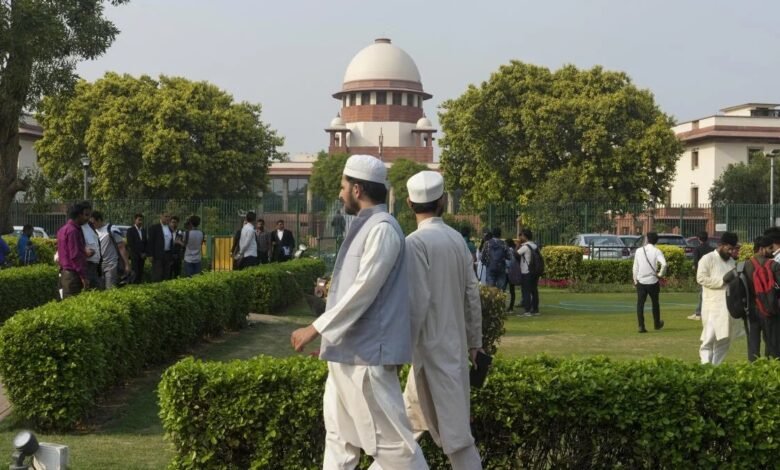
New Delhi: The Supreme Court on Monday refused to stay the entirety of the contentious Waqf (Amendment) Act, 2025, but put on hold the implementation of the provision requiring that a person must have practised Islam for at least five years before creating a waqf, citing that without a mechanism in place by the government to determine such eligibility, the clause could lead to arbitrariness.
In a 128-page interim judgement on the petitions challenging the law, the top court also stayed the provisions (specifically parts of Section 3C) that granted wide-ranging powers to a District Collector to determine if a property was government-owned land and not a Waqf property. It held that allowing the executive to adjudicate on citizens’ property rights would violate the principle of separation of powers.
The law, which according to the government aims to streamline the management of Waqf properties, with provisions to safeguard heritage sites and promote social welfare, was challenged by several Muslim bodies, opposition leaders, and individuals.
The Lok Sabha and Rajya Sabha passed the Waqf (Amendment) Act on April 3 and 4, respectively, and received Presidential assent on April 5.
Delivering the judgement on the challenge to the validity of several of the Sections of the Waqf (Amendment) Act, 2025, on the ground of they being ultra vires the Constitution of India being violative of Articles 14, 15, 19, 21, 25, 26, 29, 30 and 300A of the Constitution, the apex court said “In the totality of the circumstances, we do not find that any case is made out to stay the provisions of the entire statute. The prayer for stay of the impugned Act is, therefore, rejected.”
“However, while doing so, in order to protect the interest of all the parties and balance the equities during pendency of this batch of matters,” a bench comprising Chief Justice B R Gavai and Augustine George Masih issued several other directions.
The bench declined to stay the provisions regarding the composition of the Waqf bodies but issued directives to limit the number of non-Muslim members. It directed that the Central Waqf Council should not have more than four non-Muslim members, and the State Waqf Boards should not have more than three non-Muslim members and as far as possible, the Chief Executive Officer of a Waqf Board should be from the Muslim community.
The apex court refused to stay the abolition of “waqf by user,” a concept where a property could be recognized as a Waqf based on its long-term use for religious purposes without a formal deed.
Dealing with the challenge to Section 3(r) of the Amended Waqf Act, which de-recognises ‘Waqf by user’ prospectively, the bench said “…we are also of the view that if the legislature, in 2025, finds that on account of the concept of “Waqf by User”, huge government properties have been encroached upon and to stop the said menace, it takes steps for deletion of the said provision, the said amendment, prima facie, cannot be said to be arbitrary.”
“After noticing such instances of misuse, if the legislature finds that the concept of “Waqf by User” has to be abolished and that too prospectively, in our view, the same cannot prima facie be said to be arbitrary. In any case, as submitted by the learned Solicitor General, the deletion of clause (i) of Section 3(r) of the Original Waqf Act would come into effect from the date on which the impugned Act came into effect.
“The said provision would, therefore, not apply retrospectively. Therefore, the contention of the petitioners that the lands vested in the waqfs would be grabbed by the Government prima facie holds no water,” observed the bench, which also refused to stay the provisions that make the mandatory registration of every Waqf a prerequisite.
It was observed that the requirement for registration is not a new concept and has been a part of previous Waqf legislations, and “We are, therefore, of the prima facie view that such a provision cannot be held to be arbitrary or discriminatory.”
While dealing with the new Waqf law that seeks to overcome shortcomings of the previous Waqf Act, 1995, to improve the registration and management of Waqf assets, and address issues of mismanagement and legal disputes, the apex court said “by now, it is a settled principle of law that the courts should be very slow in granting interim relief by way of staying the provisions of an enactment.”
“Interim relief of such a nature can be granted in rare and exceptional cases, where parties are in a position to point out that either the legislature which enacted the law lacks legislative competence or the provisions are ex facie in violation of any of the provisions in Part III of the Constitution or constitutional principles or are manifestly arbitrary.|
While dealing with the provision that requires a person dedicating a property to show or demonstrate that he is practising Islam for at least 5 years, the bench said, “We are, therefore, prima facie of the view that such a provision, which requires a person practising Islam for 5 years for creating a waqf, cannot be said to be arbitrary. “
“As already discussed herein above, it cannot be said that it has no nexus with the object sought to be achieved. However, we are of the considered view that since no mechanism or procedure has been provided as of now for ascertaining as to whether a person has been practising Islam for at least 5 years or not, such a provision cannot be given effect to immediately.
“We are, therefore, of the considered view that unless the rules are made by the Central Government by exercising its rule-making power under Section 109 of the Amended Waqf Act, the provision of Section 3(r) of the Amended Waqf Act requiring a person to show or demonstrate practice of Islam for at least 5 years in order to dedicate a movable or immovable property for the purpose of creating a waqf cannot cannot be given effect to,” the bench said.
The apex court also directed that unless the issue with regard to title of the waqf property in terms of Section 3C of the Amended Waqf Act is not finally decided in the proceedings initiated under Section 83 of the Amended Waqf Act by the Tribunal and subject to further orders by the High Court, neither the waqfs will be dispossessed of the property nor the entry in the revenue record and the records of the Board shall be affected.
However, the apex court said that upon commencement of an inquiry under Section 3C of the Amended Waqf Act till the final determination by the Tribunal under Section 83 of the Amended Waqf Act, subject to further orders of the High Court in an appeal, no third-party rights would be created in respect of such properties.
The apex court held that the argument advanced before us on behalf of the petitioners was that on account of Section 3D of the Amended Waqf Act, the persons practising the Islamic religion would be deprived of performing their religious practices at the declared protected monuments, “does not hold water”.