Supreme Court’s Firm Line on Electoral Roll Revision Strengthens Democratic Process
Ms.Bornali Biswas –Editor in Chief-14th February 2026
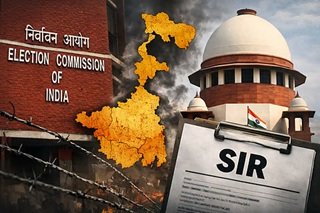
The Supreme Court’s categorical observation that no state should create impediments to the Special Intensive Revision (SIR) of electoral rolls is a timely reaffirmation of a core democratic principle: the integrity of elections begins with the integrity of the voter list. By making it clear that administrative or political disagreements cannot obstruct a constitutionally mandated exercise, the Court has drawn a necessary boundary between governance disputes and electoral processes.
Electoral roll revision is not a political favour — it is a statutory and constitutional obligation. The Election Commission of India (ECI) is entrusted with supervisory authority over voter lists precisely to insulate the process from partisan pressures. When cooperation between a state government and the Commission breaks down, judicial clarity becomes essential. The Court’s intervention does not endorse one political narrative over another; rather, it protects process continuity.
The bench’s questions regarding delays in officer deployment and communication gaps underline an important governance lesson: election-related coordination must be prompt, documented, and transparent. Delayed compliance — even if eventually fulfilled — can undermine time-bound national exercises and create avoidable suspicion.
Public messaging around such exercises must also be responsible. Raising procedural objections is legitimate; portraying revision exercises as inherently suspect without adjudicated proof risks confusing voters and weakening institutional trust. Democracy depends not only on contestation but also on confidence in neutral processes.
By extending the deadline while refusing obstruction, the Court has balanced fairness with firmness. That balance is vital. Clean rolls, verified voters, and transparent revision mechanisms are not optional — they are the infrastructure of free elections.
Explainer: What Is the SIR Exercise and Why Did the Supreme Court Intervene?
Here’s a clear breakdown of the Special Intensive Revision (SIR) issue and the recent Supreme Court proceedings:
What is SIR (Special Intensive Revision)?
- A focused verification drive of electoral rolls.
- Conducted by the Election Commission of India.
- Aims to:
- Remove duplicate or ineligible entries,
- Update voter details,
- Add eligible new voters,
- Improve roll accuracy before major elections.
Who Conducts It?
- The ECI supervises the process.
- Ground work is carried out with the help of:
- State government officers,
- Booth-level officials,
- Appointed observers.
What Triggered the Court Case?
- The SIR exercise in West Bengal was challenged by the state leadership.
- Concerns raised included:
- Deployment of micro-observers,
- Adequacy and category of officers used,
- Alleged procedural irregularities.
- The ECI responded that:
- It had requested officers multiple times,
- Names were not supplied in time,
- Micro-observers were used due to manpower gaps.
What Did the Supreme Court Say?
- No state can obstruct the SIR process.
- Electoral roll revision must continue.
- The Court questioned:
- Delay in sending officer lists,
- Timing of state communications after earlier directions.
- Deadline for SIR in the state was extended by one week.
- The Court said it would issue clarifications if needed — but not allow stoppage.
Why This Matters to Citizens
- Accurate voter rolls protect:
- Your right to vote,
- Election credibility,
- Result legitimacy.
- Errors in rolls can lead to:
- Disenfranchisement,
- Duplicate voting risks,
- Legal disputes after elections.
Bottom Line
The dispute is political, but the principle is institutional: voter list verification is a constitutional function. The Supreme Court’s message is that such exercises must proceed — with transparency, cooperation, and accountability — but without obstruction.
Historically, the Baloch insurgency was male-dominated, with suicide attacks considered both tactically unnecessary and morally contentious. Women associated with the movement were largely confined to indirect roles—mobilising opinion, fundraising, or participating in rights-based protests. That boundary collapsed in April 2022 with the first confirmed female suicide attack, and since then the trend has accelerated. The participation of educated, middle-class women challenges simplistic assumptions that such violence is driven solely by poverty or lack of awareness.
Militant groups are deploying women for calculated reasons. In a deeply patriarchal society, a female suicide bomber carries immense symbolic weight. It allows insurgent leaders to project a narrative of total societal desperation—suggesting that state repression has become so severe that even women are compelled to embrace extreme violence. This symbolism is weaponised both externally, to attract attention and legitimacy, and internally, to shame men into joining the insurgency.
There is also a tactical logic. Women are less likely to be suspected at checkpoints, can bypass certain security protocols, and generate far greater media impact. Once one faction adopts the tactic, competitive emulation sets in, as seen in the way rival Baloch groups that once criticised suicide bombings have now embraced them. The use of women thus reflects organisational pragmatism, not ideological evolution.
However, framing female suicide bombers as empowered actors risks falling into the militants’ narrative trap. These women operate within highly controlled militant structures where agency is shaped, constrained, and often manipulated. Their deaths serve strategic ends decided overwhelmingly by male leaderships who remain distant from the battlefield.
The rise of female suicide attacks should therefore be read as a sign of insurgent desperation as much as resolve. It indicates shrinking operational space, heightened militarisation, and a turn towards shock value over sustainable political mobilisation. For the state, a purely security-centric response risks reinforcing the very narratives militants seek to construct. Addressing this phenomenon demands not only counterterrorism measures but also credible political engagement, accountability, and social outreach—especially toward women—lest militancy continue to exploit despair as its most potent weapon.