Calcutta High Court Affirms Durga Puja’s Secular Essence and Right to Celebration

In a significant verdict, the Calcutta High Court, on August 25th, underscored the secular nature of Durga Puja, emphasizing that it transcends being a purely religious event. The court’s ruling came in response to the case of Manab Jati Kalyan Foundation v. State of West Bengal, wherein Justice Sabyasachi Bhattacharyya ordered the authorities in Kolkata to allow an organization to host Durga Puja festivities at a designated public ground in the city.
The High Court rejected the argument put forth by the authorities that Article 25 of the Indian Constitution doesn’t grant the petitioners the right to perform worship in public spaces such as parks, roads, and footpaths. Justice Bhattacharyya’s observation was rooted in the recognition that Durga Puja is not confined to religious practices but encompasses a diverse array of cultural elements.
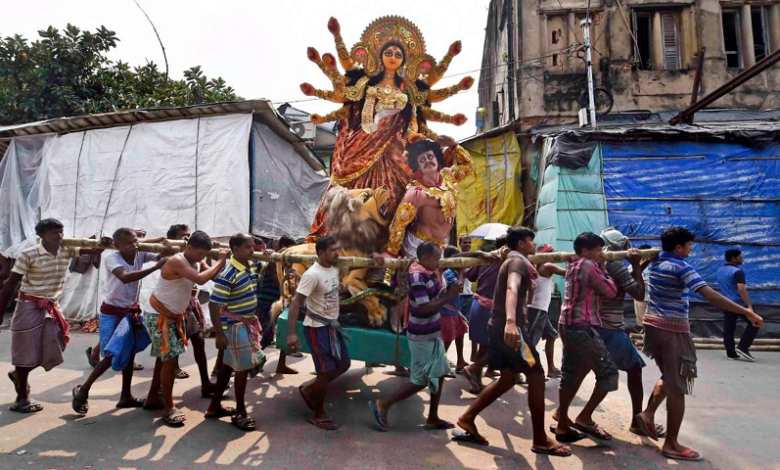
The judgment highlighted, “The Durga Puja Festival is not confined merely to the worship or religious offerings component of the incarnation of feminine power but also a melting pot of different cultures…Hence, there is as much an element of ceremony, cultural programmes, festival and fanfare involved as religious worship. In such sense, the Durga Puja Festival is much more secular in nature than a pure religious performance of a particular community and cannot, thus, be narrowed down to being a mere ‘religious offering’ of a particular community.”
The case arose from a plea challenging the authorities’ denial of permission to the petitioners to hold the Durga Utsab 2023 in the New Town Mela Ground, a venue typically used for fairs. The authorities presented several objections, which the petitioners contended were flimsy excuses for refusal. Relying on Article 14 of the Indian Constitution, the petitioners argued that they possess an equal right to host a Durga Puja festival on the designated ground, similar to others.
Justice Bhattacharyya’s observations centered on the distinctive aspect that the site for the proposed Durga Puja Festival was not a street, footpath, or playground, but a ground specifically designated for hosting fairs. The court deemed that the authorities had failed to establish a reasonable difference between a Durga Puja Festival and other fairs or festivals scheduled for the Mela Ground. Both events entail substantial footfall and crowd gatherings, including vehicle parking for attendees.
The argument that permitting Durga Puja at the site would burden the Kolkata Police was dismissed as “absolutely baseless” by the court. It pointed out that the state regularly hosts numerous large Durga Puja events organized by various entities in close proximity to each other.
Furthermore, the court asserted that an individual’s place of residence or office should not deter them from organizing a festival on public property designated for such functions. It highlighted Article 19 of the Constitution, which guarantees citizens the right to assemble peacefully and move freely throughout India. Refusing permission based solely on a person’s residency elsewhere would undermine these constitutional rights, unless there are specific reasons or intelligible criteria to justify such discrimination.
The court also acknowledged that the petitioners had agreed to pay the requisite charges, as stipulated by law and procedure, for organizing the festival. Advocates Tarunjyoti Tewari, Sandip Ray, Hiranmoy Debnath, Polly Banerjee, and Paramita Dey represented the petitioners, while Advocates Ratul Biswas and Chandan Kumar Mond represented the State.
News Mania Desk / Agnibeena Ghosh 26th August 2023