
The government protects domestic airlines despite jet fuel prices more than doubling.
News Mania Desk/ Piyal Chatterjee/1st April 2026

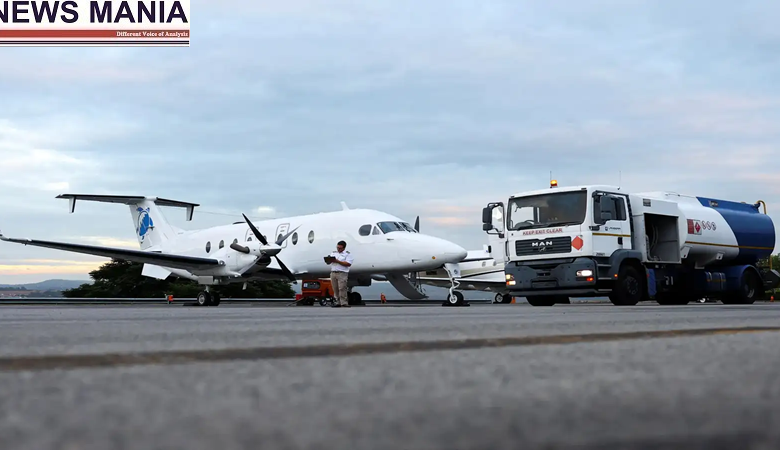
Due to restrictions on the world’s energy supply brought on by the ongoing conflict in the Middle East, the government on Wednesday protected domestic airlines from a dramatic rise in jet fuel prices.
Aviation turbine fuel (ATF) rates in Delhi were doubled by the state-owned Indian Oil Corporation on Wednesday morning to Rs 2.07 lakh per kilolitre for April. It fell to Rs 1.04 lakh/kl a few hours later. When it became clear that prices for the domestic market would rise by more than 100% starting on April 1, 2026, the government declared it would only permit a partial increase. According to the administration, this will prevent step increases in domestic airfares.
As a result, only a limited and phased rise in ticket pricing has been adopted by public sector OMCs, or oil marketing companies, after consulting with the Ministry of Civil Aviation. Instead of the entire pass-through of global pricing hikes, domestic airlines will experience a limited boost of about 25%, or roughly Rs 15 per kl, according to the government. However, in accordance with global market-linked pricing, airlines operating overseas routes will be fully responsible for the hike. This strategy would assist safeguard travelers and the airline industry, according to airline Minister Ram Mohan Naidu.
“This calibrated approach will help shield passengers from sharp fare increases, ease the burden on domestic airlines, and support the continued stability of the aviation sector at this crucial juncture,” he said. He also said this will benefit the larger economic picture by ensuring smooth cargo movement and maintaining critical air connectivity for trade and logistics.
The international energy market is in disarray as a result of the US-Israel assault on Iran, which has escalated to attacks on energy infrastructure and an embargo on tanker traffic via the Strait of Hormuz. Exports were hampered by the nearly complete blockage of the vital waterway, which transports a fifth of the world’s gas and oil supplies. As the interruption grew, prices skyrocketed.
If the increase in jet fuel had been fully implemented, local airlines—which are already struggling with narrow profit margins—would have been severely burdened. Similar damage has been done to other airlines in the area. China, the world’s biggest oil importer, has reduced petroleum exports to ensure domestic supplies, and carriers from Vietnam to New Zealand have been forced to cancel flights due to skyrocketing costs.