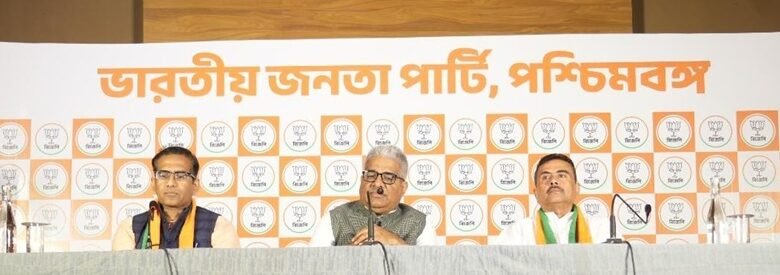
At the outset of his speech, he greeted the State leadership and members of the media. He said that the presence of Leader of the Opposition Suvendu Adhikari and media friends made the occasion significant. He noted that 11 February is important as it marks the remembrance of Deendayal Upadhyaya, the proponent of Integral Humanism, whose philosophy of welfare for the poor has guided Prime Minister Narendra Modi for the past 11 years.
He stated that India’s economy is progressing rapidly. Surpassing Japan, India has become the world’s fourth-largest economy, with GDP rising to approximately $4.18–4.19 trillion, moving the nation closer to the goal of a developed India.
He explained that a welfare state must focus on three priorities: increasing investment, generating employment, and ensuring that prosperity reaches all sections of society. Keeping this in mind, Union Finance Minister Nirmala Sitharaman presented this Budget. Guided by the vision of Sabka Saath, Sabka Vikas, the goal is to continue working towards 2047. She has presented the Budget nine consecutive times under the leadership of the Prime Minister. Capital expenditure has increased sixfold—from ₹2 lakh crore in 2014 to current levels—demonstrating steady progress.
Over the past decade, 25 crore people have risen above the poverty line. The Budget includes investments in roads, airports, ports, freight corridors, and the integration of Tier-2 and Tier-3 cities. A capital expenditure of ₹12 lakh crore has been allocated. Infrastructure will be modernized, and new sectors such as semiconductors and biopharma will receive focused attention. The Surat–Dankuni Freight Corridor is expected to reduce transportation costs by 30%. The Siliguri–Varanasi corridor and developments in Durgapur will enhance overall logistics efficiency.
A ₹10,000 crore MSME Growth Fund has been proposed. During the tenure of Chief Minister Mamata Banerjee, 6,800 listed companies have reportedly shut down, and the MSME sector has suffered. This announcement is expected to benefit West Bengal’s MSMEs. Special emphasis has also been placed on the jute sector—80% of India’s jute is produced in West Bengal, directly employing 2.5 lakh people. Technological upgrades in jute have also been highlighted in the Budget.
The Budget aims to accelerate growth in textiles, entrepreneurship, and skill development. Recognizing that many women migrate from rural areas to cities for education and work, girls’ hostels will be established in every district. Women’s empowerment remains a priority. Over the past decade, the BJP government has created 2 crore “Lakhpati Didis” nationwide. Through initiatives like C-Mart, further support mechanisms have been outlined.
The Rural Development Ministry alone has granted ₹1.10 lakh crore to West Bengal. However, he alleged that the Trinamool government represents poor governance. Implementation of MGNREGA has reportedly been flawed, with allegations of fund mismanagement. Utilization Certificates for PM Awas Yojana funds have not been properly submitted. Corruption has been alleged in PM Poshan Yojana. Disha meetings mandated by the Centre have not been held in the State. Schemes like Ayushman Bharat and PM-Kisan have not been allowed to function fully. The State is operating with low capital expenditure, borrowing continuously without increasing income—thereby jeopardizing West Bengal’s future. He described this as not just the Trinamool’s last budget, but its farewell document.
He remarked that this is the land of great scientists like Satyendra Nath Bose and Jagadish Chandra Bose, yet allocations for science education are low while ₹5,713.61 crore has been allocated to madrasas. In North Bengal, with a population of 3 crore, only ₹910 crore has been allocated. He alleged that funds are being distributed in the name of madrasas.
He further stated that BJP-ruled states are providing direct financial assistance to women, including support up to ₹2 lakh to promote self-reliance. Despite West Bengal’s strong potential in textiles.