Kerala’s Harvest Festival, ONAM
News Mania Desk / Piyal Chatterjee / 5th September 2025

Hindu mythology states that Mahabali, the grandson of the Brahmin sage Prahlada, defeated the Gods (Devas) and seized control of the three planets. The Devas asked Lord Vishnu to aid them in their fight against Mahabali, but Vishnu declined because Mahabali was a good ruler and his follower. After defeating the gods, Mahabali had to perform a Yajna and grant everyone’s wishes. In an attempt to gauge Mahabali’s level of devotion, Lord Vishnu approached him while posing as Vamana, a dwarf lad.
The king gave the kid everything he had, but Vamana rejected, stating that he only needed three paces and that one should not seek more than one needs. Despite being taken aback by the boy’s request, Mahabali granted it. Vamana expanded, covering the sky with one foot and the land and ocean with another. Mahabali now volunteered himself to place his third foot. Mahabali was crushed to Pathala (hell) by Vamana, who was moved by his devotion and granted him permission to return to his homeland annually. The festival of Onam coincides with the return of Mahabali.
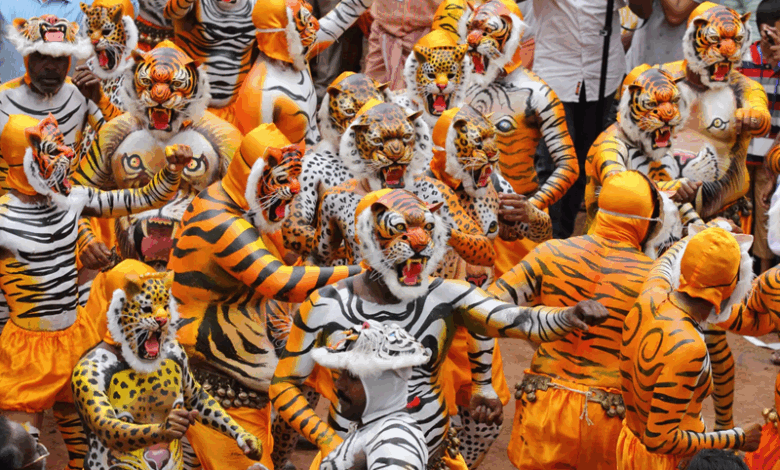
The state-wide Onam festivities begin with the Atthachamayam, also known as Thripunithura Athachamayam, a magnificent procession at Thrippunithura, close to Kochi. Elephants marching, folk art, drum beats and other music, floats, and people wearing masks and colorful costumes are all part of the procession. In the past, the Kochi king would visit and greet his subjects by leading a magnificent military procession from his palace to the Thrikkakara temple while wearing full ceremonial robes. This event is supported by the state in modern times.
Traditionally, the parade floats depict scenes from epics like the Ramayana and the Mahabharata. Furthermore, some floats promote harmony and unity by using both contemporary and biblical elements. Tripunithura to the Vamanamoorthy Temple in Thrikkakara, Ernakulam district, has traditionally been the procession route. In his Vamana (dwarf) form, Vishnu is worshipped at the temple. The marchers pray once they have reached the temple.
Known as Onapookkalam or simply Pookkalam, the floral carpet is composed of collected blooms, with many flower species of varying hues pinched up into tiny bits to create and embellish patterns on the floor, especially at temple grounds and entrances. It resembles a flower mat. Lamps are placed along the perimeter or in the center. A delicate touch and a unique creative sense of tone and blending are used to create this holy art piece, which is usually the collective effort of women and girls. When finished, it is covered with a miniature pandal, or umbrella, that is strung with tiny festoons. Rangoli, which is famous in North India and is made of powders of different colors, is comparable to pookkalam.
On Atham Day, the customary practice of laying pookkalam begins. On this day, the pookkalam is referred to as Athapoo and is comparatively modest. With every day of the Onam festival, the pookkalam gradually gets bigger. Atham will just have yellow flowers, a single circular layer, and a straightforward design. On this day, statues or sculptures of Vamana and Mahabali are also placed at the entrance to every home.
Atthapookalams traditionally included Dashapushpam (10-flowers) and Keralan native flowers, but today they employ various kinds of flowers. Together with the Pookalam, earthen mounds that resemble square pyramids and symbolize Mahabali and Vamana are positioned in the dung-plastered courtyards in front of the house. They are exquisitely adorned with flowers. Pookalam tournaments are a regular occurrence on Onam day throughout Kerala.
The importance of the feast to the Kerala’s Onam celebration culture is captured in the famous Malayalam proverb “Kaanam Vittum Onam Unnanam” which means “One must have the Onam lunch even by selling one’s property, if need be“. Although a lighter version is also given at dinner, the sadhya is typically served for noon. The dishes are ready before 10:00 a.m. on the day of the celebration, with preparations starting the night before. About 24 to 28 dishes can be offered as a single course during a regular Sadhya. In situations where it is significantly larger, it may include 64 or more things. To qualify as a valla sadhya, where both physical and spiritual purity are crucial, it must be cooked by certified chefs. In a traditional Sadhya ceremony, individuals sit on mats with their legs crossed. Without cutlery, food is consumed using the right hand. A ladle is formed by cupping the fingers.
The foods are served in a certain order and at certain locations on the banana leaf. To make it easier for the waiters to recognize and choose whether to provide extra portions, the pickles are placed in the upper left corner and the banana in the lower left corner. Due to their abundance in Kerala, rice, veggies, coconut, and coconut oil are the most often used ingredients in all of the cuisines. Some recipes call for coconut milk, while others use coconut oil as an ingredient or for frying.
Depending on the location and religion, the cuisine varies. Some cultures incorporate non-vegetarian meals in the sadhya, particularly those in northern Kerala. While using seasonal and traditional vegetables that are native to Kerala or the South West Coast of India was customary, it is now normal practice to incorporate vegetables like carrots, pineapples, and beans into the meals. According to tradition, the sadhya does not usually use garlic or onions. Traditionally, vettila murukkan—chewing betel leaf with lime and arecanut—may come after the meal. This clears the palate and aids in meal digestion.