
Amidst global uncertainties, Australia and the EU reach a comprehensive trade agreement.
News Mania Desk/ Piyal Chatterjee/24th March 2026

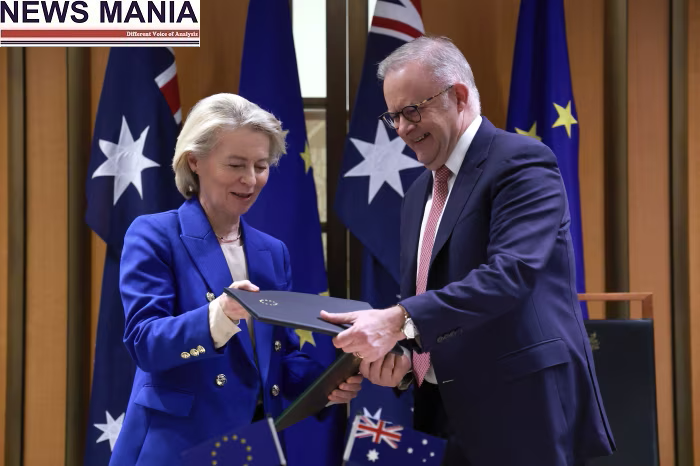
After eight years of negotiations, Australia and the EU have reached a comprehensive free trade agreement. The agreement, which was signed in Canberra and is estimated to be worth A$10 billion ($7 billion; £5.2 billion), was referred to as a “win-win” by both the visiting European Commission President Ursula von der Leyen and Australia’s prime minister.
The agreement, according to her, focuses on “collective resilience” in a “deeply changing” world. In addition to eliminating nearly all trade tariffs, the two parties decided to strengthen their defense and vital mineral cooperation. European automakers applauded the agreement, while Australian and European farmers were dissatisfied with the export quotas set for Australian lamb and cattle.
Over the next ten years, the amount of Australian beef permitted to enter the EU is expected to expand more than tenfold; however, European farmers opposed the increases, while Australian producers had desired more. Given the rapidly shifting geopolitical landscape and the unpredictability of US President Donald Trump, the agreement reached in Canberra on Tuesday is the most recent trade agreement reached by Brussels as it attempts to diversify its international commercial partnerships.
After nearly twenty years of intermittent negotiations, the EU and India struck a historic trade agreement in January. The European Parliament recently blocked another significant trade agreement that the EU had made with the Mercosur alliance of South American nations due to concerns from the farming sector.
“Today we are telling an important story to a world that is deeply changing. A world where great powers are using tariffs as leverage and supply chains as vulnerabilities to be exploited,” von der Leyen told a news conference in Canberra – a nod to Trump’s use of tariffs and China’s control of the critical minerals market.
She added that “trust matters more than transactions”, noting Australia and the EU had a “unique relationship” that was “built for the long term”.
Under the deal, almost all EU tariffs will be lifted on Australian agricultural products such as wine, fruit and vegetables, olive oil, seafood, most dairy products and wheat and barley.
According to the government, local wine growers and exporters will save almost A$37 million as a result. The agreement will result in cheaper European pasta, wine, spirits, biscuits, and chocolates for Australian customers.
According to the agreement, Australian-made Italian-style sparkling wine can still be marketed domestically under the term prosecco, but exports will no longer be able to use it for ten years. Although “grandfathering and lengthy phase-out periods” will apply to feta, Australian manufacturers are still permitted to use names like parmesan.Australia is currently the only nation outside of Italy to have obtained EU approval to use the name Prosecco. Food naming rights are a delicate topic in both Europe and Australia. The trade agreement was a “perfect balance,” according to von der Leyen, since it will make it easier for Australians to export to the EU while increasing the availability of EU-made goods in Australia. Australian Prime Minister Anthony Albanese brought up the issue, pointing out that the nation’s modern history was built on migrants.