“Earthset and Beyond: How NASA’s Artemis II Redefined Human Space Exploration”
Ms.Bornali Biswas –Editor in Chief

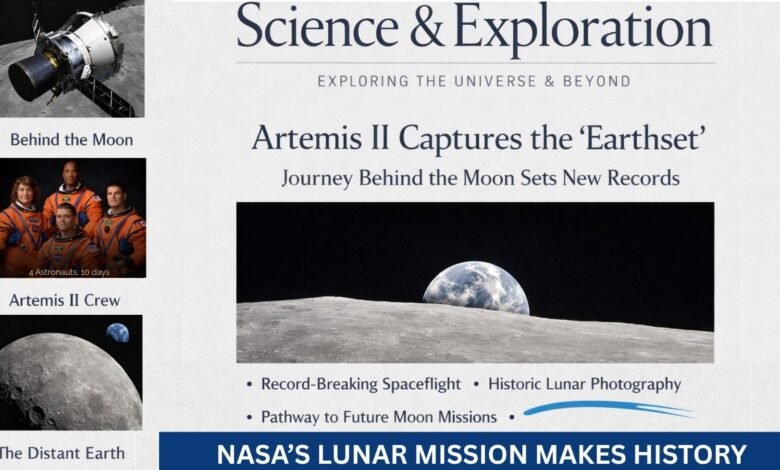
In a moment that will forever be etched in the annals of space history, NASA’s Artemis II mission has delivered breathtaking “Earthset” photos and propelled humanity deeper into space than ever before. On April 6, 2026, the four‑astronaut crew aboard the Orion spacecraft Integrity captured a striking image of Earth disappearing behind the Moon’s horizon — an event now known as Earthset — reminiscent of the iconic Earthrise captured during the Apollo 8 mission in 1968.
The Earthset photograph shows our home planet as a crescent, partially illuminated against the stark lunar surface, an awe‑inspiring reminder of both our fragility and unity in the vastness of space. Taken by astronaut Reid Wiseman through a window of the Orion capsule, this image not only mirrors the deep emotional impact of earlier lunar photography but also highlights how far our technology and exploration efforts have advanced since the Apollo era.
Historic Human Distance Record
Artemis II has already rewritten human spaceflight records. During its lunar flyby, the mission carried its crew farther from Earth than any previous human flight, surpassing the Apollo 13 distance milestone of approximately 248,655 miles. The spacecraft reached a peak distance of about 252,760 miles, setting a new standard for deep space exploration.
This feat marks the first time astronauts have ventured beyond low Earth orbit in over 50 years, underscoring a bold resurgence in crewed lunar exploration that paves the way for future missions, including a lunar landing slated under Artemis III and a sustained human presence on the Moon.

Mission Purpose and Achievements
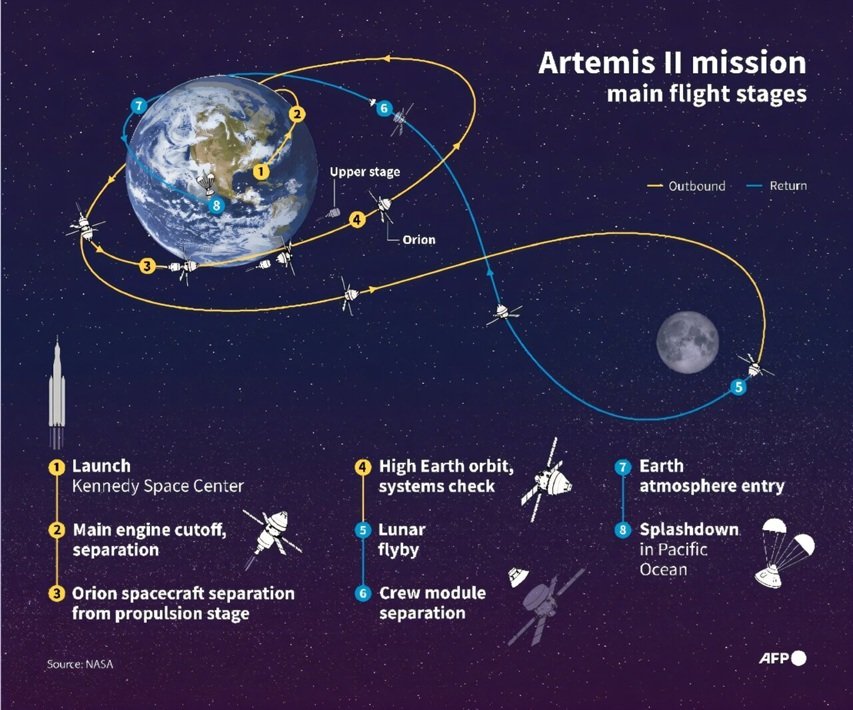
Launched on April 1, 2026, Artemis II is a ten‑day lunar flyby mission designed to test deep‑space capabilities critical for upcoming lunar surface missions and, eventually, crewed voyages to Mars. The mission builds on the success of the uncrewed Artemis I flight in 2022 and represents the first crewed launch of NASA’s Space Launch System (SLS) rocket paired with the Orion spacecraft.
The mission’s accomplishments extend beyond stunning visuals. While orbiting the Moon’s far side — a region many of the crew had never seen firsthand — the astronauts gathered valuable scientific observations, documented features of the lunar landscape never photographed by human eyes, and even witnessed a total solar eclipse from space during the flyby.
Legacy and Inspiration
Artemis II’s achievements are as symbolic as they are scientific. The mission embodies a reinvigorated spirit of exploration, bridging the gap between historic Apollo missions and future journeys that will return humans to the lunar surface for the first time since 1972. It also offers inspiration and imagery that will resonate across generations, reminding humanity of its capacity to explore beyond terrestrial borders.
As the Orion spacecraft prepares for its return to Earth, culminating with a dramatic re‑entry and splashdown in the Pacific Ocean, Artemis II stands as a testament to international cooperation, advanced engineering, and the enduring human curiosity to explore the unknown.
In capturing Earthset, breaking distance records, and charting a course for future lunar exploration, Artemis II has not only reached new physical distances — it has pushed the boundaries of human achievement itself