80% Deficit Monsoon: A Looming Shadow of an Approaching Natural Disaster?

Bornali Biswas-Editor in Chief
The Indian monsoon is more than a seasonal weather event—it is the backbone of the country’s economy, agriculture, water security, and food supply. Nearly 55% of India’s net sown area remains rain-fed, and despite rapid urbanisation, millions of livelihoods continue to depend directly on timely and adequate monsoon rainfall. Therefore, reports of an 80% rainfall deficit in several regions have triggered serious concerns among meteorologists, policymakers, farmers, and economists alike.
Understanding the Deficit
The India Meteorological Department (IMD) classifies rainfall as “deficient” when it is 20% to 59% below the Long Period Average (LPA). An 80% deficit, however, is an extreme anomaly that can occur over specific districts or short periods, signalling severe rainfall failure rather than a nationwide seasonal average.
Several districts across central, eastern, and northwestern India have periodically witnessed such deficits during prolonged dry spells, often due to delayed monsoon onset, weak monsoon currents, or atmospheric disturbances linked to El Niño and the Indian Ocean Dipole (IOD).
Agriculture Faces the First Blow
Agriculture is the most immediate casualty of deficient rainfall.
According to the Ministry of Agriculture, nearly half of India’s cultivated land still lacks assured irrigation. Crops such as paddy, pulses, soybean, cotton, maize, and groundnut depend heavily on monsoon rains during sowing.
An 80% rainfall deficit can result in:
- Delayed sowing and lower crop acreage
- Poor germination and crop failure
- Reduced groundwater recharge
- Increased dependence on expensive irrigation
- Declining farm incomes
The ripple effect extends to food inflation, rural employment, and agricultural exports.
Water Crisis Intensifies
Rainfall is India’s primary source of freshwater replenishment.
A prolonged deficit affects:
- Reservoir storage
- River flows
- Groundwater levels
- Drinking water supply
- Hydroelectric generation
Data from the Central Water Commission (CWC) regularly show that reservoir storage falls significantly during poor monsoon years. Urban centres such as Bengaluru, Chennai, and Delhi have already experienced water shortages despite receiving normal annual rainfall due to uneven distribution and over-extraction of groundwater.
Economic Consequences
The Reserve Bank of India (RBI) has repeatedly identified deficient monsoons as one of the biggest risks to inflation.
Poor rainfall affects:
- Food prices
- Rural demand
- FMCG sales
- Automobile purchases in rural markets
- Fertiliser consumption
- Agricultural credit repayment
Economists estimate that every major monsoon failure can shave 0.3–0.5 percentage points off India’s GDP growth depending on its severity.
Climate Change Is Altering the Monsoon
Scientists increasingly believe that climate change is making the Indian monsoon more unpredictable.
Studies by the Indian Institute of Tropical Meteorology (IITM) and the Intergovernmental Panel on Climate Change (IPCC) indicate that while India’s total seasonal rainfall may not decline dramatically, rainfall events are becoming more erratic.
Key emerging trends include:
- Longer dry spells
- More intense cloudbursts
- Fewer rainy days
- Greater regional disparities
- Increased frequency of extreme weather events
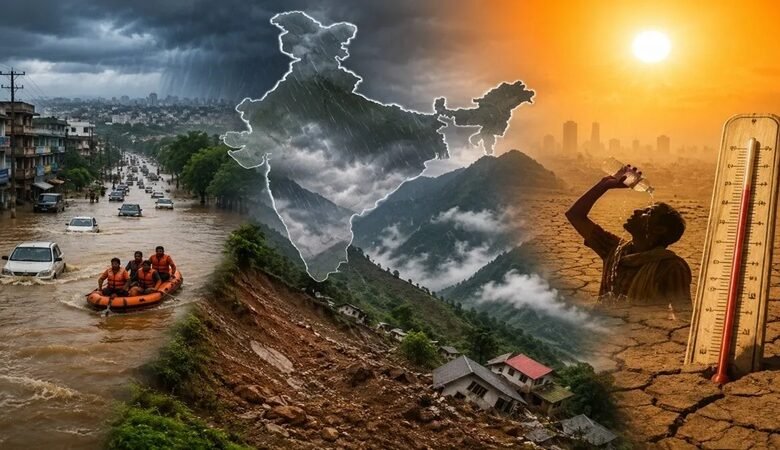
This means regions may witness devastating floods one week and severe drought the next.
Ecological Impact
An extended rainfall deficit also threatens ecosystems.
Reduced rainfall leads to:
- Drying wetlands
- Forest stress
- Increased forest fires
- Wildlife migration
- Loss of biodiversity
- Soil degradation
Lower river flows also reduce water quality, affecting fisheries and aquatic ecosystems.
Government Preparedness
India has strengthened its disaster preparedness through multiple initiatives.
These include:
- PM Krishi Sinchai Yojana for irrigation expansion.
- Jal Jeevan Mission for rural drinking water.
- National Mission for Sustainable Agriculture promoting climate-resilient farming.
- Atal Bhujal Yojana for groundwater management.
- Improved weather forecasting by the IMD.
- Reservoir monitoring by the Central Water Commission.
The government has also encouraged micro-irrigation, crop diversification, millets, and water-efficient farming to reduce dependence on erratic rainfall.
Is India Heading Towards a Natural Disaster?
An 80% rainfall deficit in isolated regions should not automatically be interpreted as a nationwide catastrophe. However, if such deficits persist across large geographical areas or continue through critical agricultural months, the consequences could include drought, water scarcity, food inflation, power shortages, and ecological stress.
Experts stress that India must shift from crisis response to climate resilience by investing in watershed management, rainwater harvesting, precision agriculture, groundwater conservation, and climate-smart infrastructure.
Conclusion
The spectre of an 80% monsoon deficit serves as a stark reminder of India’s vulnerability to climate variability. While improved forecasting, irrigation projects, and policy interventions have strengthened resilience, the increasing unpredictability of rainfall demands a long-term strategy that integrates science, sustainable water management, and climate-adaptive agriculture. The challenge is no longer merely coping with a weak monsoon but preparing the nation for an era where weather extremes become increasingly frequent. Success will depend on coordinated action by governments, scientists, farmers, industries, and citizens to safeguard India’s food, water, and economic security.
References
- India Meteorological Department (IMD) – Monsoon and rainfall classification reports.
- Central Water Commission (CWC) – Weekly Reservoir Storage Bulletins.
- Ministry of Agriculture & Farmers Welfare – Agricultural Statistics at a Glance.
- Reserve Bank of India (RBI) – Monetary Policy Reports on inflation and monsoon risks.
- Indian Institute of Tropical Meteorology (IITM), Pune – Monsoon variability research.
- Intergovernmental Panel on Climate Change (IPCC) Sixth Assessment Report.
- NITI Aayog – Composite Water Management Index.
- Ministry of Jal Shakti – Jal Jeevan Mission and Atal Bhujal Yojana reports.