How Petroleum Products Are Boosting India’s Export Growth
News Mania DEsk/ 27th August 2026

India’s merchandise exports have maintained strong momentum in 2026, with petroleum products emerging as one of the major contributors. While the country is gradually diversifying its export basket, the sharp rise in refined petroleum shipments has played an important role in driving overall growth.
According to the Ministry of Commerce and Industry, merchandise exports increased 16.09% to US$88.91 billion during April–May 2026-27, compared with the corresponding period a year earlier. Non-petroleum exports also grew by 10.49%, indicating that growth is not entirely dependent on energy products.
Refineries Turn India into a Major Export Hub
India has developed substantial refining capacity, allowing domestic refiners to import crude oil, process it into higher-value products such as diesel, petrol and aviation turbine fuel, and export them to international markets.
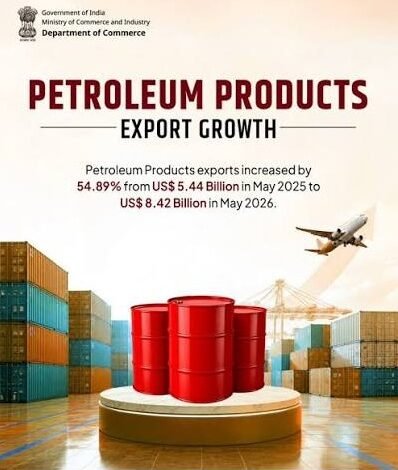
In May 2026 alone, petroleum-product exports rose 54.89% year-on-year, from US$5.44 billion to US$8.42 billion. Engineering goods, electronics, chemicals and gems and jewellery also contributed to export growth. Global supply disruptions have further strengthened India’s position. Geopolitical tensions and disruptions to supplies from the Middle East and Russia have encouraged buyers to source refined fuels from alternative suppliers. Indian refiners have consequently increased exports to markets facing shortages.
A Strategic Advantage — But Also a Vulnerability
The surge demonstrates India’s strength as a refining and energy-trading hub. However, heavy dependence on petroleum products also makes export performance sensitive to international crude prices, refinery margins and geopolitical developments.
Data from Crisil showed that when crude prices corrected sharply in June, India’s petroleum export growth slowed considerably, illustrating how quickly energy-related exports can influence overall merchandise trade performance.
Diversification Remains Crucial
India’s longer-term export strategy will therefore require sustained growth in sectors such as electronics, engineering, pharmaceuticals, chemicals, automobiles and other manufactured goods. Electronics, for instance, recorded strong growth alongside petroleum products in recent months.
The government has also adjusted export levies in response to changing global energy prices. In August, the export levy on petrol was reduced to zero, while duties on diesel and aviation turbine fuel were also revised.
Petroleum products are currently giving India’s export engine a powerful boost. But the bigger challenge will be converting this momentum into a broader, more diversified export structure—one capable of sustaining growth even when global energy markets turn less favourable.