SHILLONG: A HOMETOWN SLOWLY SLIPPING AWAY
By Ms.Bornali Biswas-Editor in Chief

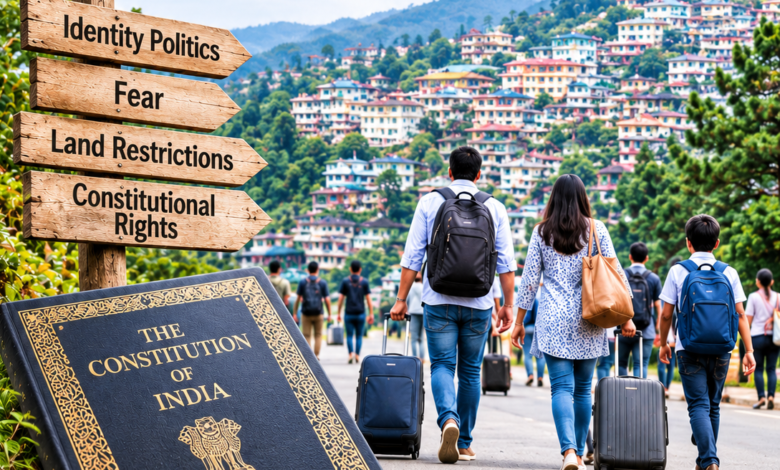
The Silent Exodus of Non-Tribals – Between Identity Politics, Fear, Land Restrictions and the Question of Constitutional Rights
There was a time when Shillong represented much more than a picturesque hill station in Northeast India. It was a city of intellectual vibrancy, cultural diversity and social coexistence, where communities of different linguistic, religious and ethnic backgrounds shared neighbourhoods, educational institutions, businesses and everyday life. For generations of non-tribal families, Shillong was not merely a place of residence; it was home.
Today, however, an uncomfortable question is emerging: Is Shillong gradually losing the multicultural character that once made it one of the most cosmopolitan cities of Northeast India?
Before the advent of British rule in the Khasi-Jaintia Hills, Hima Shulong was regarded as the largest among the Khasi traditional native states, retaining its prominence until the mid-19th century. At its greatest territorial extent, the kingdom stretched from Domoria (Nongsala) in the Brahmaputra Valley in the north to Gowainghat in the Sylhet Valley in the south. Its vast geographical reach reflects the historical influence, political organisation and territorial significance of the traditional Khasi Hima system, which governed the region long before colonial administration transformed the political landscape.The Contribution of Non-Tribals to Shillong’s Historical Legacy
The history of Shillong is deeply intertwined with the contributions of its non-tribal communities. Since the British established Shillong as an administrative headquarters in the 19th century, Bengalis, Assamese, Marwaris, Punjabis, Gurkhas and others have contributed significantly to its urban development, administration, trade and commerce. Many helped establish neighbourhoods, civic infrastructure and commercial networks that transformed Shillong into a thriving hill town.
Non-tribal educators, scholars and missionaries also played an important role in developing its educational institutions, including St. Edmund’s, St. Anthony’s ,St.Mary’s and Lady Keane College, nurturing generations of students. Their contributions extended to journalism, literature, printing, healthcare, social welfare and cultural activities. Shillong’s cosmopolitan character was further enriched by generations of shared social and intellectual engagement.
Historically, many non-tribal residents also supported the aspirations for Meghalaya’s statehood, demonstrating that Shillong’s identity was shaped by cooperation across communities.
Following the Partition of 1947, the migration of displaced Hindu Bengali families further shaped Shillong’s social and economic landscape. These communities established businesses, served in government institutions, contributed to education and healthcare, and became an integral part of the city’s civic life.
Meghalaya became a full-fledged state on January 21, 1972, under the North-Eastern Areas (Reorganisation) Act, 1971. The constitutional recognition of indigenous autonomy and protection of tribal land was an important milestone in the state’s political evolution.
However, the question today is whether the balance between indigenous protection and the rights of other long-settled communities is being maintained.
The Growing Sense of Insecurity
During my recent visit to Shillong, my hometown, I was confronted with a disturbing change in its social landscape.Several neighbourhoods that once had substantial non-tribal populations appear to have undergone considerable demographic changes. Houses that were once occupied by non-tribal families have changed hands or occupants, and many families seem to have relocated elsewhere.
While this observation requires systematic demographic verification, the emotional reality among sections of the non-tribal population deserves attention.People are increasingly expressing concerns about their future, livelihood, property rights, employment opportunities and social security.
The activities of pressure groups, particularly certain inspection and enforcement drives undertaken by the Khasi Students’ Union (KSU), have also generated anxiety among sections of non-tribal residents and business owners.
In July 2024, media reports documented KSU-led inspections of non-tribal employees and business establishments. Separate allegations of assault and intimidation involving labourers and a technician at Jawaharlal Nehru Stadium prompted police investigations and notices to individuals associated with the union.
Recent tensions involving the Khasi Students’ Union (KSU) in Shillong center around an August 2026 black-flag bike rally that turned violent against non tribals , leading to major police investigations, leadership arrests, and ongoing negotiations with the Meghalaya government over a five-point charter of demands
There is a growing concern over the increasing incidents of violence and intimidation against non-tribal communities, while many grievances remain unreported, inadequately addressed or unresolved, with little visible intervention or lasting solutions from the authorities.
No student organisation or pressure group should become an alternative authority exercising policing powers.
Petrol Bomb Attacks and an Atmosphere of Uncertainty
The security situation has added another dimension to the growing anxiety.
Shillong witnessed several petrol-bomb and arson incidents during 2026. In September, attacks were reported against government offices, a police station, a health department establishment and a police outpost. Further suspected petrol-bomb incidents were reported during Durga Puja in October, including attacks near public establishments.
Although investigations are underway and the motives remain to be established, repeated incidents of arson and violence inevitably affect public confidence.A city may continue with its daily markets, educational institutions and festive celebrations, but normal-looking streets do not necessarily reflect the anxieties experienced by every resident.For families already concerned about their long-term security, such incidents deepen uncertainty.
The Economic and Emotional Cost of Displacement
The gradual relocation of non-tribal families to Guwahati, Kolkata, Delhi, Bengaluru and even overseas destinations is a matter that deserves serious public attention.Every departing family represents more than a change of address. It may mean the closure of an established business, the sale or abandonment of ancestral property, disruption of children’s education, separation from neighbourhood relationships and the loss of a generation’s connection with its hometown.
The most troubling question is whether people are leaving because they genuinely wish to relocate or because they increasingly feel that they have no sustainable future in the city.A voluntary migration driven by opportunity is different from displacement caused by fear, intimidation or economic exclusion.The government must investigate this distinction rather than dismissing these concerns as isolated grievances.
Constitutional Rights Cannot Be Overlooked
The Sixth Schedule of the Indian Constitution recognises special administrative arrangements for tribal areas. The Meghalaya Transfer of Land (Regulation) Act, 1971, provides safeguards against unauthorised transfers of tribal land.These protections serve an important purpose and must be respected.However, constitutional protection of indigenous interests cannot become a justification for discrimination, violence or denial of lawful rights.
Article 14 guarantees equality before the law to every person. Article 21 protects life and personal liberty. Article 19(1)(d), (e) and (g) guarantees citizens the rights to move freely, reside and settle anywhere in India, and practise a profession or carry on a lawful occupation, trade or business, subject to constitutionally permitted restrictions.
The Protection of Human Rights Act, 1993, also empowers the National and State Human Rights Commissions to examine human-rights violations and negligence by public authorities in preventing them.
What Must the Government Do?
The Union & Meghalaya Government must urgently consider:
- Independent Human Rights Assessment: Commission an impartial assessment of alleged intimidation, discrimination, threats and the circumstances surrounding the relocation of long-settled families.
- Protection from Intimidation: Ensure that police investigate threats, assaults, extortion and attacks irrespective of the victim’s ethnicity or community.
- Transparent Land Regulation: Review land-transfer procedures to ensure lawful transactions, clear documentation, timely decisions and accessible grievance redressal.
- Regulation of Pressure Groups: Establish clear boundaries between legitimate democratic activism and unlawful enforcement, intimidation or violence.
- Livelihood Protection: Ensure that lawful businesses, employees, professionals and established residents receive equal protection under applicable laws.
- Community Dialogue: Create a permanent dialogue platform involving Khasi traditional institutions, student organisations, non-tribal representatives, business associations and government authorities.
Shillong Must Not Lose Its Soul
The Khasi people have every legitimate right to protect their ancestral land, identity, language, traditions and political autonomy. Equally, generations of non-tribal families who have made Shillong their home deserve dignity, security and a fair opportunity to live and work.This is not a demand to dilute indigenous rights. It is a demand for constitutional balance, democratic accountability and peaceful coexistence.A city cannot be built on fear, just as its identity cannot be preserved through hostility towards its neighbours.
If the present concerns remain unaddressed, Shillong risks losing not merely its non-tribal population but also an important part of its shared historical and cultural legacy.
The question is no longer simply who owns the land or who belongs to which community. The question is whether every lawful Indian citizen, irrespective of ethnicity, can live in Shillong without fear.
For those of us who grew up calling Shillong home, watching the city change in this manner is deeply painful.
Shillong belongs to its indigenous heritage, but its history also belongs to everyone who helped build its shared social and cultural identity. Protecting both is the responsibility of a democratic government.