
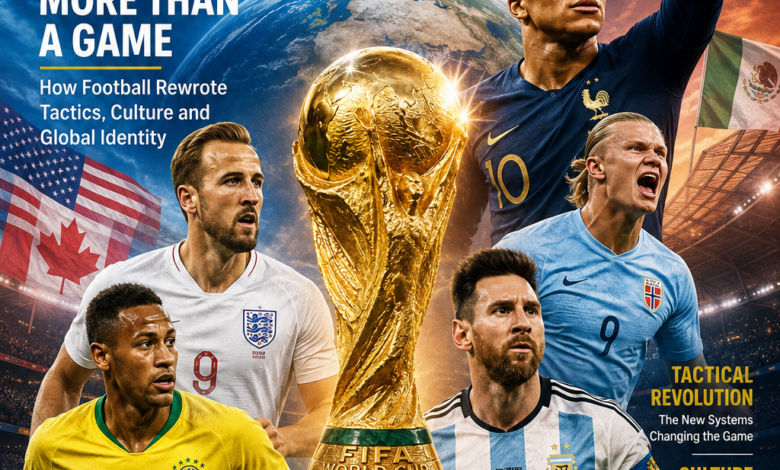
“The FIFA World Cup is no longer just about lifting a trophy—it is where strategy meets identity, technology meets tradition, and rivalries become part of global history.”
News Mania Desk : The FIFA World Cup 2026 will be remembered not merely for its champions but for redefining what the world’s biggest sporting event represents. Hosted jointly by the United States, Canada, and Mexico, the tournament marked the first-ever 48-team World Cup, featuring an unprecedented 104 matches across North America. It was a celebration of football’s tactical evolution and an extraordinary display of cultural unity, proving once again why football remains the world’s universal language.
The New Tactical Revolution
Modern football is evolving at breathtaking speed, and the 2026 World Cup showcased how innovation has become as important as individual brilliance.
One of the tournament’s defining tactical trends was the emergence of the “Bonus Back”—full-backs no longer confined to defensive duties but actively joining attacks inside the penalty box. Teams such as Portugal and Croatia repeatedly created numerical superiority by using overlapping defenders to engineer dangerous 2-on-1 situations on the flanks.
Equally fascinating was the rise of fluid positional football. Traditional formations became increasingly flexible as players constantly exchanged roles based on possession and transitions. Argentina’s dynamic 4-3-3 perfectly illustrated this evolution, with midfielders Rodrigo De Paul and Enzo Fernández shielding the defence while allowing Lionel Messi to operate freely between defensive lines, exploiting the half-spaces that modern tactical analysts consider football’s most valuable territory.
Host nations also embraced sophisticated pressing systems. The United States and Canada frequently occupied central areas during build-up play before releasing attacking full-backs into wide spaces, reflecting principles popularised by Europe’s elite clubs.
Football in 2026 was no longer defined by fixed positions—it became a game of intelligent movement, spatial awareness, and collective decision-making.
Historic Rivalries Rekindled
Every World Cup creates unforgettable contests, but few rivalries carry the emotional weight of Argentina versus England.
Their encounters transcend football, shaped by decades of sporting history dating back to the 1966 World Cup, Diego Maradona’s unforgettable “Hand of God” and “Goal of the Century” in 1986, and continuing competitive tensions in modern football. Every meeting between these two footballing giants becomes more than ninety minutes—it becomes a contest of memory, pride, and national identity.
The 2026 semifinal once again reminded the world that football’s greatest rivalries are built not only on trophies but also on shared history and collective emotion.
A Tournament That United Continents
Perhaps the World Cup’s greatest achievement lay beyond the stadiums.
Despite logistical challenges, long-distance travel, and complex visa arrangements across three host nations, millions of supporters transformed North America into a living festival of cultures.
Cities such as New York, Toronto, Atlanta, Dallas, Los Angeles, Mexico City, and Vancouver became vibrant global meeting points where Brazilian samba blended with Argentine chants, English supporters shared streets with Japanese fans, and African drumbeats echoed alongside European anthems.
Local communities enthusiastically embraced international visitors, while restaurants, public squares, and fan zones became multicultural gathering spaces celebrating diversity rather than division.
For one month, national borders became secondary to the shared passion for football.
Technology Changes the Beautiful Game
Technology played an even greater role than in previous editions.
Enhanced Video Assistant Referee (VAR) systems, semi-automated offside technology, advanced player tracking, AI-assisted tactical analysis, and real-time performance data transformed coaching decisions and match preparation.
Teams increasingly relied on sports science, predictive analytics, and data-driven decision-making to gain marginal advantages—illustrating how football is entering an era where information is as valuable as talent.
Football’s Growing Global Influence
The expanded tournament also reflected FIFA’s ambition to make football more inclusive.
The 48-team format gave emerging football nations unprecedented opportunities to compete on the biggest stage, broadening the sport’s global reach while introducing new tactical styles and football cultures to international audiences.
For many nations, qualification itself became a historic achievement, reinforcing football’s ability to inspire dreams far beyond traditional powerhouses.
More Than a Sporting Event
The FIFA World Cup 2026 demonstrated that football remains one of humanity’s most powerful cultural forces.
It showcased tactical innovation, celebrated diversity, revived historic rivalries, embraced technological advancement, and united millions across languages, religions, and political boundaries.
Long after the final whistle, the tournament’s greatest legacy may not be remembered through statistics or scorelines alone, but through the images of strangers celebrating together, children inspired by their heroes, and cities transformed into symbols of global unity.
In an increasingly divided world, the FIFA World Cup once again proved a timeless truth: football is more than a game—it is a shared human experience capable of bringing the world together.
References
Football analytics studies by Opta Analyst, StatsBomb, and the CIES Football Observatory on positional play, pressing systems, and tactical evolution.
FIFA World Cup 2026 Tournament Regulations and Technical Reports.
FIFA Technical Study Group (TSG) – Tactical Analysis.
International Football Association Board (IFAB) – Laws of the Game and VAR protocols.
FIFA High Performance & Football Technology Reports.
Historical FIFA World Cup archives (1966, 1986, 1998, 2002, 2022).