
In Beijing, a Chinese robot named Tiangong completed the 100 meters in less than nine seconds.
News Mania Desk/ Piyal Chatterjee/ 27th August 2026

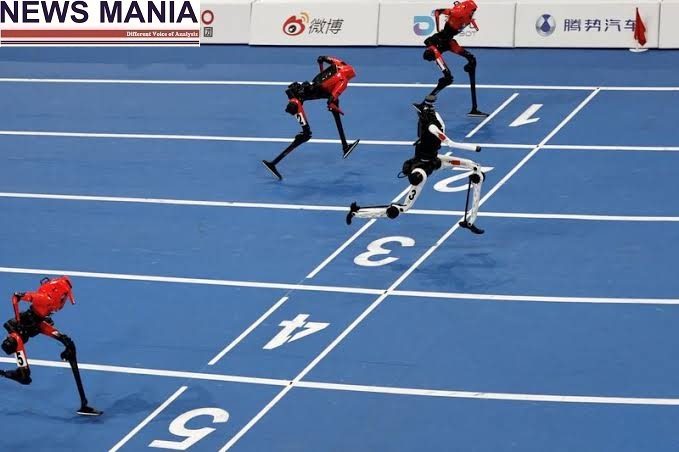
At the World Humanoid Robot Games in Beijing on Tuesday, China’s Tiangong Ultra humanoid robot ran 100 meters in 8.86 seconds, which was faster than its initial time of 9.39 seconds. The pace was about seven tenths of a second quicker than the men’s human world record of 9.58 seconds, which was set in 2009 by the legendary Jamaican sprinting athlete Usain Bolt. The Beijing Humanoid Robot Innovation Center’s Tiangong Ultra set a new record in the large-size robot category semifinal.
At the second Beijing festival, where over 2,000 robots from 666 teams are competing in 51 events, including football, dancing, and industrial-task contests, one of the main draws has been the robots’ quick development.
Months after winning the world’s first humanoid robot half-marathon in Beijing last year with an amateur-level time of 2 hours 40 minutes, Tiangong won the 100 meters at the inaugural games last year with a significantly slower pace of 21.50 seconds.
“Reading that a motor-powered robot can run faster than a human is one thing,” said Li Hui, 26, an engineer with Fudan University’s table-tennis team. “Seeing it rush past you during training is completely different. You realise how impressive it is.”
In order to stop the sprinting machines, Tiangong struck a thick mat that was positioned beyond the finish line to complete its sub-nine-second sprint. The hit caused the robot to collapse, and a tiny fire started in its torso. A robot broke apart in the middle of the race in the other semifinal.
The sub-nine-second sprint came after Tiangong’s victory on Saturday, when it overtook Honor’s Lightning, a smartphone manufacturer, close to the finish after falling behind early. Lightning’s time of 9.47 seconds was likewise less than Bolt’s. In a test run, Honour had earlier achieved a quicker time of 9.32 seconds. Earlier on Tuesday, the Beijing Humanoid Robot Innovation Center said that its Tiangong robots had already surpassed four human world records.
According to Chinese corporate data source Qichacha, the center’s shareholders include state-owned businesses, a number of investment funds, cloud and AI behemoth Baidu, which opens a new tab, and Xiaomi, a manufacturer of smartphones and electric vehicles, which opens a new tab robotics unit.
As businesses and policymakers look to apply advancements in artificial intelligence, motors, and sensors to manufacturing, logistics, and services, China has designated humanoid robots as a critical developing sector.