14-Year-Old Chinese Boy Wins Gold for Low-Cost Device That Helps Young Trees Get Water
News Mania Desk/ Piyal Chatterjee/ 29th September 2026

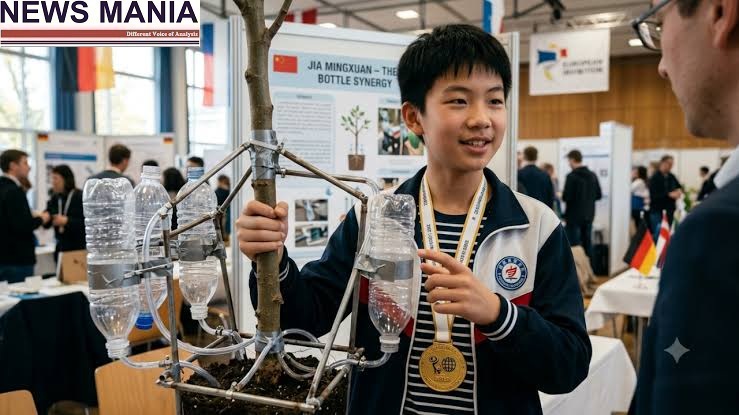
A 14-year-old boy from northern China has won a gold medal at an international invention exhibition in Germany for developing a simple device designed to help young trees survive in dry regions. Jia Mingxuan, from Aohan Banner in Inner Mongolia, built the device using discarded plastic bottles and steel tubes.
Jia developed the invention to address the difficulty of providing enough water to newly planted trees in areas affected by dry conditions. His hometown lies close to the Horqin Sandy Land, where limited water availability can make it difficult for young saplings to establish themselves.
The teenager’s idea was based on the natural process of condensation. He became interested in the concept after observing water droplets forming on the lid of a cooking pot. Connecting the observation with principles he had studied in physics, Jia began exploring whether moisture present in the atmosphere could be collected and used to provide water to young trees.
His early experiments did not produce the desired results. Jia continued modifying the design and eventually developed his fifth prototype, which was able to collect atmospheric moisture. The device uses plastic bottles and steel tubes to capture condensed water and direct it towards the roots of young trees.
The invention was subsequently presented at the 77th Nuremberg International Invention Exhibition in Germany. The event brought together more than 540 inventions from different participants. Jia’s device received the gold medal in the youth group, drawing attention to the potential of a relatively inexpensive solution to a practical environmental challenge.
The use of discarded plastic bottles is also intended to keep the device affordable and accessible. Rather than relying on complicated equipment, Jia’s design uses easily available materials and a basic understanding of condensation and water collection.
The invention has attracted interest because of its potential application in areas where water shortages pose challenges for tree-planting and ecological restoration projects. Further testing and improvements may be needed to determine how effectively the device can operate under different environmental conditions and whether it can be adapted for larger-scale use.