When Human Greed Leaves No Space for Wildlife
Diksha Varma – Banglore/ 3rd October 2026

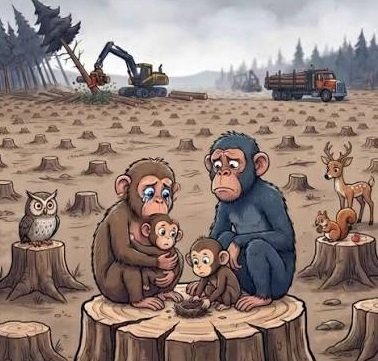
Animals are adapting to our cities—but adaptation should not become an excuse for destruction
Animals are not visitors to our planet; they are its fellow inhabitants. From forests and oceans to grasslands and wetlands, every species contributes to the delicate balance that sustains life. Yet, in the race for economic growth, infrastructure and urban expansion, human beings are steadily taking away the spaces that animals need to survive.
Forests are cleared for buildings, roads and industries. Wetlands disappear beneath concrete. Highways divide habitats that once allowed animals to move freely. Power lines, traffic, artificial lights and constant noise further transform the natural environment. For wildlife, the modern city can become a maze of danger.
The consequences extend far beyond the animals themselves. Birds depend on healthy habitats for nesting and feeding. Bees and other insects pollinate plants and crops. Predators help regulate populations of other species. Elephants, deer and countless other animals help disperse seeds and maintain ecosystems. When one species disappears or its population declines, the effects can spread throughout the ecological chain.
Yet wildlife continues to demonstrate extraordinary adaptability. Crows have learned to use traffic to crack nuts. Squirrels and other animals use power lines as pathways, while urban mammals can alter their movements and activity patterns to avoid humans. Buildings and other structures sometimes become unexpected shelters.
But there is an important distinction between adaptation and survival under pressure. The ability of an animal to adjust does not mean that its habitat can be destroyed without consequences. An animal learning to cross a road does not make the road harmless. A bird nesting on a building does not mean that disappearing forests no longer matter.
The real question is not whether wildlife can adapt to our world, but how much of the natural world we are willing to sacrifice before adaptation becomes impossible.
Development is necessary, but development without responsibility becomes destruction. Urban planning must include wildlife corridors, protected green spaces, wetlands, tree cover and safer crossings. Artificial lighting and unnecessary noise should be controlled in ecologically sensitive areas. Construction projects should consider habitats before, rather than after, damage occurs.
Human civilisation should not be measured only by the height of its buildings or the speed of its technology. It should also be measured by whether a bird can still find a tree, an elephant can still follow an ancient route and a wild animal can still find a place where humans have left it alone.
We do not inherit the Earth from our ancestors merely to consume it. We share it with generations—and species—that come after us.