Japan’s MMX Mission to Explore Mars’ Moons Set for Launch Aboard H3 Rocket
News Mania Desk/ Piyal Chatterjee/ 18th October 2026

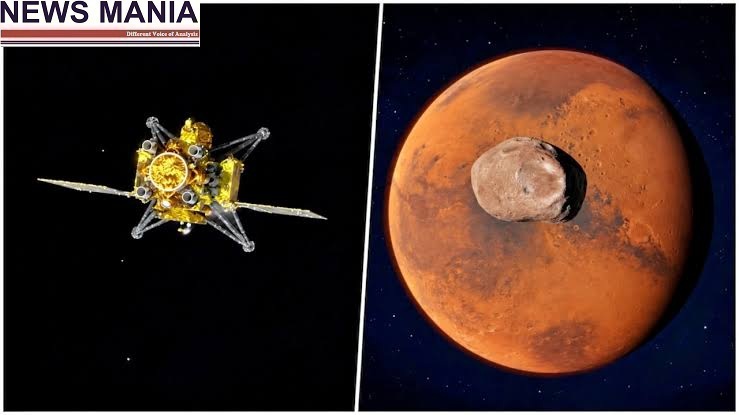
Japan is preparing to launch its Martian Moons eXploration (MMX) mission, an ambitious space project aimed at investigating Mars’ two natural satellites, Phobos and Deimos. The mission, developed by the Japan Aerospace Exploration Agency (JAXA), is scheduled to lift off aboard the H3 rocket on October 20, 2026, marking another important step in international planetary exploration.
The MMX mission aims to examine the origin, composition and evolution of Mars’ moons. Scientists have long debated whether Phobos and Deimos are asteroids captured by Mars’ gravitational pull or formed from debris produced by a massive collision involving the planet. Detailed observations and the collection of samples could help researchers resolve this longstanding scientific question.
One of the mission’s most significant objectives is to collect material from Phobos and return it to Earth for laboratory analysis. The spacecraft is expected to reach the Martian system, study both moons and gather samples before beginning its return journey. The samples are planned to arrive on Earth in 2031, potentially providing scientists with unprecedented insights into the history of the Martian system.
The mission will also investigate the surface characteristics, geological composition and surrounding environment of Phobos and Deimos. These observations could improve understanding of how the moons evolved and provide clues about the early history of Mars and the Solar System.
The launch will also draw attention to Japan’s H3 rocket programme, developed by JAXA in partnership with Mitsubishi Heavy Industries. The rocket is designed to provide a reliable and cost-effective launch vehicle for scientific and commercial missions. However, the programme has faced technical challenges, making the MMX launch an important milestone for Japan’s space ambitions. NASA and other international partners are contributing to the mission, highlighting cooperation in planetary science.