
Government Approves E100 Fuel Rules, Clearing Path for Vehicles Running on Nearly Pure Ethanol
News Mania Desk/ Piyal Chatterjee/ 27th October 2026

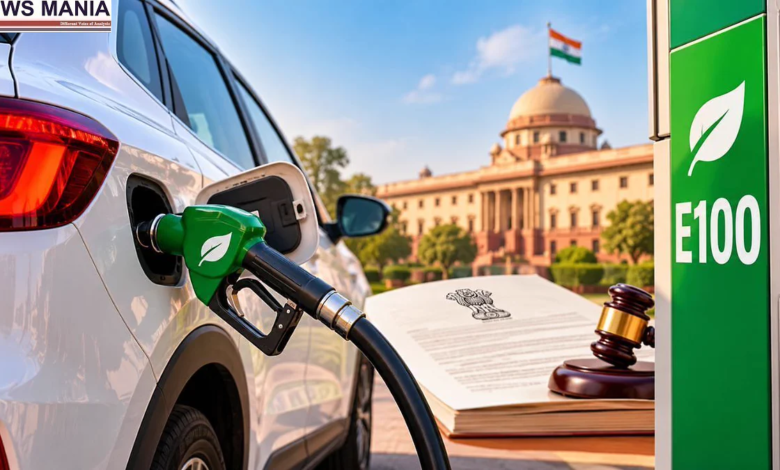
The government has amended the Central Motor Vehicles Rules, 1989, to formally include E100 fuel, opening the way for vehicles specifically designed to run on nearly pure ethanol. The move is intended to reduce vehicle emissions, lower India’s dependence on imported crude oil and encourage the development of flex-fuel vehicles.
The Ministry of Road Transport and Highways (MoRTH) announced the changes on October 23. The amendments extend existing regulatory provisions for E85 fuel to include E100, covering fuel specifications, vehicle testing requirements and emission standards. The revised framework will allow manufacturers to develop and introduce vehicles capable of operating on higher ethanol blends.
E85 contains up to 85% ethanol, while E100 is almost entirely ethanol. Both fuels are intended for vehicles specifically engineered and approved to use them. Ordinary petrol-powered vehicles cannot automatically switch to E85 or E100 under the amended rules.
A senior road transport ministry official said fuels containing more than 20% and up to 100% ethanol would be intended for vehicles designed to operate on those blends. Flex-fuel vehicles are engineered to run on varying proportions of ethanol and petrol, giving manufacturers greater scope to use alternative fuels.
The amendments modify several provisions of the existing rules to incorporate E100 into the regulatory framework. They also expand references to E85 in relevant clauses and increase the applicable gross vehicle weight limit from 3,000 kg to 3,500 kg.
The draft amendments were released in April for a 30-day public consultation, allowing stakeholders to submit objections and suggestions before the final notification.
Automakers have begun developing vehicles compatible with higher ethanol blends as the government pushes alternative fuels. In June 2026, Maruti Suzuki introduced the Wagon R Flex Fuel, described as India’s first flex-fuel passenger vehicle, with compatibility ranging from E20 to E100. Toyota, Tata Motors and Hyundai are also working on flex-fuel technologies.
The policy forms part of India’s broader effort to reduce its reliance on imported crude oil, which contributes to pressure on the country’s current account balance. The government has already implemented E20 petrol, containing 20% ethanol, and achieved its ethanol-blending target ahead of the original 2030 deadline.
India’s ethanol production capacity has reached nearly 2,000 crore litres, while annual tenders for E20 compliance have exceeded 11 billion litres. The inclusion of E100 in vehicle regulations provides a formal basis for manufacturers to expand the use of higher ethanol blends, although wider adoption will depend on the availability of compatible vehicles and supporting infrastructure.