PM Modi In Manila For Quad Summit, Emphasis On Defence Relations
News Mania Desk/ Piyal Chatterjee/ 17th November 2026

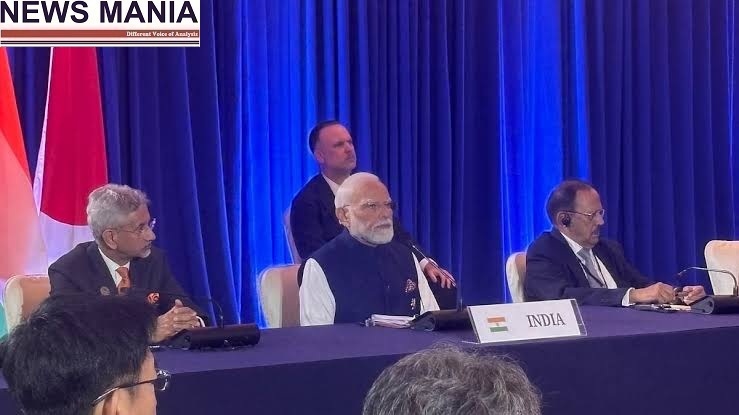
Prime Minister Narendra Modi arrived in Manila on Monday to participate in the ASEAN-India and East Asia summits, emphasizing maritime security, economic collaboration, and India’s increasing strategic engagement with Southeast Asia during his visit. The journey will unite the leaders of the four Quad nations for their first summit in over two years, amidst renewed diplomatic interactions between Washington and Beijing.
On Tuesday, PM Modi will participate in the seventh Quad Leaders’ Summit alongside US President Donald Trump, Australian Prime Minister Anthony Albanese, and Japanese Prime Minister Sanae Takaichi. The gathering will probably center on essential minerals, robust supply chains, awareness of maritime domains, and the protection of commercial shipping lanes throughout the Indo-Pacific.
The event is occurring only days prior to Trump’s trip to China for the Asia-Pacific Economic Cooperation (APEC) summit, where he will meet with Chinese President Xi Jinping. The series of interactions has added new importance to the Manila gathering, particularly as the four nations aim to maintain cooperation on regional security and economic issues while Washington prepares for top-level talks with Beijing.
US Secretary of State Marco Rubio mentioned before the conference that the Quad is not aimed at any specific nation, including China. The announcement arrives amidst ongoing uncertainties regarding the group’s strategic direction and how its members will manage balancing collaboration in the Indo-Pacific with their individual diplomatic and economic relations with Beijing.
The Quad consists of India, the United States, Japan, and Australia. The four countries collaborated to deliver humanitarian assistance following the 2004 Indian Ocean tsunami. They initially encountered each other at an official capacity in May 2007 during the ASEAN Regional Forum in Manila.
The Quad was elevated to the level of leaders in 2021, and its inaugural summit was held virtually on March 12 of that year. Since that time, its aim has expanded from conventional security collaboration to include essential technologies, infrastructure, supply-chain resilience, health security, and disaster management.
The most recent Quad Leaders’ Summit took place in Wilmington, Delaware, on September 21, 2024. The upcoming edition was planned for India in 2025; nonetheless, the summit did not occur. The Manila summit thus provides the four leaders a chance to assess the group’s progress and reaffirm its objectives.
This will be PM Modi’s seventh Quad Leaders’ Summit, establishing him as the sole leader to have participated in every iteration since the format began in 2021. The Quad has gradually evolved from a forum for strategic discussions to initiatives that deliver concrete advantages to nations throughout the Indo-Pacific. It has organized its agenda into four main priorities: maritime and transnational security; economic security and prosperity; critical and emerging technologies; and disaster response and humanitarian assistance.
Maritime safety remains a crucial element. Efforts such as the Indo-Pacific Partnership for Maritime Domain Awareness (IPMDA) aim to enhance the ability of regional countries to oversee maritime operations, identify unusual activities, and boost understanding of incidents in their adjacent waters.
The Quad is examining increased cooperation on essential minerals, which have gained strategic significance as governments seek to diversify sources of materials crucial for electronics, electric vehicles, batteries, and the defense sector. Additional initiatives aimed at enhancing economic resilience and connectivity are the Quad Critical Minerals Initiative and the Ports of the Future Partnership.
In his departure statement, PM Modi said ASEAN is “at the heart of India’s Act East Policy,” and it is also central to India’s MAHASAGAR (Mutual and Holistic Advancement for Security and Growth Across Regions) vision. “With a foundation of centuries of civilisational exchanges, our relationship has blossomed into a dynamic partnership that encompasses trade, connectivity, maritime security, technology and people-to-people relations,” he said.