The Supreme Court extends the deadline by one week and cautions Bengal against establishing SIR obstacles.
News Mania Desk /Piyal Chatterjee/ 9th February 2026
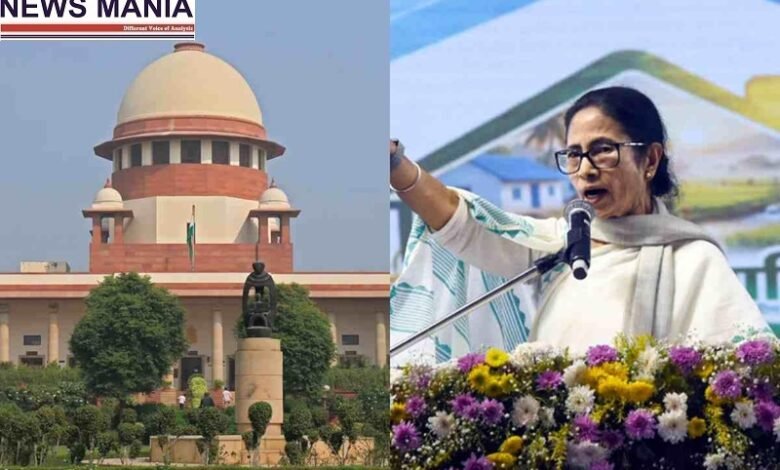
While promising to resolve any real issues with the process, the Supreme Court on Monday warned the West Bengal administration against putting up any “impediments” to the completion of the Special Intensive Revision (SIR) of the electoral records process. Additionally, the court extended by one week the deadline for finalizing data and finishing the scrutiny or applications in Bengal SIR.
Mamata Banerjee, the chief minister of West Bengal, had asked the Supreme Court to alter the SIR procedure by stopping the issuance of official directives over WhatsApp. In addition to requesting that all instructions be legally given and posted on the ECI website, it has also called for the dismissal of micro observers and suggested 8,505 Group B officers in their place.
Chief Justice of India Surya Kant made the court’s position clear, stating, “We will remove hurdles, but we will not create any impediments in the completion of SIR. Let us be very clear about it”.
The bench, which also included Justices NV Anjaria and Joymalya Bagchi, emphasized that the modification process must go forward according to the plan. Speaking on behalf of the poll body, senior counsel DS Naidu expressed grave concerns regarding the selection of Electoral Registration Officers (EROs).He maintained that because EROs carry out quasi-judicial duties, they need to have sufficient adjudicatory experience.
Naidu argued that although the ECI had requested over 300 Group B officers, only 64 of them had this kind of experience; the rest appointments were selected based on wage parity.Under the SIR, adjudicatory decisions are subject to appeal to appellate bodies, and he said that personnel like engineers were not prepared to handle them.
The function of microobservers was also examined. Senior counsel Shyam Divan cautioned against mass exclusion and contended that micro observers could not be used to remove voter identities on a wide scale.
Divan emphasized the need for urgency, pointing out that the final electoral roll will be published on February 14th, the day the SIR process is set to end.According to him, there are 7.08 crore voters on the draft electoral roster, of whom 6.75 crore have been mapped, about 32 lakh are still unmapped, and 1.36 crore have been classified as “logical discrepancies.”
He added that minor name variants like “Dutta” and “Datta” or “Roy” and “Ray” account for more than half of the disparities.
In response to these worries, the CJI stated that micro observers were a component of a system of support for EROs and Assistant EROs, but that the EROs had the last say. He added that the court would examine the outcome of the verification exercise. “We will see after the verification how many of these notices are dropped. If 80% of the cases are dropped, then your argument will be the same — that minor discrepancies are incorrect,” the CJI remarked.
Speaking on behalf of the West Bengal administration, senior counsel Abhishek Manu Singhvi criticized the deputation of micro observers from outside the state, claiming that many of them were unfamiliar with the local environment and customs.
He argued that thousands of Group B officers and more than 80,000 Booth Level Officers had already been sent by the state to help with the exercise.The CJI pointed out that full data and appropriate nomenclature were necessary for official deployment and coordination with district authorities, and the court also saw procedural errors in the officers’ deputation. The Chief Justice pointed out that the court’s approach was consistent because similar orders had previously been given in a case involving Bihar. The top court announced that it would continue to hear the issue, striking a balance between the necessity to complete the SIR on time and protections against arbitrary voter exclusion. The issue stems from petitions that contest West Bengal’s SIR process. Chief Minister Mamata Banerjee had personally attended a previous court to present her case.
The Supreme Court emphasized the urgency of the procedure and the necessity of ensuring fairness and legality in the modification of electoral rolls when it announced that it would continue considering the case.