What is the uproar over the Transgender Act ? Explained
News Mania Desk /Piyal Chatterjee/ 25th March 2026

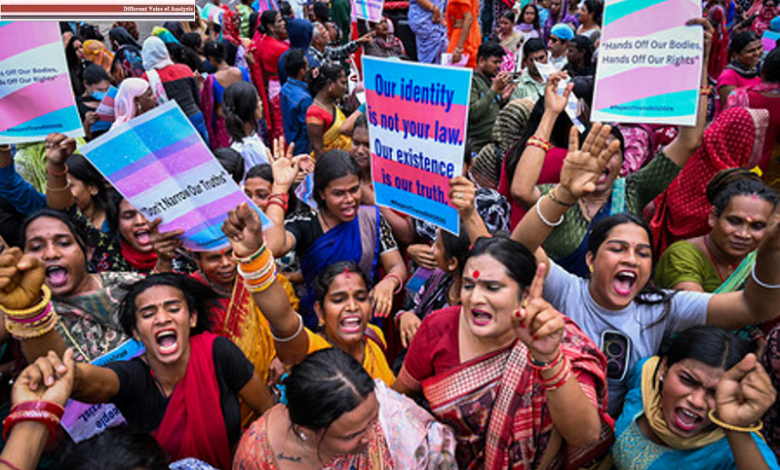
Transgender rights activists have issued a dire warning as Parliament gets ready to consider the proposed amendments to the Transgender Persons (Protection of Rights) Act. They contend that the changes could undermine self-identification and restrict the legal definition of transgender persons, thereby eliminating significant portions of the community.
The reforms, which are slated for review and approval in Parliament on Monday, were protested by the activists and members of parliament from a number of opposition parties at a public gathering on Sunday.
The planned change to require “medical proof” of gender identity, which essentially undermines the concept of self-identification, is at the center of the criticism. This, according to activists, is a change from the 2019 law, which recognized a wide range of identities and described a transgender person as someone whose gender does not match the one assigned at birth. The goal of the revisions is to eliminate this broad definition and replace it with a narrow set of categories that will exclude a large number of people who were previously covered.
Although the Supreme Court’s 2014 NALSA (National Legal Services Authority) ruling made a clear distinction between gender identity and sexual orientation, activists claim that the Bill’s statement that it “shall not include or shall never have included” people with diverse sexual orientations and self-perceived sexual identities confuses the two.
The modifications, according to lawyer and activist Raghavi, who is a trans woman herself, disregard the fact that not all trans people have the resources to have surgery to conform to their stated gender.
The proposed change would only classify people as “trans persons” if they are “born intersex” or had been “forced or induced” to undergo hormonal therapy, castration, or mutilation. But many transgender people are left out.
“It’s not easy to get the surgery. If you remove self-identification, then how does one get included? I myself am a transwoman but getting the surgery requires a huge amount of money and support that most people do not have,” says Raghavi.
Another issue, according to the activist, is bureaucratic recognition. Raghavi also questioned how individuals would prove “socio-cultural identity” if recognition is limited to communities such as kinners, hijras or eunuchs.
“Do they expect everyone to join a Gharana and accept a Guru? Would this mean that any Guru can sign the certificate ?” asks Raghavi, who says that many such groups don’t accept people easily.
“Many transpersons face abuse at home because of how they feel about the gender assigned at birth. Many run away as teenagers or young adults due to social and family pressure to conform to that assigned gender. If the definition is restricted to those born with physical or genetic variations, what will happen to all these people?” Raghavi asked.
Furthermore, activists contend that since kinnar and hijra societies have historically included trans women but not those who identify as men but were assigned female at birth, such a definition effectively excludes trans men from recognition. They also wonder what happens to trans women who are excluded from these communities or who do not want to join them. This change appears to “buy into the myth that trans persons force children to undergo castration,” according to activists.
“It assumes that children or adults are forced into presenting themselves as trans through coercion or ‘undue influence’. This framing suggests that transgender identity is something imposed or artificially created, and shifts the legal narrative towards suspicion and control rather than recognising gender identity as based on self-identification,” says a public statement released last week by activists.
The statement further warned that “these changes strengthen negative stereotypes by linking transgender identity with crime and coercion”.
Even though there is no solid proof or documented pattern of such behavior in India, the proposed reforms criminalize transgender people and their relatives or allies for “alluring” or “forcing” people to become transgender by imposing harsh prison sentences of up to five years. Activists claim that the Bill’s ambiguous and expansive phrasing will result in abuse and violence, unfairly harming an already marginalized minority and inhibiting open expression of identity.
Additionally, activists claimed that little public input preceded the introduction of the revisions. They pointed out that whereas community stakeholders were involved in the 2019 Act, the National Board for Transgender Persons was not consulted in the current process. According to reports, at least four Board members are against the Bill.
Activists warn that provisions like Section 18 could criminalize support for transgender individuals due to vague definitions of “force” and “inducement.” They argue this could lead to misuse by authorities against families or individuals assisting transgender persons. The provision allows jail terms for compelling anyone to act against their will, potentially misused by police and families claiming coercion.
Activists highlighted the uncertainty faced by those with legal recognition under current laws and called for a pause in the legislative process for broader consultations, emphasizing the need to uphold self-identification and dignity principles affirmed by the Supreme Court.
- Concerns Over Amendments: Activists warn that proposed changes to the Transgender Persons (Protection of Rights) Act could undermine self-identification and narrow the legal definition of transgender persons, potentially excluding many from legal recognition.
- Medical Proof Requirement: The proposed amendment to require “medical proof” of gender identity is criticized for weakening the concept of self-identification and restricting a broad, inclusive definition established in the 2019 law.
- Exclusion Risks: The amendments might exclude many transgender individuals who cannot afford or choose not to undergo medical procedures, and may also limit recognition to specific communities, further marginalizing others.
- Call for Broader Consultation: Activists highlight a lack of public input and consultation with the National Board for Transgender Persons, urging a pause in the legislative process to ensure that the rights and dignity of transgender individuals are upheld.