Bengal’s Political Earthquake: BJP’s Historic Sweep Redefines State Politics (2026 Analysis)
Ms.Bornali Biswas-Editor in Chief / 4th May 2026

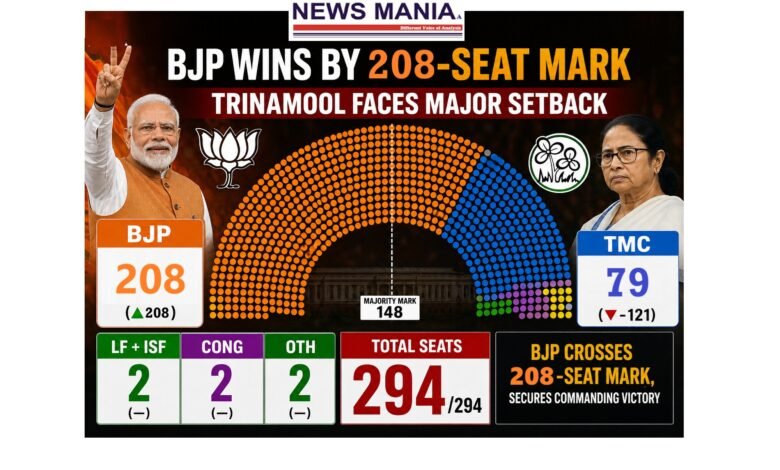
The West Bengal Assembly Election 2026 has delivered one of the most dramatic political transformations in recent Indian history. With the Bharatiya Janata Party (BJP) winning around 208 seats, far above the majority mark of 148, the party has not only formed the government for the first time in the state but also dismantled over a decade of Trinamool Congress (TMC) dominance.
The final tally—BJP 208, TMC 79, Congress 2, Left+ISF 2, Others 2—signals a decisive and structural shift in Bengal’s electoral landscape.
Collapse of TMC’s Fortress
For nearly 15 years, West Bengal was politically synonymous with Mamata Banerjee’s TMC. However, the 2026 verdict marks a sharp reversal from TMC’s 2021 landslide (215 seats) to a reduced tally of under 80 seats. Several factors contributed to this collapse:
- Anti-incumbency fatigue after three consecutive terms
- Allegations of governance issues and corruption narratives
- Weakening grassroots control in rural and semi-urban regions
The symbolic defeat of key leaders, including high-profile constituency battles, reinforced the perception of a declining TMC stronghold.
BJP’s Strategic Rise: From Challenger to Dominant Force
The BJP’s rise in Bengal has been gradual but systematic. From 77 seats in 2021 to over 200+ in 2026, the party executed a long-term strategy combining organization, messaging, and leadership.
Key Drivers of BJP’s Victory:
- Booth-level micro-management (e.g., “Panna Pramukh” model)
- A strong “Aspirational Bengal” narrative targeting youth and first-time voters
- Consolidation of Hindu vote banks and polarization strategies
- The “Modi factor”, with high-intensity campaigning and national leadership appeal
Additionally, the BJP effectively expanded beyond its traditional urban pockets into rural Bengal, which proved decisive.
Role of Leadership and Political Realignments
Leadership played a pivotal role in shaping the outcome:
- Suvendu Adhikari, a former TMC heavyweight, emerged as a central architect of BJP’s victory, symbolizing internal erosion within TMC.
- The contest between Adhikari and Banerjee became emblematic of a larger political transition in the state.
Such defections and realignments significantly weakened TMC’s organizational cohesion while strengthening BJP’s local credibility.
Electoral Dynamics and Controversies
The election was not without controversy:
- Reports of EVM complaints and repolling in certain constituencies
- The Special Intensive Revision (SIR) of voter rolls, which became a major political flashpoint
Critics alleged voter exclusion, while authorities maintained the process was lawful. Regardless, these issues influenced the political narrative during counting and post-result debates.
Fragmentation of Opposition
The Congress and Left alliance (Left+ISF) failed to make any meaningful impact, collectively securing just 4 seats.
This reflects:
- Lack of a unified opposition strategy
- Voter polarization into a direct BJP vs TMC contest
- Continued decline of traditional Left politics in Bengal
Economic and Governance Expectations
The BJP’s victory has generated high expectations among industry and business communities, with hopes of:
- Increased investment
- Job creation
- Infrastructure push
At the national level, this win strengthens BJP’s footprint, giving it governance control in a majority of Indian states, thereby enhancing policy leverage.
Broader Political Implications
This result is not just a state-level shift—it carries national ramifications:
- Strengthens BJP ahead of future general elections
- Weakens the broader opposition bloc (INDIA alliance)
- Demonstrates BJP’s ability to penetrate regional strongholds historically resistant to it
The 2026 West Bengal election is a watershed moment in Indian politics. The BJP’s sweeping victory represents more than a change in government—it signals a deep restructuring of voter alignments, political narratives, and power dynamics in eastern India.
For the TMC, the challenge ahead is existential: rebuilding organizational strength and reconnecting with voters. For the BJP, the real test begins now—translating electoral success into governance delivery in a politically complex and culturally distinct state like West Bengal.