West Bengal 2026: The Earthquake Election — How a 15-Year Political Order Collapsed and a New Era Began
Ms.Bornali Biswas-Editor in Chief / 10th May 2026

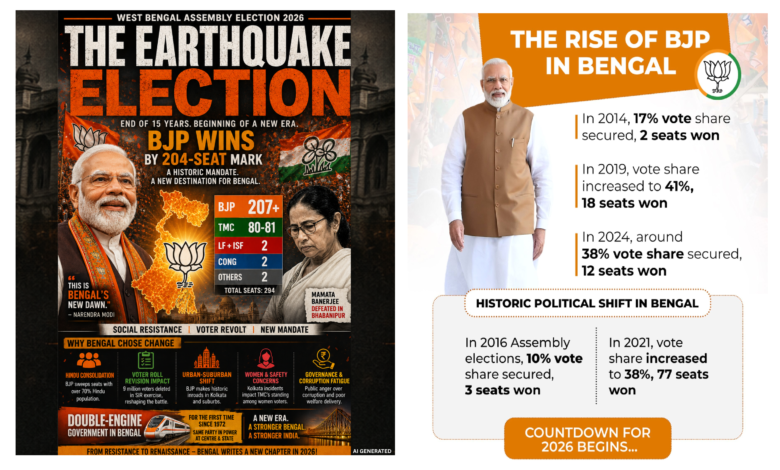
The 2026 West Bengal Assembly election, according to emerging projections and post-count political analysis, is being described as one of the most consequential electoral realignments in modern Indian state politics. In what commentators are calling a “seismic democratic shift,” the Bharatiya Janata Party (BJP) appears to have secured a commanding majority with approximately 207 seats in the 294-member Assembly, while the Trinamool Congress (TMC), which has governed the state for 15 years, has been reduced to around 80 seats.
If these results are viewed as the final mandate, West Bengal is witnessing not just a change of government, but a structural transformation of its political identity.
A Mandate of Unprecedented Scale
At the heart of this election lies a dramatic redistribution of power.
The BJP’s projected rise from 77 seats in 2021 to over 200 seats in 2026 represents one of the steepest electoral ascents in Indian state politics. Its vote share, estimated to have climbed to approximately 45.84%, reflects a consolidation that cuts across rural, semi-urban, and increasingly urban constituencies.In contrast, the TMC’s decline to the 80-seat range signals a collapse of its earlier dominance, where it once commanded a supermajority of 215 seats. The shift is not incremental—it is structural. The symbolism is further intensified by reports that Chief Minister Mamata Banerjee have lost her own constituency, Bhabanipur, marking what would be one of the most significant symbolic defeats in contemporary Indian politics.
The Geography of Change: From Rural Strongholds to Urban Breakthroughs
One of the most striking features of this electoral outcome is its geographical spread.
Historically, the BJP’s influence in West Bengal was concentrated in pockets of North Bengal and select semi-urban regions. However, the 2026 projection suggests a far more comprehensive penetration:
- North Bengal: Near-total consolidation, continuing earlier trends
- Rural South Bengal: Significant gains driven by local leadership shifts
- Kolkata & Suburbs: A breakthrough moment, with urban wards showing a noticeable tilt
This urban shift is particularly significant. Kolkata, long considered a TMC stronghold, appears to have experienced a reversal of political sentiment, suggesting changing priorities among middle-class and first-time voters.
The Social Realignment Factor
Analysts interpreting this shift point to what they describe as a “deep social realignment” rather than a purely electoral swing.
One of the most widely discussed factors is the consolidation of Hindu votes in several constituencies, particularly those with a Hindu population exceeding 70%. In many such regions, BJP’s performance is reported to have been overwhelming, leading to clean sweeps in multiple assembly segments.
However, political observers caution against reducing the outcome to a single-axis explanation. The shift appears to be the result of multiple overlapping forces:
- Fragmentation of traditional vote banks
- Changing youth aspirations and employment concerns
- Perception shifts around governance and welfare delivery
- Intensified digital and booth-level campaigning
The election, in this reading, becomes less about identity alone and more about the convergence of identity, governance expectations, and political messaging.
The Governance Question: Welfare, Trust, and Fatigue
Perhaps the most persistent undercurrent in this election is what analysts describe as “governance fatigue.”
After more than a decade of TMC rule, sections of the electorate appear to have developed concerns around:
- Allegations of corruption at local administrative levels
- Uneven implementation of welfare schemes
- Bureaucratic inefficiencies in public service delivery
- Perceived disconnect between state leadership and urban voters
While the TMC retained strong pockets of support in rural welfare-driven constituencies, the erosion among urban and semi-urban voters appears to have been decisive.
The BJP campaign, in contrast, is understood to have focused heavily on governance narratives, development promises, and administrative accountability.
The Role of Controversy and Public Sentiment
Another critical dimension shaping the electoral mood is the impact of social issues and public safety concerns.
In the months leading up to the election, several high-profile incidents involving law and order in urban centers reportedly intensified public debate around safety, particularly among women voters in metropolitan and semi-urban constituencies.
While political parties interpreted these events differently, the cumulative effect appears to have influenced perceptions of administrative control and responsiveness.
Additionally, grassroots mobilizations led by emerging local figures—often outside traditional party structures—contributed to a broader narrative of “social resistance,” particularly in constituencies where anti-incumbency sentiment was already strong.
The Collapse of a Political Fortress
The scale of TMC’s projected decline is what makes this election historically significant.
A drop from 215 seats to nearly 80 represents not just a defeat but a systemic unraveling of a once-dominant political machine.
For over a decade, the TMC had maintained a reputation for electoral resilience, even in the face of national-level opposition surges. That perception has now been fundamentally altered. Political analysts describe this moment as the “end of invincibility”—a phrase that captures both the psychological and organizational shock within the party ecosystem.
Internal fragmentation, candidate-level dissatisfaction, and weakening booth-level coordination are all being cited as contributing factors.
The National Implication: A New Eastern Power Axis
Beyond West Bengal, the implications of this shift are significant for national politics.
If the BJP consolidates governance in West Bengal, it effectively strengthens its presence across Eastern India, complementing its influence in neighboring states. This creates a contiguous political belt that alters electoral arithmetic for future general elections.
Key implications include:
- Stronger federal alignment between state and central governance structures
- Enhanced administrative coordination on infrastructure and industrial projects
- Increased political leverage for national policy implementation in the eastern corridor
- Strategic momentum heading into the 2029 general elections
For the BJP, West Bengal represents not just a state victory but a symbolic completion of its expansion into regions long considered resistant to its influence.
The End of an Era, the Beginning of Another
West Bengal has historically been a state of ideological cycles—from decades of Left Front dominance to the rise of the TMC as a mass regional force. The 2026 projection suggests the beginning of yet another cycle, one defined by consolidation under a national party with a strong organizational footprint.
But beneath the numbers lie a more complex story: a shifting electorate, evolving aspirations, and a redefinition of political identity.
The electorate is no longer static. It is younger, more digitally connected, and increasingly responsive to narratives that combine development with identity and governance.
A Mandate That Redefines the State
Whether viewed as a political earthquake or a gradual culmination of underlying trends, the 2026 West Bengal election stands as a defining moment.
A projected 207-seat victory for the BJP, paired with the dramatic reduction of the TMC to a marginal opposition role, signals more than a transfer of power—it signals a reordering of political expectations in one of India’s most politically conscious states.West Bengal, once defined by entrenched ideological loyalties, now appears to be entering a phase of fluid political identity.
And in that fluidity lies both uncertainty and transformation.