Earth-Like in Colour, Extreme in Reality: Scientists Investigate Planet with Glass Rain and Supersonic Winds
News Mania Desk/ Piyal Chatterjee/ 5th June 2026

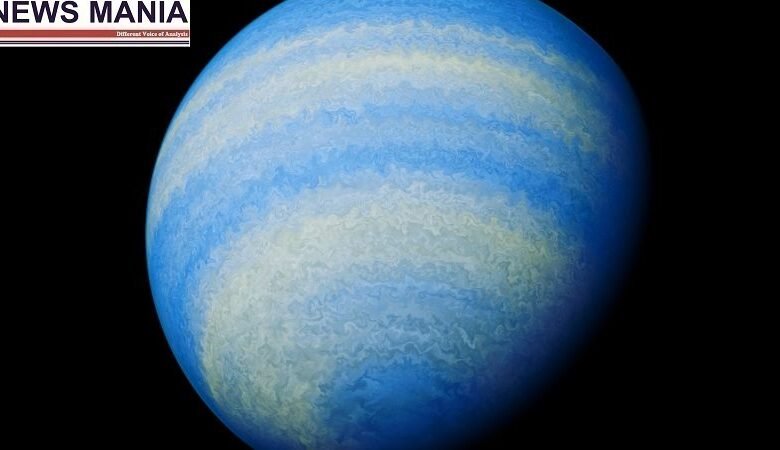
Astronomers continue to be fascinated by a distant exoplanet that appears strikingly similar to Earth in colour but possesses some of the most hostile weather conditions ever discovered. Located approximately 63 light-years away, the planet HD 189733b is known for its deep blue appearance, yet scientists say it is far from being a habitable world.
The giant gas planet, often classified as a “hot Jupiter,” orbits its parent star at an extremely close distance. As a result, it completes one orbit in just over two Earth days and is subjected to intense heat. Researchers estimate that temperatures on the planet’s day side soar beyond 1,000 degrees Celsius, making it one of the hottest known worlds outside the Solar System.
One of the planet’s most remarkable features is its violent weather system. Scientists have found that winds racing through the atmosphere can reach speeds of nearly 7,000 kilometres per hour. These powerful winds are driven by the dramatic temperature differences between the permanently sunlit side and the darker side of the planet.
Adding to the planet’s extreme conditions is the presence of silicate particles in its atmosphere. Similar to the materials that form sand and glass on Earth, these particles are exposed to such high temperatures that they melt and condense into droplets. Carried by the planet’s fierce winds, the molten glass falls sideways rather than vertically, creating a bizarre phenomenon often described as “glass rain.”
The planet’s vivid blue colour, first observed through space-based telescopes, is not caused by oceans as on Earth. Instead, scientists believe the hue results from the scattering of blue light by silicate particles suspended in the atmosphere.
Researchers regard HD 189733b as one of the most extensively studied exoplanets. Its unusual characteristics are helping scientists better understand the diversity of planetary systems and the extreme environments that can exist beyond our Solar System.