TMC at a crossroads: end of political era for misuse , fragmentation, corruption and internal crisis
Ms.Bornali Biswas-Editor in Chief / 10th June 2026

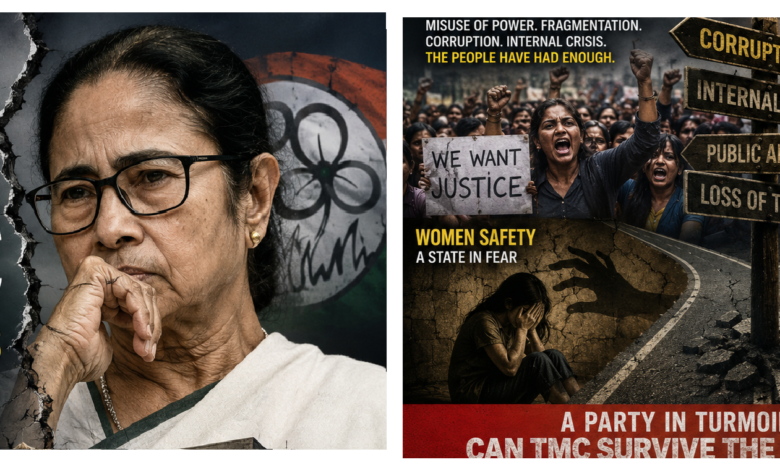
What followed, however, was not merely a transition of power—but what analysts describe as a deep structural collapse within the state’s political architecture.
A Government Under Pressure
Reports and post-election analysis suggest that the decline of the previous administration was not sudden but the result of cumulative pressures. Allegations of systemic corruption, widely referred to in public discourse as tolabaji and “cut money” culture, had long shadowed the administration. These claims pointed to informal networks where commissions were allegedly demanded for public services and infrastructure contracts.
Central agency raids and periodic recovery of unaccounted cash,government beongings like blanket,lungi,saree,mosquito nets which were meant for the relieve and undervillege linked to political operatives further intensified public distrust. While these allegations remain politically contested, they contributed significantly to a perception crisis that the ruling establishment struggled to reverse.
Governance and Public Discontent
Beyond corruption allegations, governance challenges played a critical role in shaping voter sentiment. One of the most emotionally charged issues was the widespread public outrage surrounding the RG Kar Medical College incident, which triggered debates on women’s safety, institutional accountability, and administrative responsiveness where Mamata banerjee was found backing for the accused.
Incidents such as the The Sandeshkhali case refers to a major 2024 political controversy in West Bengal surrounding systemic land-grabbing and sexual assault allegations against local Trinamool Congress (TMC) leaders further deepened concerns over local law and order. Critics argue that such episodes created an environment where public confidence in administrative neutrality began to erode, particularly among rural and semi-urban voters.
Economic Strain and Structural Challenges
Economically, the state narrative reflects concerns over declining industrial momentum and limited large-scale private investment. Critics of the former government argue that West Bengal’s economy became overly dependent on subsidies and welfare-driven expenditure, rather than capital formation and industrial expansion.
Unemployment among youth and migration to other states in search of stable jobs became recurring themes in political debates. Fiscal discussions also pointed to rising public debt, estimated in political discourse to have crossed ₹4.5 lakh crore, raising concerns about long-term financial sustainability.
Electoral Shift and Opposition Surge
The BJP’s electoral strategy is described as a combination of anti-incumbency mobilisation and targeted campaigning around governance and corruption issues. The party’s consolidation of opposition votes reportedly played a decisive role in shifting the electoral balance after more than a decade of Trinamool dominance.
Political fatigue among voters after 15 years of continuous rule also contributed to what analysts call a “natural cycle of anti-incumbency sentiment,” which ultimately reshaped the electoral map.
TMC Faces Deepening Internal Rift as Rebel MLAs Clash Over Mamata Banerjee’s Role
The Trinamool Congress is witnessing intensified internal fragmentation following reports that nearly 60 MLAs have distanced themselves from the central leadership, forming a rebel bloc after the party’s electoral defeat to the BJP. The group, reportedly led by Ritabrata Banerjee, has gained prominence and received recognition within legislative proceedings, triggering speculation of a formal split in the party’s legislature wing.
Tensions escalated after a proposal suggesting party founder Mamata Banerjee be designated as “chief adviser” to the reorganised bloc, which was strongly opposed by several rebel MLAs. Leaders such as Gulshan Mullick and Sangeeta Roy Basunia insisted she remains the supreme leader and warned of reconsidering their position if her authority is diluted.
The rebellion is also shaped by internal disagreements over the influence of Abhishek Banerjee, highlighting a widening rift between senior and emerging leadership factions. The developments underline deep political instability and competing leadership claims within the fractured TMC.

Post-Election anger and Violence Sparks by the public
Political tensions have escalated in West Bengal following reported attacks on Trinamool Congress leaders after the 2026 Assembly elections. On May 30, TMC National General Secretary Abhishek Banerjee was allegedly confronted by a hostile mob in Sonarpur, South 24 Parganas, where stones, shoes, and eggs were hurled at his convoy during a visit to post-poll violence-affected families.
A day later, senior leader Kalyan Banerjee was reportedly injured in Chanditala, Hooghly, after being struck during a protest march. Reports indicate that since the power shift in early May 2026, several local and ward-level leaders of the TMC have reportedly faced public anger and localized physical confrontations across various villages
Allegations, Protests, and Political Turmoil
The post-election period has also been marked by allegations of expulsions, internal disciplinary actions, and claims of a “signature scandal” involving legislative appointments. While these remain politically sensitive and contested claims, they have added to the atmosphere of instability.
Investigative Findings and Controversies
Allegations regarding illegal immigration, document fraud, and the exploitation of West Bengal’s welfare schemes have fueled while appeasing muslims over Hindu welfare were the major concern
Welfare Scheme Audits: The West Bengal government ordered a Special Investigation Team (SIT) probe into the Lakshmir Bhandar cash-transfer scheme, investigating allegations of up to 30 lakh fake or illegal accounts. A separate money laundering investigation is also underway.
Document Exploitation: Reports and viral testimonies emerged following the administrative transition, with several detained individuals claiming that local grassroots networks had previously assisted them in illegally securing Aadhaar cards, voter IDs, and ration cards in exchange for electoral support
Administrative Loopholes: Critics highlighted significant systemic gaps after irregularities were uncovered—such as funds from the women-only Lakshmir Bhandar scheme reportedly being diverted or registered to male individuals
A State in Transition
West Bengal today stands at a critical juncture. Whether viewed as a democratic correction, a political collapse, or a transitional restructuring, the scale of change is undeniable within the narrative presented by current political discourse.
As the dust settles, the central question remains: is this the end of a political era—or the beginning of a more fragmented and organized phase in West Bengal’s democratic journey?
For now, the state remains suspended between history and uncertainty, as old structures dissolve and new power equations trying reform the mistakes and work for the welfare of the state.