


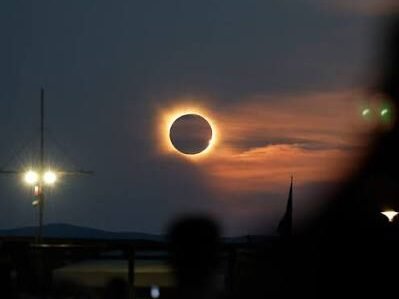
Daylight turned to moonlight earlier than usual in Spain on Wednesday as the country witnessed its first total solar eclipse in more than a century, plunging it into eerie darkness in one of nature’s greatest spectacles.
The spectral glow of the Sun’s outer corona, shimmering out of the edges of the shadowy Moon, drew gasps and cheers from huge crowds, just 90 minutes after it first appeared in the remote Arctic region of northern Russia. “It’s a sight I never would have imagined seeing,” said Isabel Troyano, a 56-year-old homemaker, watching with her son in Tarragona, on Spain’s Mediterranean coast. “I got goosebumps.”
The eclipse, which was the first to occur in continental Europe since 2006, raced south to suffocate Keflavik, which is around 50 kilometres from Reykjavik, the capital of Iceland, before arcing across the Atlantic Ocean to northern Spain. Total solar eclipses haven’t occurred in Reykjavik since 1433, and the next one isn’t expected until 2196.
The moon shadow in Spain travelled diagonally over a short route from the country’s northern coast to the Mediterranean Balearic Islands, where inhabitants and visitors congregated to observe from the beach. Many of them were wearing bathing costumes and safety glasses. A partial eclipse was visible over Europe, Canada, the northern United States, and northwest Africa, therefore supplies of special viewing glasses were in high demand.
Visitors were able to witness the scene, which attracted throngs in London, Paris, and throughout the continent, as dense clouds dispersed minutes beforehand on the summit of the Pic du Midi in the French Pyrenees. Eclipses have evoked awe, terror, and veneration throughout human history because they seem to abruptly halt the natural order.
The recent partial eclipse lasted approximately one hour and 45 minutes, providing scientists with a unique opportunity to study the Sun’s atmosphere. Livestreamed by NASA and the European Space Agency, the event was witnessed by tens of thousands in northwest Iceland, where clear skies enhanced visibility. Tourists and locals, despite concerns about rain, enjoyed the experience, with many expressing emotional reactions.
In Spain, the eclipse generated significant economic interest, with predictions of 450,000 extra tourists and a $400 million boost. Authorities deployed nearly 25,000 police officers to maintain order, emphasizing the narrow path of totality across the peninsula. Future eclipses are scheduled for August 2027 and an annular eclipse in 2028.