

Astronomers have frequently come upon a problem since the James Webb Space Telescope (JWST) started looking deep into the early universe: small, bright red objects that do not neatly fall into well-known classifications of stars, galaxies, or black holes. Now, one extremely extreme “little red dot” might reveal the true nature of some of them.
According to a study published in Nature, the particle, known as MoM-BH*-1, was created approximately 660 million years after the Big Bang. It is around the size of the solar system, looks almost totally red, and generates significantly more energy thru nuclear fusion than a typical star could.
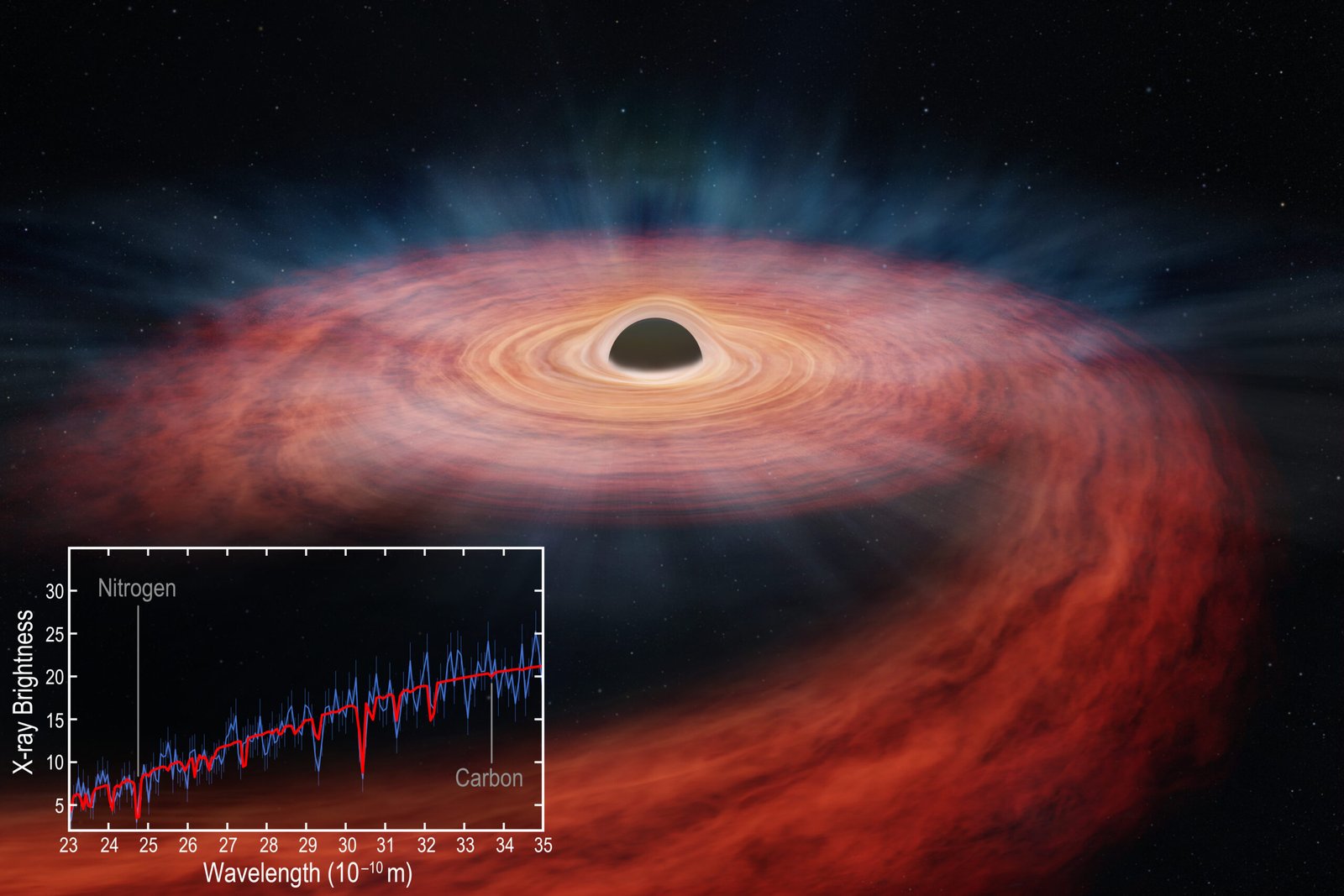
The most plausible scenario, according to researchers, is a fast expanding black hole hidden behind a very dense gas cocoon. Put otherwise, the red dot and the hypothetical “black hole star” are two different perspectives on the same item. The “black hole star” is what scientists believe might be concealed inside MoM-BH*-1, the red point seen by the JWST.
The massive energy comes from the black hole, and the light departing the system is absorbed and reshaped by the surrounding hydrogen gas, giving it certain properties often associated with a star. It is not a typical star, despite the name.
The several other “little red dots” the JWST has discovered in the early universe may be explained by that scenario. Determining the nature of these small red sources has proven difficult for astronomers. If MoM-BH*-1 is indicative, then at least some of them may be juvenile black holes trapped during an early phase of rapid expansion and concealed behind dense gas.
The puzzle of how supermassive black holes emerged so quickly after the Big Bang may also be addressed by this hypothesis. When the universe was only hundreds of millions of years old, astronomers discovered massive black holes, giving them very little time to originate and expand.
Rohan Naidu of the Massachusetts Institute of Technology, who led the study, suspects black hole stars could be an early stage in the evolution of today’s supermassive black holes, including the one at the center of the Milky Way.
“For decades we have anticipated something spectacular must be afoot in the very early universe. Black hole stars may be the ‘something spectacular.’ They may be the nascent, swaddled phase that marks the beginning of almost every supermassive black hole’s journey,” Naidu said.