
Shillong on Edge: KSU’s Five-Point Fight Turns Into a Law-and-Order Crisis
Ms.Bornali Biswas ,Editor in Chief/ 27th August 2026

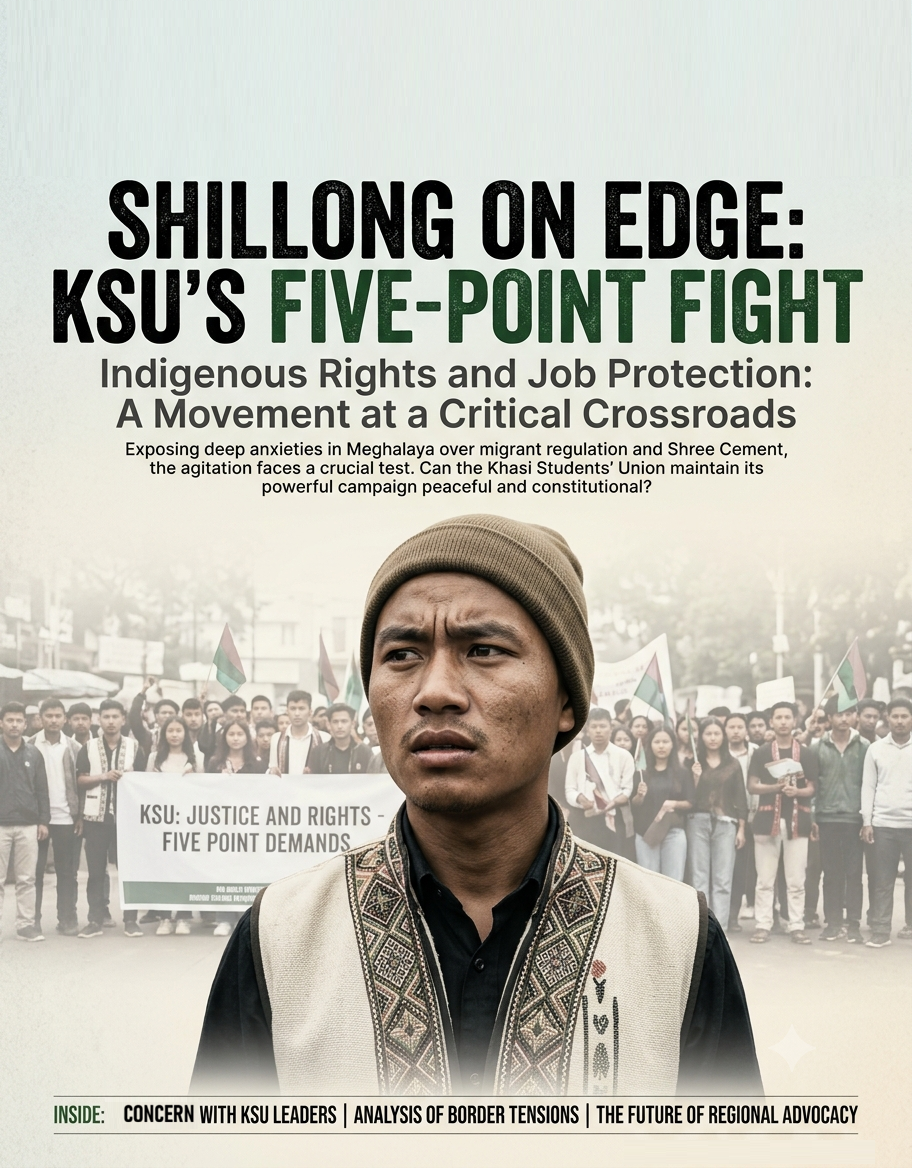
From indigenous rights and job protection to migrant regulation and the Shree Cement hearing, the Khasi Students’ Union’s latest agitation has exposed deep anxieties in Meghalaya. But after violence, arrests and border tensions, the movement now faces a crucial test: can a powerful regional voice keep its campaign peaceful and constitutional?
For Meghalaya, the latest confrontation between the Khasi Students’ Union (KSU) and the state government is no longer merely another student agitation. What began as a 15-day ultimatum over a five-point charter of demands has escalated into violence on Shillong’s streets, arrests of senior KSU leaders, restrictions on further demonstrations and tensions spilling towards the Assam–Meghalaya border.
The KSU had submitted its demands to Chief Minister Conrad K. Sangma on August 4, giving the government 15 days to respond. With the deadline passing without the union seeing adequate action, the organisation intensified its campaign through public meetings on August 17 and 18, followed by a black-flag motorcycle rally on August 19.
The five-point fault line
At the heart of the agitation is the July 31 environmental public hearing for Shree Cement’s proposed limestone mining project in East Jaintia Hills. The KSU has demanded that the hearing be cancelled and the proceedings declared invalid, alleging that the process was stage-managed and that opponents were prevented from participating. It has also sought action against senior district administration, police and Meghalaya State Pollution Control Board officials. These allegations are claims made by the union and remain a matter of dispute.
The second major demand concerns the Meghalaya Residents Safety and Security Act (MRSSA), 2016. The KSU wants the law fully operationalised, along with facilitation centres at entry and exit points. It has specifically demanded functioning centres at 18 entry points in the Khasi and Jaintia Hills and regards MRSSA as an immediate protective mechanism while continuing to press for an Inner Line Permit (ILP) system.
The third issue is regulation of migrant workers. The union is demanding implementation of the amended Meghalaya Identification, Registration (Safety and Security) of Migrant Workers Act, including stronger verification and registration mechanisms. The demand reflects a longstanding KSU position that uncontrolled migration can put pressure on local employment, land and demographic security.
Employment and recruitment form the fourth major battleground. The KSU has demanded reforms in recruitment through the Meghalaya Public Service Commission and District Selection Committees and the removal of personal interviews for Group B, C and D posts. It argues that recruitment must become more transparent and resistant to corruption and favouritism.
The fifth area focuses on recruitment at NEIGRIHMS, particularly nursing appointments. The union has sought implementation of earlier assurances on indigenous reservation and recruitment reforms, including concerns surrounding the reported 80:20 female-to-male ratio and examination arrangements.
A rally that changed the narrative
The August 19 black-flag bike rally was intended to demonstrate the strength of the agitation. Instead, it became the turning point.
Police and officials reported attacks on vehicles, damage to public property and the burning of at least two government vehicles. Statues of Swami Vivekananda and Netaji Subhas Chandra Bose were also allegedly vandalised. Meghalaya Police later said that 15 FIRs had been registered, with reports indicating 16 people injured, two vehicles burnt and 31 vehicles damaged.
The KSU has maintained that unidentified or “negative” elements infiltrated the rally and attempted to divert the movement from its stated objectives. The union has therefore sought to distance its five-point political demands from the acts of vandalism and violence. But the authorities have responded firmly.
Leaders arrested, public meetings restricted
Three senior KSU leaders—President Raymond Kharjana, General Secretary Reuben Najiar and Vice-President Pynkmenlang Sanmiet—were arrested in connection with the violence and subsequently sent to 14 days’ judicial custody. Police cited alleged involvement in assaults, attacks on vehicles, arson, damage to public property and creating fear during the rally.
The Meghalaya government has also decided to invoke the Meghalaya Maintenance of Public Order Act (MMPO) to recover damages to public and private property. The East Khasi Hills administration has revoked permission for a subsequent KSU agitation, while authorities have stressed that further demonstrations will have to comply with lawful conditions
At the same time, the administration has said that the situation does not presently warrant an internet shutdown or curfew. Five companies of central forces have been approved/deployed in Meghalaya to reinforce security following the unrest.
The Assam connection
The repercussions have extended beyond Shillong. Several Assam-registered vehicles were reportedly damaged, triggering tension at the Assam–Meghalaya border. Transport workers in Assam restricted movement of Meghalaya-bound vehicles at Jorabat, while concerns grew over disruption of the busy Guwahati–Shillong corridor.
Assam Chief Minister Himanta Biswa Sarma and Meghalaya Chief Minister Conrad K. Sangma have spoken about maintaining peace and preventing the situation from escalating into a wider inter-state confrontation.
The larger question
The KSU’s demands touch sensitive questions that have shaped Meghalaya politics for decades: protection of indigenous communities, regulation of migration, access to government employment, recruitment transparency, control over natural resources and the long-standing demand for an ILP mechanism.
The Meghalaya government itself has acknowledged concerns surrounding residency and migration. In February 2026, Chief Minister Conrad Sangma told the Assembly that the government would revisit and amend the 2016 MRSSA to address concerns over illegal immigration while ensuring that any revised law withstands judicial and constitutional scrutiny. That makes the current confrontation particularly significant. The issues raised by the KSU cannot simply be dismissed as student politics. At the same time, legitimate grievances cannot justify attacks on civilians, public property or national symbols.
Shillong now faces a difficult balancing act. The government must address substantive concerns over recruitment, migrant-worker regulation, indigenous safeguards and environmental procedures without compromising constitutional rights and due process. The KSU, meanwhile, faces an equally important responsibility—to demonstrate that its influence can translate into disciplined democratic mobilisation rather than street violence.
The future of this agitation may ultimately depend on whether both sides can move from confrontation to structured dialogue.
For Meghalaya, the stakes are bigger than one rally. They concern the delicate balance between indigenous identity, development, constitutional governance and public order—a balance that the state can ill afford to lose.