
When Charity Becomes Show Business: Are We Helping the Poor or Selling an Image?
Ms.Bornali Biswas ,Editor in Chief/ 4th September 2026

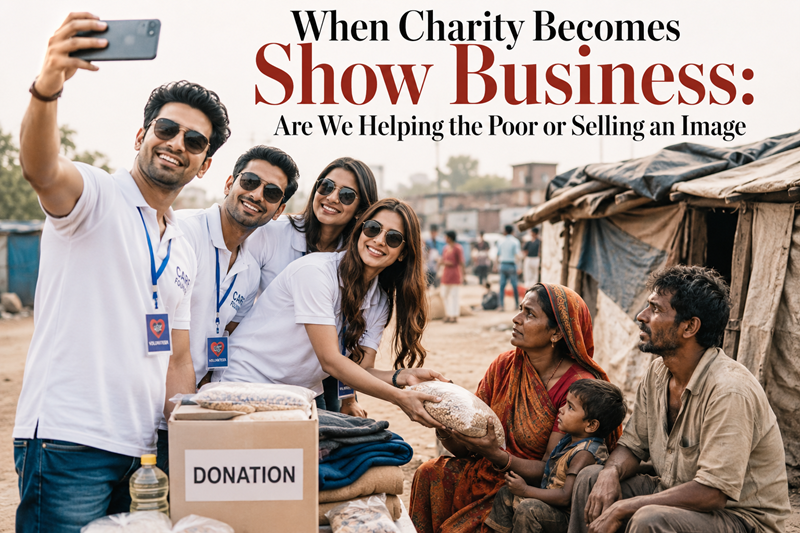
Charity is increasingly becoming a spectacle. What should be a quiet act of compassion is often turned into a public relations exercise—with banners, cameras, social-media posts and carefully staged photographs of donors handing over food packets, clothes, school kits or cheques. The event lasts a few hours; the publicity may last for weeks. But for the person receiving the aid, the underlying struggle often remains unchanged.
The uncomfortable question is: are we trying to end poverty, or merely making poverty more presentable?
There is nothing wrong with corporate houses, celebrities or organisations contributing to society. Corporate Social Responsibility (CSR) has an important role in addressing social challenges. The problem begins when CSR targets become more important than social impact, and when the number of beneficiaries, photographs and publicity coverage become the measure of success rather than the number of lives genuinely transformed.
A blanket distribution of food, clothes, school bags or blankets may provide immediate relief, but it rarely changes a person’s circumstances permanently. A hungry family needs food today—but it also needs an opportunity to earn tomorrow. A child needs a school uniform—but more importantly, education, skills and a pathway to employment.
One day of charity cannot change the fate of an underprivileged community. What can change lives is sustained intervention that creates independence.
Instead of simply distributing resources, why not create livelihood programmes? Why not train unemployed youth in trades, provide women with market-linked skills, establish small production units, support micro-enterprises, or connect trained beneficiaries directly with employers? A sewing machine accompanied by training, raw materials and market access can be more transformative than distributing clothes once a year. A vocational course linked to an actual job can be more valuable than a ceremonial scholarship.
The real measure of charity should therefore not be how many photographs were taken, how many beneficiaries stood in a queue, or how much money was spent, but how many people became capable of standing on their own feet.
Charity should provide a bridge from dependence to dignity.
Corporates also need to rethink the meaning of CSR. Spending money merely to complete an annual target should never become the objective. CSR investment should be measured through long-term outcomes—jobs created, businesses established, children educated, skills developed and families lifted towards financial independence.
Society does not need more charity events that disappear after the cameras leave. It needs commitment that remains after the banners come down.
Let charity be the first step, not the final destination. Let us move from giving people something to live on to giving them something to live for—and the means to earn it themselves.