Governing National Party Takes Early Lead in Closely Contested Vote In New Zealand Election
News Mania Desk/ Piyal Chatterjee/ 7th November 2026

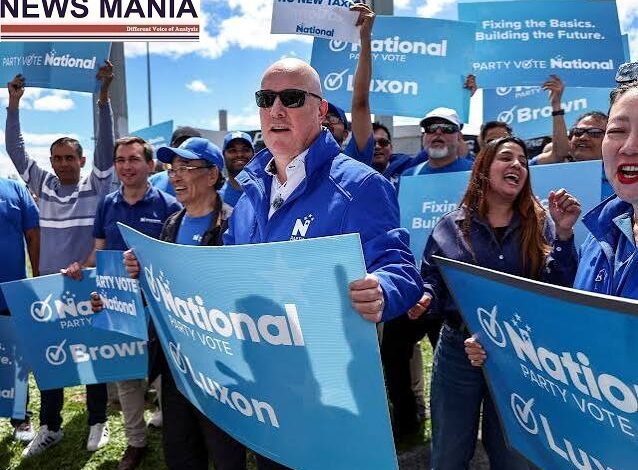
New Zealand’s governing National Party has taken a narrow lead in the country’s closely contested general election, according to early results released on Saturday, November 7. The outcome points to a tight electoral battle between Prime Minister Christopher Luxon and the opposition Labour Party led by former prime minister Chris Hipkins, with the final composition of Parliament likely to depend on smaller political parties.
The National Party secured 30.81% of the votes counted, narrowly ahead of Labour, which received 29.99%, according to preliminary figures. The small difference between the two major parties highlights the uncertainty surrounding the election and raises questions about which political bloc will be able to secure enough parliamentary support to form the next government.
The election has attracted considerable attention because neither of the leading parties appears certain to win an outright majority. Under New Zealand’s mixed-member proportional representation (MMP) system, smaller parties can play a decisive role in determining the country’s next government. Parties must secure at least 5% of the party vote or win an electorate seat to enter Parliament through the proportional representation system.
Among the smaller political groups, the centrist Opportunity Party emerged as an important factor after crossing the required electoral threshold. Its performance could influence coalition negotiations and potentially shape the balance of power in the new Parliament. Other parties, including the Greens, ACT and New Zealand First, are also expected to play significant roles in government formation.
Luxon is seeking another term as prime minister after leading a coalition government comprising the National Party, ACT and New Zealand First. His administration has faced political pressure over economic conditions, public spending and its approach to domestic policy. The election therefore represents an important test of public support for the governing coalition. Meanwhile, Labour leader Chris Hipkins is attempting to bring his party back to power after its defeat in the 2023 general election. Labour’s campaign focused on economic challenges and concerns affecting households, while seeking to capitalise on dissatisfaction with the incumbent government.
The cost of living, inflation, employment, housing affordability and healthcare remained among the major issues during the election campaign. Economic recovery and the government’s handling of public services also featured prominently in debates between political parties. With the National Party and Labour separated by less than one percentage point in the early count, the final results could significantly alter the political landscape. Further counting, including special votes, is expected to provide a clearer picture of the distribution of parliamentary seats. Coalition negotiations could ultimately determine whether Luxon retains the prime minister’s office or Hipkins leads a new government.