National Bureau
NEW DELHI, Oct 2: The government on Thursday launched an integrated scheme with an outlay of ₹23,731 crore to accelerate development of India’s compressed biogas (CBG) sector, targeting nearly a ten-fold increase in domestic production to around 5 million standard cubic metres per day (MMSCMD) by 2035-36.
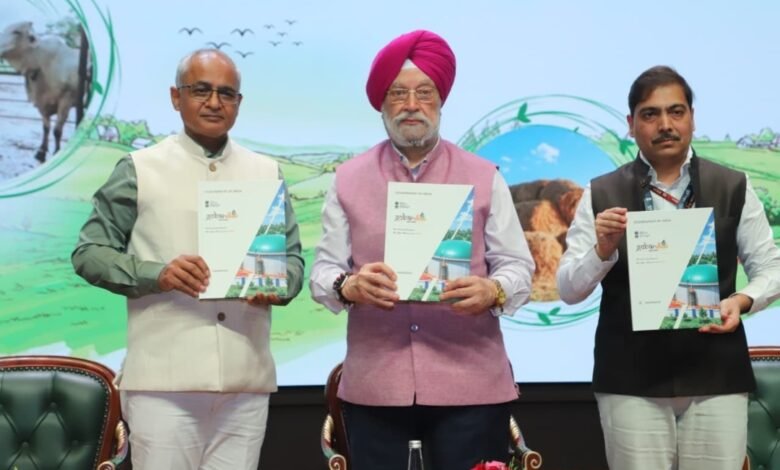
Launched by Petroleum and Natural Gas Minister Hardeep Singh Puri, the Central Sector Scheme for development of CBG provides a 10-year framework from 2026-27 to 2035-36 and brings assured offtake, stable pricing, capital assistance, pipeline connectivity and credit support under a unified framework, the Petroleum Ministry said.
“India’s growing energy requirements must be addressed through availability, affordability and sustainability, with greater development of energy resources available within the country,” Puri said, stressing the potential of CBG to convert crop residue, cattle dung and other organic waste into clean domestic energy.
Puri said CBG can also generate organic manure and create new economic opportunities in rural areas, with farmers, cooperatives, gaushalas and local enterprises participating in feedstock collection, transportation and processing.
Petroleum Secretary Dr Neeraj Mittal said India currently meets nearly half of its natural gas requirement through imports and CBG offers an opportunity to convert domestic organic waste into a domestic gas resource.
He said the sector had faced volatile revenues, fragmented support, limited long-term policy visibility, feedstock constraints, uncertainty over manure offtake and limited access to finance. GOBARdhan addresses these challenges through a single nodal ministry, predictable pricing, assured gas offtake and enhanced capital assistance, he added.
The scheme provides an administered CBG price of ₹2,110 per MMBtu and capital assistance of up to ₹2 crore per tonne per day of installed capacity for eligible greenfield projects.
The government will also support up to 80 per cent of eligible capital expenditure for pipelines connecting CBG clusters to trunk networks and up to 50 per cent for standalone plants connecting to CGD networks.
As of August 2026, India had 217-plus commissioned CBG plants with installed capacity exceeding 1,700 tonnes per day, the ministry said. The scheme is expected to save over ₹40,000 crore in foreign exchange, add more than ₹75,000 crore to GDP and generate over 1.5 lakh jobs.