China Plans 1,000-Scientist AI Initiative to Challenge OpenAI and Anthropic in Mathematics
News Mania Desk/ Piyal Chatterjee/ 14th October 2026

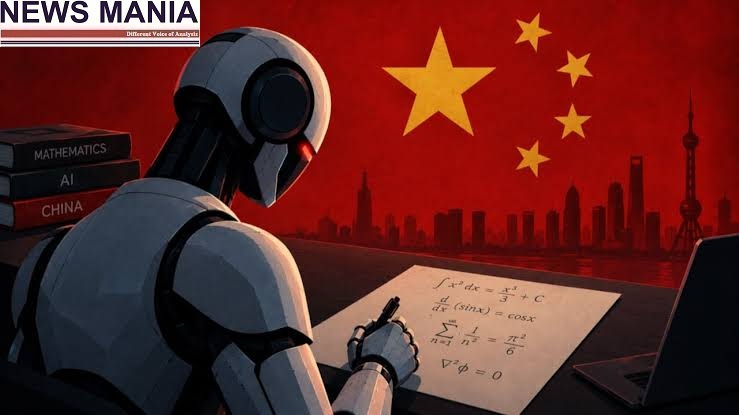
China is building a major research alliance involving more than 1,000 scientists to advance artificial intelligence in mathematics and compete with leading American AI companies, including OpenAI and Anthropic. The initiative aims to strengthen China’s position in AI-driven scientific research by combining mathematical expertise with advanced computing technologies.
The project, known as the Yau Laboratory Alliance for Mathematics and Artificial Intelligence, is led by Shing-Tung Yau, a prominent mathematician and Fields Medal recipient. The alliance brings together eight leading institutions and seeks to establish a collaborative research network focused on developing AI systems capable of tackling complex mathematical problems.
The initiative will concentrate on integrating artificial intelligence into mathematical research, including generating new mathematical conjectures, formalising mathematical proofs and developing models capable of advanced logical reasoning. Researchers also intend to improve the interpretability of AI-generated solutions so that mathematicians can examine how systems arrive at their conclusions.
The move comes amid intensifying AI competition between China and the United States. American companies such as OpenAI and Anthropic have invested heavily in developing AI models with stronger reasoning capabilities, including systems designed to solve difficult problems in mathematics, science and programming.
China’s new research alliance reflects a broader effort to expand the country’s capabilities in foundational AI research rather than focusing exclusively on commercial applications. By bringing together specialists from mathematics and computer science, the project aims to accelerate the development of tools that could support scientific discoveries.
The initiative also follows growing international interest in AI-generated mathematical research. Recent advances have demonstrated that AI systems can assist researchers in exploring difficult problems and producing potential solutions. However, such results require rigorous verification to establish their correctness and significance.
Questions remain about how AI-generated discoveries should be evaluated, verified and credited. Mathematicians have stressed the importance of transparent reasoning and independently checking proofs before accepting computer-generated results as established knowledge.
China’s planned alliance represents a significant investment in the intersection of mathematics and artificial intelligence. Its success will depend on whether researchers can develop systems that consistently produce reliable, verifiable mathematical results and contribute meaningfully to scientific progress.