The judge in the Meerut Blue Drum Murder case cites the Gita when imposing the death penalty.
News Mania Desk/ Piyal Chatterjee/ 13th October 2026

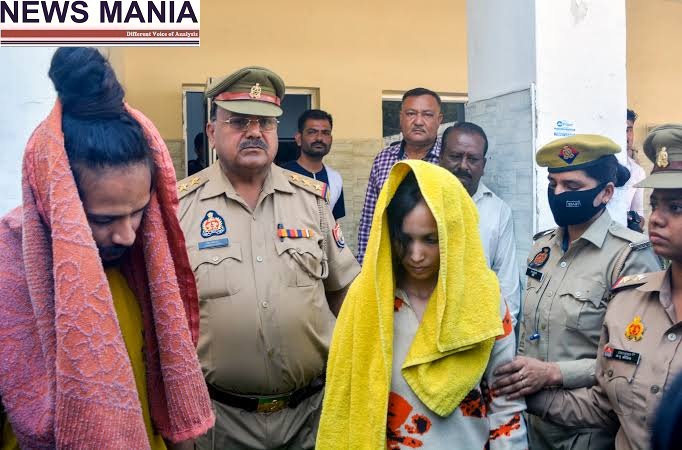
The Bhagavad Gita was used by the Meerut court that condemned Muskaan Rastogi and her boyfriend Sahil Shukla to death on Wednesday for the murder of Rastogi’s husband, merchant naval officer Saurabh Rajput, according to the victim’s attorney.
“The judge cited references from the Mahabharata, affirming that the court would perform its duty, as ‘dharma also means punishing those who commit wrongs’. Despite significant efforts by the defence,” Saurabh Rajput’s lawyer said outside court. The detailed judgment was awaited.
Lord Krishna’s speech to the warrior Arjuna on the Kurukshetra battlefield is documented in the Bhagavad Gita, a section of the Mahabharata. In it, Krishna exhorts Arjuna to fulfilll his dharma, or obligation. Two weeks after the two were found guilty, District Judge Arvind Kumar Mishra issued the punishment. Twenty-two witnesses testified over the trial’s 126 hearings.
According to the court, Rastogi and Shukla plotted Rajput’s murder and used concrete and sand to hide his mutilated body inside a blue industrial drum. The judge added that these actions instill dread in the general public. Earlier on Wednesday, Rastogi’s parents told the court that Rajput was a “very good person”. They said that if the guilty were sentenced to death, “we will not protest”. Rastogi’s family never met her in prison.
The police case states that on March 3, 2025, Rastogi laced Rajput’s food at their Indra Nagar house in order to subdue him. According to the prosecution, Shukla showed up soon after, and the two killed Rajput by stabbing him and dismembering his body in the restroom. According to the investigation, they piled the body pieces inside a big blue plastic drum, shut it, and filled it with a wet mixture of cement, water, and sand to stop the decomposition smell. The following day, the two ran away to Himachal Pradesh. In order to give the impression that Rajput was alive and on business, Rastogi texted his family using Rajput’s cell phone.
On March 17, 2025, suspicious relatives went to the house with local authorities. The couple’s six-year-old daughter had reportedly told neighbours, “Papa is in the drum.” Police cut open the sealed drum and found Rajput’s remains. Rastogi and Shukla were arrested two days later.
The prosecution used a variety of technical, physical, and circumstantial evidence during the trial. Local retailers said that prior to the murder, they had sold the accused the blue drum, cement bags, sand, cleavers, and razors. Shukla was at the house when the crime was committed, according to call detail records and cell tower data. The couple’s joint travels were linked to hotel stays in Manali and Shimla by the same data. Rajput was stabbed to death, according to the post-mortem.