Israel’s election deadlock raises questions over ties with India, Iran tensions and Gaza conflict
News Mania Desk/ Piyal Chatterjee/ 30th October 2026

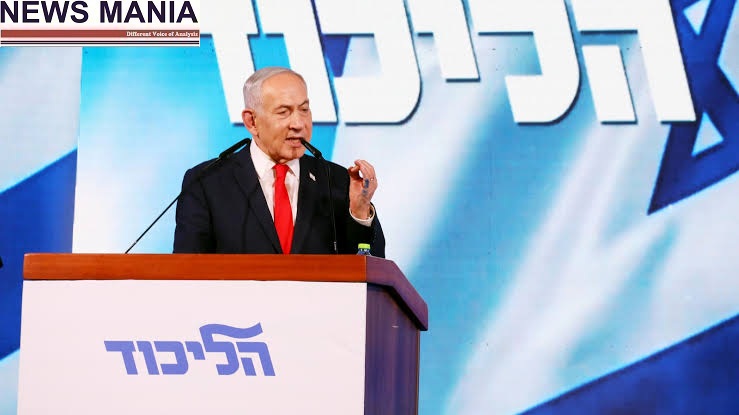
Israel’s inconclusive October 27 election has created fresh political uncertainty, with potential consequences for its relations with India, tensions with Iran and the continuing conflict in Gaza. The election has left Prime Minister Benjamin Netanyahu facing difficulties in securing a parliamentary majority, raising questions about the country’s political direction and its broader regional policies.
Netanyahu’s Likud-led bloc secured 53 seats in the 120-member Knesset, while the opposition alliance led by former army chief Gadi Eisenkot won 48 seats. Arab-led parties secured a record 19 seats. Neither political grouping managed to reach the 61-seat threshold required to form a government independently.
The outcome has opened the possibility of prolonged coalition negotiations. Netanyahu is expected to get the first opportunity to assemble a governing coalition, although an opposition-led arrangement or a national unity government could also emerge. If political parties fail to reach an agreement, Israel may face another election.
The political uncertainty comes at a sensitive time for West Asia, particularly as tensions between Israel and Iran continue to influence regional security. Any renewed military confrontation between the two countries could threaten energy infrastructure, disrupt international shipping routes and push up global oil prices. Such developments would have consequences beyond the region, affecting countries dependent on energy imports.
The election result also raises questions about the future of the Gaza conflict and Israel’s policy towards the Palestinians. Both Netanyahu and Eisenkot have maintained tough positions on Hamas and expressed opposition to Palestinian statehood. Consequently, a change in government may not necessarily produce an immediate shift in Israel’s approach to Gaza or its broader Palestinian policy.
For India, the political developments carry considerable strategic significance. New Delhi has expanded its relationship with Israel across several sectors, including defence cooperation, artificial intelligence, cybersecurity, agriculture, water management and space technology. Israel remains an important partner in India’s defence modernisation and technological development.
However, India also maintains important economic and diplomatic relationships with Iran and the Gulf countries. Its energy security, trade interests and regional connectivity projects depend on maintaining stable relations across West Asia. Any escalation between Israel and Iran could complicate this diplomatic balancing act. The uncertainty could also affect initiatives such as the India-Middle East-Europe Economic Corridor (IMEC), which aims to strengthen connectivity between India, the Middle East and Europe. Regional instability could delay infrastructure development and discourage investment.