Iran destroys $300-million US THAAD in Middle East
News Mania Desk / Piyal Chatterjee/ 7th March 2026
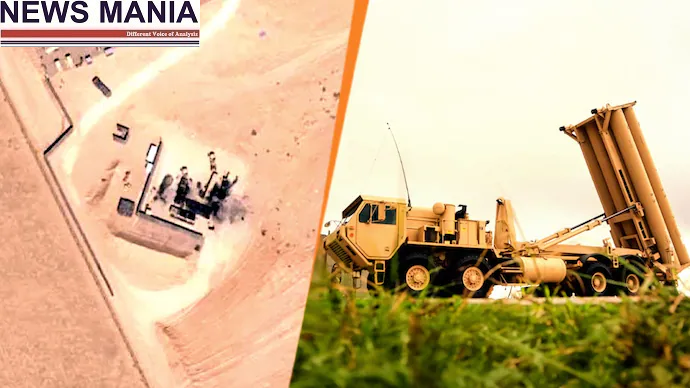
As the war between Iran, the US, and Israel enters its second week, Iran has destroyed a crucial Terminal High Altitude Area Defense (THAAD) radar system that the US uses to detect and intercept ballistic missiles in the Middle East. This is a significant blow to Washington’s missile defense network, according to Bloomberg.
The AN/TPY-2 radar, a crucial part of the THAAD missile defense system, was hit and destroyed at Muwaffaq Salti Air Base in Jordan in the early stages of the battle, a US official told Bloomberg. The radar, which is thought to have cost about $300 million, aids in directing interceptor missiles that are intended to locate and eliminate approaching ballistic threats.
The radar complex at the air base, a crucial US military hub more than 800 kilometers from Iran, was severely damaged, according to satellite imagery examined by analysts. Two sizable craters close to the radar site were visible in post-attack photos, indicating that more than one bullet may have been used. The core of the THAAD battery’s detection and tracking capabilities is the radar equipment, which is installed on multiple huge trailers. According to satellite data, the strike either completely destroyed or severely damaged the radar and its supporting equipment.
Prior to the start of hostilities on February 28, when the US and Israel initiated synchronized strikes on Iranian targets, the radar had been stationed at the Jordanian facility since mid-February. According to analysts, the system was compromised on March 1 or 2.One of the most cutting-edge missile defense systems in use by the US military is THAAD. They can neutralize long-range threats before they reach their targets since they are built to intercept ballistic missiles high in the stratosphere in the last stages of their flight path.
Since the AN/TPY-2 radar at Muwaffaq Salti is no longer operational, Patriot air defense systems—which are usually employed to address shorter-range missile threats—may be more responsible for missile interception in the region. Eight THAAD batteries are operated by the US globally, with deployments in Guam and South Korea. Six truck-mounted launchers, many interceptor missiles, a radar system, and a tactical command unit make up each battery, which costs over $1 billion.
For US forces operating in the area, the Muwaffaq Salti Air Base has been a crucial operational base. More than fifty aircraft, including fighter jets, drones, and transport planes, were stationed at the base, according to pre-war satellite photos. According to research by the James Martin Centre for Nonproliferation Studies, an Iranian attack earlier in the conflict also reportedly destroyed another US radar site, the AN/FPS-132 early warning radar in Qatar.