A Decade of Transformation: Narendra Modi’s India Story4,399 Days @A Leadership Journey That Reshaped Bharat
Ms.Bornali Biswas-Editor in Chief / 13th June 2026

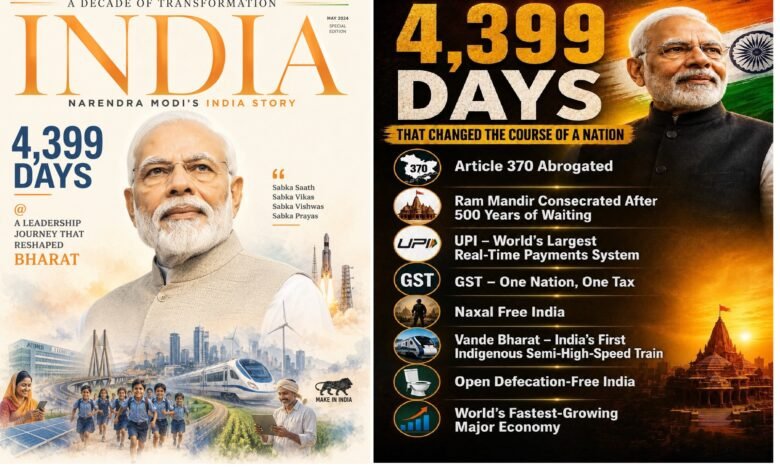
As Prime Minister Narendra Modi completes 4,399 days in office, his tenure stands as one of the most consequential periods in modern India’s history. More than a political milestone, this journey reflects a transformative era marked by bold reforms, ambitious infrastructure development, technological innovation, cultural resurgence, and a renewed confidence on the global stage.
Born after India’s Independence, Narendra Modi became the first Prime Minister from a generation that inherited a free nation rather than witnessing the struggle for freedom. Before assuming the country’s highest executive office in 2014, he served as Chief Minister of Gujarat for over twelve years, making him the Prime Minister with the longest Chief Ministerial experience in India’s history.
Over the past twelve years, his government has sought to redefine governance through a philosophy centered on development, delivery, and digital empowerment. The result has been a period of unprecedented change that supporters describe as the foundation of a “New India”—confident, self-reliant, and future-ready.
Infrastructure: Building the Foundations of Growth
One of the defining features of the Modi era has been the scale and speed of infrastructure development. India has witnessed significant expansion in highways, expressways, airports, metro rail networks, ports, and railway modernization.
Projects such as the Delhi-Mumbai Expressway, Dedicated Freight Corridors, Bharatmala, Sagarmala, and the modernization of railway stations have sought to improve connectivity and reduce logistics costs. The introduction of Vande Bharat Express trains symbolized India’s ambition to create indigenous, world-class transportation systems.
The government’s focus on infrastructure has also extended to rural India through improved road connectivity, electrification, housing initiatives, and access to clean drinking water.
Digital India: Revolutionizing Governance and Inclusion
Perhaps no transformation has been as visible as India’s digital revolution. The Digital India initiative expanded internet access, digitized government services, and encouraged innovation across sectors.
At the heart of this transformation lies the Unified Payments Interface (UPI), which has become the world’s largest real-time digital payments system. Today, billions of transactions take place monthly through UPI, making digital payments accessible even in the most remote corners of the country.
The Jan Dhan-Aadhaar-Mobile (JAM) framework has further strengthened financial inclusion by enabling direct benefit transfers, reducing leakages, and ensuring welfare reaches beneficiaries efficiently.
India’s rise as a global leader in digital public infrastructure is increasingly being studied and adopted by countries around the world.
Economic Reforms and Structural Changes
The introduction of the Goods and Services Tax (GST) marked one of the most significant economic reforms since Independence. By replacing a complex web of indirect taxes with a unified tax framework, GST aimed to create a common national market and simplify business operations.
Other reforms included the Insolvency and Bankruptcy Code (IBC), Production Linked Incentive (PLI) schemes, corporate tax rationalization, startup promotion policies, and measures to enhance the ease of doing business.
India has also emerged as one of the world’s fastest-growing major economies, with growing foreign investment, expanding manufacturing capabilities, and a rapidly developing startup ecosystem.
National Security and Strategic Decisions
The Modi government’s approach to national security has been characterized by a strong emphasis on decisive action and strategic clarity.
Among the most significant political decisions was the abrogation of Article 370 in August 2019, which removed the special constitutional status of Jammu and Kashmir and fully integrated the region into the Indian constitutional framework.
The government also strengthened border infrastructure, modernized defense capabilities, and promoted the vision of “Atmanirbhar Bharat” in defense manufacturing.
Cultural Renaissance and Civilizational Confidence
For many supporters, the consecration of the Ram Mandir in Ayodhya in January 2024 represented a defining moment in India’s civilizational journey. The temple’s inauguration fulfilled a long-standing aspiration that had shaped public discourse for decades.
The government has also promoted initiatives aimed at preserving cultural heritage, reviving traditional knowledge systems, and projecting India’s civilizational identity globally.
From the restoration of historic sites to the return of stolen cultural artifacts from foreign countries, cultural diplomacy has become an important component of India’s global engagement.
India’s Growing Global Influence
Under Narendra Modi’s leadership, India has significantly expanded its diplomatic footprint. The country’s role in forums such as the G20, BRICS, Quad, and the United Nations has grown steadily.
India’s successful presidency of the G20 in 2023 showcased its ability to bring together diverse nations and champion issues important to the Global South. The adoption of the African Union as a permanent G20 member during India’s presidency was widely viewed as a significant diplomatic achievement.
From vaccine diplomacy during the COVID-19 pandemic to leadership on climate action, renewable energy, and technology partnerships, India has increasingly positioned itself as a key global stakeholder.
The Road Ahead
Like every transformative period, the Modi era has inspired both admiration and debate. Yet few would dispute that India has undergone profound changes during these 4,399 days.
The story of Narendra Modi’s leadership is ultimately intertwined with the story of a nation seeking to realize its aspirations in the 21st century. Whether through infrastructure, digital innovation, economic reform, cultural revival, or global engagement, his tenure has left an enduring imprint on India’s development trajectory.
As Bharat moves toward the vision of becoming a developed nation by 2047, the legacy of these transformative years will continue to shape the country’s future. More than a record of time served, 4,399 days represent a chapter of ambition, resilience, and national transformation.
The story of New India continues.