Scientists Propose Dying Stars Could Create New Universes Instead of Black Holes
News Mania Desk/ Piyal Chatterjee/ 19th June 2026

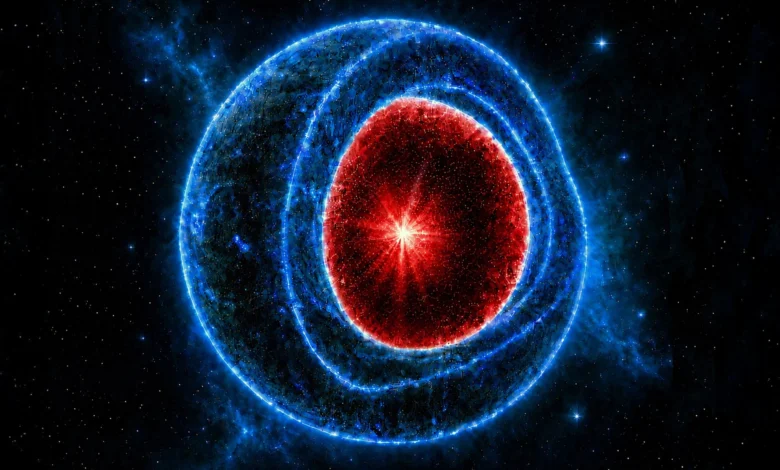
A team of physicists has put forward a provocative new theory suggesting that some dying stars may not end their lives as black holes. Instead, under certain conditions, they could give rise to entirely new universes hidden within their collapsing cores, offering a potential solution to one of modern physics’ biggest puzzles.
For decades, scientists have believed that when massive stars exhaust their nuclear fuel, they collapse under their own gravity and form black holes. At the heart of these objects lies a singularity—a point of seemingly infinite density where the known laws of physics cease to function. The existence of singularities has long troubled researchers because they represent a breakdown in current scientific understanding.
The new study, conducted by researchers at Goethe University Frankfurt, proposes an alternative scenario. Using mathematical models based on Einstein’s theory of general relativity, the scientists suggest that the collapse of a massive star could trigger the formation of a tiny, expanding universe within the stellar core. This process would be driven by dark energy, the mysterious force believed to be responsible for the accelerating expansion of the universe.
According to the researchers, the expansion of this newborn universe could generate enough outward pressure to prevent the complete gravitational collapse of the star. Rather than forming a singularity, the object would stabilize into what is known as a gravastar, or gravitational vacuum star. Such an object would resemble a black hole from the outside but would lack both an event horizon and a singularity.
The theory offers a possible explanation for how nature might avoid the problematic concept of infinite density. Researchers describe their model as one of the first to show how gravastars could emerge naturally from stellar collapse rather than existing only as theoretical constructs.
While the proposal remains speculative and has yet to be supported by observational evidence, scientists say it opens new avenues for studying gravity, dark energy and the evolution of massive stars. If future observations support the theory, it could significantly alter current ideas about black holes and the origins of universes.