Why Kolkata Matters: A Special Conversation with Dr Elena Remizova
Interviewed By: Debasmita Moulick, Senior Journalist

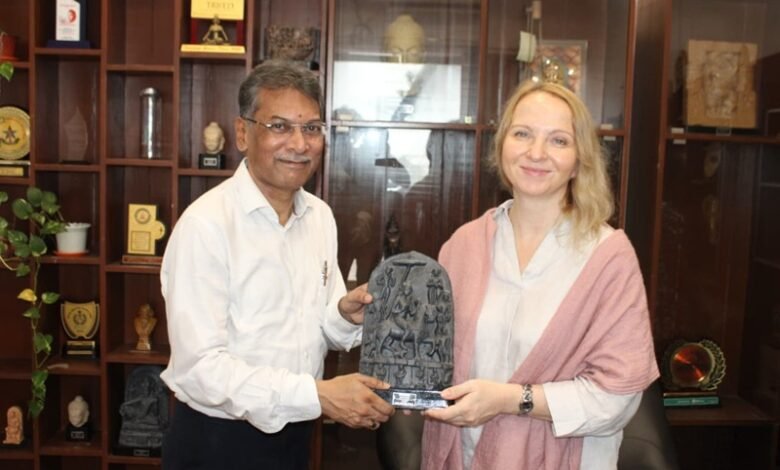
Dr Elena Remizova recently wrapped up a long-awaited visit to Kolkata, the cultural capital of India. Despite an intense schedule and insistent monsoon rains, she managed a remarkable two-day whirlwind tour—exploring museums, heritage sites, tracking historical India-Russia connections, and interacting with local residents. The trip left a lasting impression, fuelling an eager desire to return.
As the Head of Rossotrudnichestvo in India, globally recognized as the “Russian Houses”, Dr Remizova’s visit carried profound historical weight. Leading an organization that recently celebrated its centenary, she felt a deep sense of reflection walking past Kolkata’s century-old architecture. At a time when cultural diplomacy is more vital than ever, the mission of the Russian House beautifully mirrors the enduring, time-tested relationship between India and Russia.
Every city has a public reputation and a hidden reality. What did Kolkata reveal to you that you completely did not expect?
Dr Elena Remizova (E.R.): My expectations of Kolkata were incredibly positive from the very beginning, and my time spent in the city has beautifully validated those feelings.
First-time visitors often come with preconceived notions. What is one assumption Kolkata completely shattered for you?
E.R.: Prime Minister Rajiv Gandhi famously referred to Kolkata as a “dying city.” Of course, his critique was directed specifically at the underperformance of its urban infrastructure at the time, rather than the spirit of the place itself.
However, the moment I arrived, I realized that Kolkata is a city where life is in full swing. It is completely diverse, breathtakingly colourful, and teeming with energy. I can say that it is neither a dying city today, nor could it ever truly have been one in the past. It is, in fact, one of the most vibrant, eternally living metropolises in India.
What was your biggest ‘aha!’ moment during your first few hours here?
E.R.: Historically, Kolkata was conceived and constructed primarily as a grand centre for maritime trade and economic power. Yet, what struck me almost immediately—literally from my very first steps into the city—was how powerfully its cultural and educational identity can still be felt on the surface. Realizing that its intellectual soul shines just as brightly as its commercial history was my true ‘aha!’ moment (smiles).
The Indian Museum houses centuries of civilization under one roof. As someone exploring it for the first time, which exhibit or historical layer of the city fascinated you the most?
E.R.: I found myself completely fascinated by all the collections at the Indian Museum, and it was only a pity that a few galleries were temporarily closed for restoration.
Beyond the artifacts themselves, I was captivated by the historical archiving system of the building. In very few museums around the world can you still witness how geological specimens, minerals, and stones were categorized and displayed 50 or 60 years ago. The museology itself is a living historical milestone. While these halls will inevitably be modernized and optimized in the foreseeable future, viewing this vintage, scientific approach to preserving and sharing knowledge with the public was deeply interesting to me from an academic perspective.
You spent an entire day immersing yourself in the city. If you had to pick one specific interaction or street scene that captured the true essence of Kolkata for you, what would it be?
Given the rushed schedule and lack of time on your current trip, what are you looking forward to prioritizing on your itinerary for your next visit to Kolkata?
E.R.: At the top of my list are the National Library and The Asiatic Society. On this trip, I arrived at the National Library after closing, yet I thoroughly enjoyed admiring its magnificent exterior—its tall structural columns, symmetrical entryways, and the massive canopy of the historic banyan tree. I was also eager to see the Mother Teresa statue outside the gates, which was gifted by the Russian Consulate General in 2012.
We also drove past The Asiatic Society. Knowing it stands as India’s oldest institution of modern learning, dedicated to preserving the subcontinent’s rich cultural heritage, it stirred a deep sense of reverence inside me. A proper tour inside both iconic institutions is my absolute priority for next time.
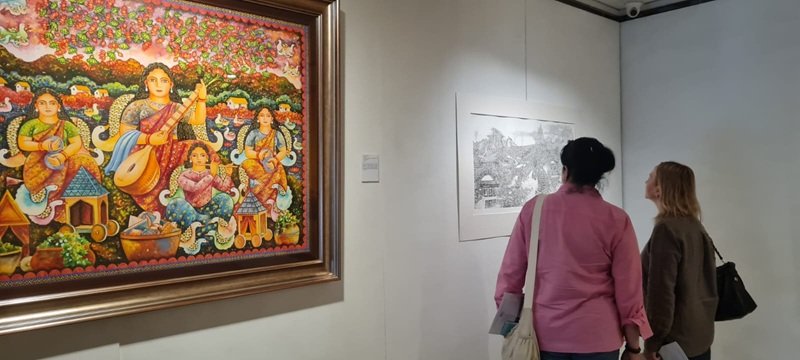
What is, or are, some of the memories that you think will, or have, left a lasting impression on you that will remain with you as an individual, as a person, keeping aside your professional perspective?
E.R.: Setting my professional perspective aside, the most vibrant memory I will carry with me is the intellectual energy of the people. It is instantly clear that Kolkata is a city that breathes history and art. Seeing so many local residents actively exploring the historical museums was wonderful to witness.
Another standout memory for me was visiting CIMA, the gallery of modern art. I noticed entire families coming together, bringing their young children along to experience contemporary art. Witnessing art being integrated so naturally into everyday family life was incredibly touching and is a personal memory I will cherish deeply.
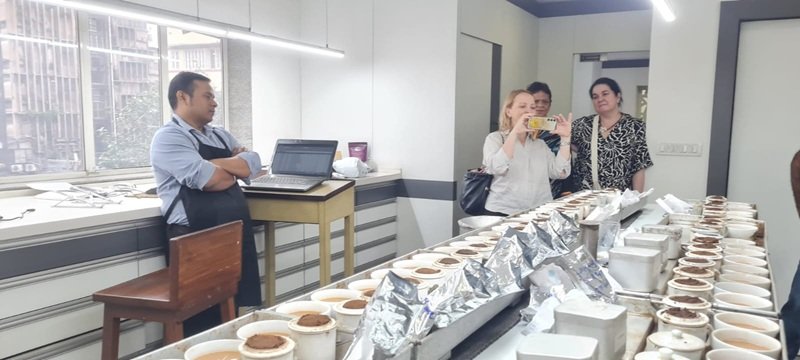
E.R.: Visiting Kolkata has been a long-held dream, largely due to its reputation as India’s tea capital. I was delighted to visit Tosh House, a 129-year-old heritage institution that holds a special place in our shared history—in 1953, it became the first Indian company officially registered as the USSR government’s tea purchasing agent.
At Tosh House, we tasted iconic Darjeeling tea and toured their laboratory where varieties are meticulously blended. It was equally fascinating to step into their heritage retail shops. Seeing how seamlessly tea is woven into the daily lives of Kolkatans was wonderful. People buy multiple varieties on their way home, choosing different teas for different moods and weather conditions. It is a genuine, living tea culture that I was incredibly grateful to experience.
E.R.: Yes, Kolkata is truly a city of vibrant conversations, and its most precious asset is its incredibly open people. Throughout my tour, people in cafes and museums warmly approached me to ask, “What is your impression of our city?” It made it abundantly clear just how deeply Kolkatans love their home and the unbreakable bond they share with their soil. As a cultural phenomenon, it immediately reminded me of St. Petersburg, where residents similarly cannot separate their identity from their city. Finding that parallel cultural psyche here was fascinating and deeply moving.
If you could whisper one piece of advice to a Kolkatan starting to learn the Russian language today, what would it be?
E.R.: Kolkatans are true intellectuals who are naturally drawn to discovering new cultures. Given that Kolkata is a celebrated literary hub, learning Russian is a natural fit. While the classics are widely available in translation, an author’s subtle nuances and emotional depths are frequently lost; reading them in the original language will profoundly enrich any Bengali or resident of Kolkata.
Beyond literature, today’s Russia is a modern scientific and technological powerhouse. I am extremely pleased to see the growing interest of Indian youth in our country today. Through the Russian Houses, we are actively encouraging the younger generation to visit and experience what Russia is truly about. Ultimately, mastering the language builds vital contemporary ties, opening limitless professional and personal doors in global business, trade, and technological partnerships.
As our conversation drew to a close, it became clear that Dr Elena Remizova’s whirlwind maiden trip was far more than a routine diplomatic visit. In just two days, the monsoon-soaked streets of Kolkata revealed a city that is fiercely alive, deeply intellectual, and inextricably bound to its cultural roots—sharing an invisible, artistic kinship with the soul of St. Petersburg. While her current itinerary may have been brief, the foundations laid through the century-old legacy of Tosh House and the contemporary halls of the CIMA gallery ensure that her next visit will not just be a return, but a continuation of a beautiful, enduring cultural bridge.