Sarpagandha( Rauvolfia serpentina): Amultiuse endangered medicinal plant
Saikat Kumar Basu/ 27th October 2026

Introduction
Medicinal plants have played an important role in the evolution of modern pharmacology, and Rauvolfia serpentina (L.) Benth. ex Kurz—commonly known as Indian snakeroot or Sarpagandha—is one of the most significant examples of a traditional medicinal plant that contributed directly to modern drug discovery. Belonging to the family Apocynaceae, the plant has a long history of use in South Asian traditional medicine. Its importance in modern medicine is particularly associated with its rich diversity of monoterpenoid indole alkaloids, including reserpine, ajmaline, ajmalicine, serpentine and related compounds.
The story of R. serpentina is especially important from the perspective of medicinal chemistry, cardiovascular pharmacology and allopathic therapeutics. Two chemically distinct pharmacological contributions stand out: reserpine, which helped establish an important pharmacological approach to hypertension, and ajmaline, an antiarrhythmic alkaloid derived from the plant.
From traditional medicine to modern pharmaceutical science
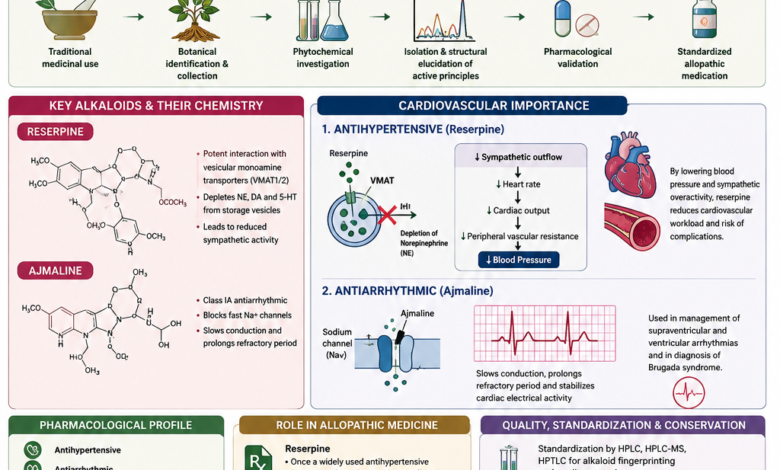
The therapeutic history of R. serpentina illustrates how traditional botanical knowledge can stimulate modern pharmaceutical research. During the twentieth century, systematic chemical investigations of Rauvolfia roots resulted in the isolation and characterization of numerous alkaloids. By the middle of the 20th century, reserpine had become an important antihypertensive drug, while research on other alkaloids revealed additional cardiovascular activities.
This transition—from crude plant material to purified chemical constituents and finally to defined pharmacological mechanisms—is an important model for natural-product drug discovery.
It also demonstrates an essential principle of medicinal chemistry: the therapeutic activity of a medicinal plant may arise from several chemically distinct molecules, and the pharmacological profile of the whole plant cannot automatically be equated with that of a single purified compound.
Medicinal chemistry of Rauvolfia serpentina
The roots, particularly the root bark, contain a complex mixture of indole alkaloids. Among the best-characterized constituents are reserpine, ajmaline, ajmalicine, serpentine, yohimbine, deserpidine, rescinnamine and other related monoterpenoid indole alkaloids.
Modern phytochemical investigations have identified hundreds of alkaloids and other secondary metabolites across the genus Rauvolfia. Analytical methods such as HPLC, HPLC-MS and HPTLC are important for authentication, standardization and quality control of plant material and preparations.
From the medicinal-chemistry perspective, reserpine is particularly fascinating because its molecular structure produces a highly specific interaction with vesicular monoamine transporters (VMATs).
Reserpine interferes with the uptake and storage of monoamine neurotransmitters—including noradrenaline, dopamine and serotonin—within presynaptic storage vesicles. Depletion of noradrenaline from sympathetic nerve terminals reduces sympathetic activity and consequently produces a fall in blood pressure. Thus, the molecule provided an early pharmacological demonstration of how altering neurotransmitter storage can modify cardiovascular physiology.
Reserpine and cardiovascular pharmacology
The most historically important pharmaceutical contribution of R. serpentina is undoubtedly its role in the development of antihypertensive therapy. Reserpine was one of the first drugs to be used extensively for long-term treatment of systemic hypertension. It can also reduce renin secretion as part of its overall sympatholytic effect.
Clinical evidence indicates that reserpine can lower systolic blood pressure, although its contemporary use is much less common than that of newer antihypertensive medicines. A Cochrane review concluded that reserpine can produce meaningful systolic blood-pressure reduction but noted limitations in the available trial evidence and in determining dose-response relationships.
Therefore, R. serpentina should not simply be described as a “traditional antihypertensive herb”; it is historically important because it provided a chemically defined molecule that became a genuine pharmaceutical antihypertensive agent.
Cardioprotective significance: an important distinction
The term cardioprotective should be used carefully.The strongest established cardiovascular contribution of R. serpentina in conventional pharmacology relates to blood-pressure control and control of certain cardiac arrhythmias, rather than evidence that the crude plant universally prevents myocardial infarction or heart failure.
Persistent hypertension increases the workload imposed on the heart and contributes to vascular and cardiac complications. By reducing sympathetic activity and blood pressure, pharmacological treatment with reserpine historically provided a means of reducing this haemodynamic burden.
Consequently, the plant can be considered important in the history of cardiovascular risk management, although modern clinical practice generally uses other antihypertensive drug classes as first-line therapy.
An even more direct cardiac pharmacological connection comes from ajmaline. Ajmaline is a monoterpenoid indole alkaloid isolated from R. serpentina and is classified as a Class IA antiarrhythmic agent. It affects cardiac electrical activity, particularly through effects on sodium-channel-dependent action-potential conduction.
Ajmaline has been used in the management of certain arrhythmias and has acquired an additional modern role in electrophysiological diagnosis of Brugada syndrome, where controlled administration can help unmask characteristic ECG abnormalities. This gives R. serpentina an extraordinary place in pharmacology: one plant produced chemically distinct molecules relevant to both blood-pressure regulation and cardiac electrophysiology.
Ajmaline: a landmark molecule in cardiac pharmacology
From the viewpoint of medicinal chemistry, ajmaline is particularly significant because it demonstrates how a naturally occurring alkaloid can become a pharmacologically useful molecule through understanding of its interaction with cardiac ion channels.
Cardiac contraction depends on precisely regulated ionic currents across cardiomyocyte membranes. Sodium-channel activity is crucial for rapid depolarization and propagation of the cardiac action potential. Ajmaline modifies the electrophysiological processes and thereby influences cardiac conduction and refractoriness. It has consequently been used as an antiarrhythmic drug in several countries.
Recent research continues to investigate the antiarrhythmic potential of R. serpentina alkaloid mixtures and tissue-culture-derived material, illustrating that the plant remains relevant to contemporary natural-product and pharmacological research.
Pharmacological diversity beyond the cardiovascular system
Although cardiovascular pharmacology is particularly important, R. serpentina possesses a much broader pharmacological profile.Investigations of Rauvolfia species have reported activities involving cardiovascular regulation, central nervous system effects, antihypertensive activity, antiarrhythmic effects, antioxidant activity, antimicrobial activity, hepatoprotective effects and other experimental pharmacological activities.
However, experimental pharmacological activity should not automatically be interpreted as established clinical efficacy. Modern drug development requires reproducible pharmacology, toxicological evaluation, pharmacokinetic studies, standardized preparations and appropriately designed clinical trials.
Rauvolfia serpentina and allopathic medicine
The history of R. serpentina is particularly important in understanding the relationship between traditional medicine and allopathic pharmacology. The plant itself is not equivalent to a modern pharmaceutical preparation.
Instead of administering an uncontrolled quantity of plant material, pharmaceutical science can isolate a defined active molecule, establish its chemical identity, study its mechanism and determine appropriate pharmaceutical dosage.
This distinction is crucial because the concentration of alkaloids in plant material can vary according to genotype, geographical origin, cultivation conditions, plant age, plant part and extraction method. Modern quality-control studies therefore use chromatographic and spectrometric techniques to characterize Rauvolfia preparations.
Why reserpine declined in modern cardiovascular practice
The pharmaceutical success of reserpine also provides an important lesson in the evolution of drug therapy. Although reserpine is pharmacologically effective, depletion of monoamines throughout the nervous system can produce undesirable effects. Historical and pharmacological literature has associated its use with adverse effects including sedation, nasal congestion, gastrointestinal effects and depression.
Consequently, modern hypertension management has largely shifted toward drug classes with more favourable contemporary risk-benefit profiles and more predictable therapeutic targeting. This does not diminish the importance of R. serpentina. Rather, it illustrates the process by which pharmacology advances from a biologically active natural product toward increasingly selective and tolerable medicines.
Conservation and sustainable pharmaceutical use
The pharmaceutical importance of R. serpentina also creates a conservation responsibility. Because roots are the principal source of many important alkaloids, indiscriminate harvesting can threaten natural populations. Sustainable cultivation, authenticated planting material, controlled harvesting and plant tissue culture may therefore become increasingly important.
Recent research using R. serpentina tissue culture to produce alkaloid-rich material illustrates the possibility of developing alternative sources of valuable compounds while reducing pressure on wild populations. This connects medicinal-plant conservation with modern pharmaceutical biotechnology.
Conclusion
Rauvolfia serpentina is far more than an important Ayurvedic medicinal plant; it is a landmark species in the history of modern pharmacology and pharmaceutical chemistry. Its importance can be understood through three interconnected dimensions like presence of monoterpenoid indole alkaloids—particularly reserpine and ajmaline that provide structurally sophisticated natural molecules with defined pharmacological targets.
The plant demonstrates the transformation of traditional medicinal knowledge into standardized, chemically characterized pharmaceutical agents. Reserpine became an important historical antihypertensive, while ajmaline remains a specialized antiarrhythmic and diagnostic pharmacological agent in countries where it is available.
The contemporary lesson is therefore not that Rauvolfia serpentina should replace modern cardiovascular medicines, but that medicinal plants can serve as exceptionally valuable starting points for pharmaceutical discovery. The future significance of R. serpentina lies in combining ethnobotanical knowledge, medicinal chemistry, pharmacology, biotechnology, analytical chemistry and evidence-based clinical research to discover safer and more precisely targeted cardiovascular therapeutics.