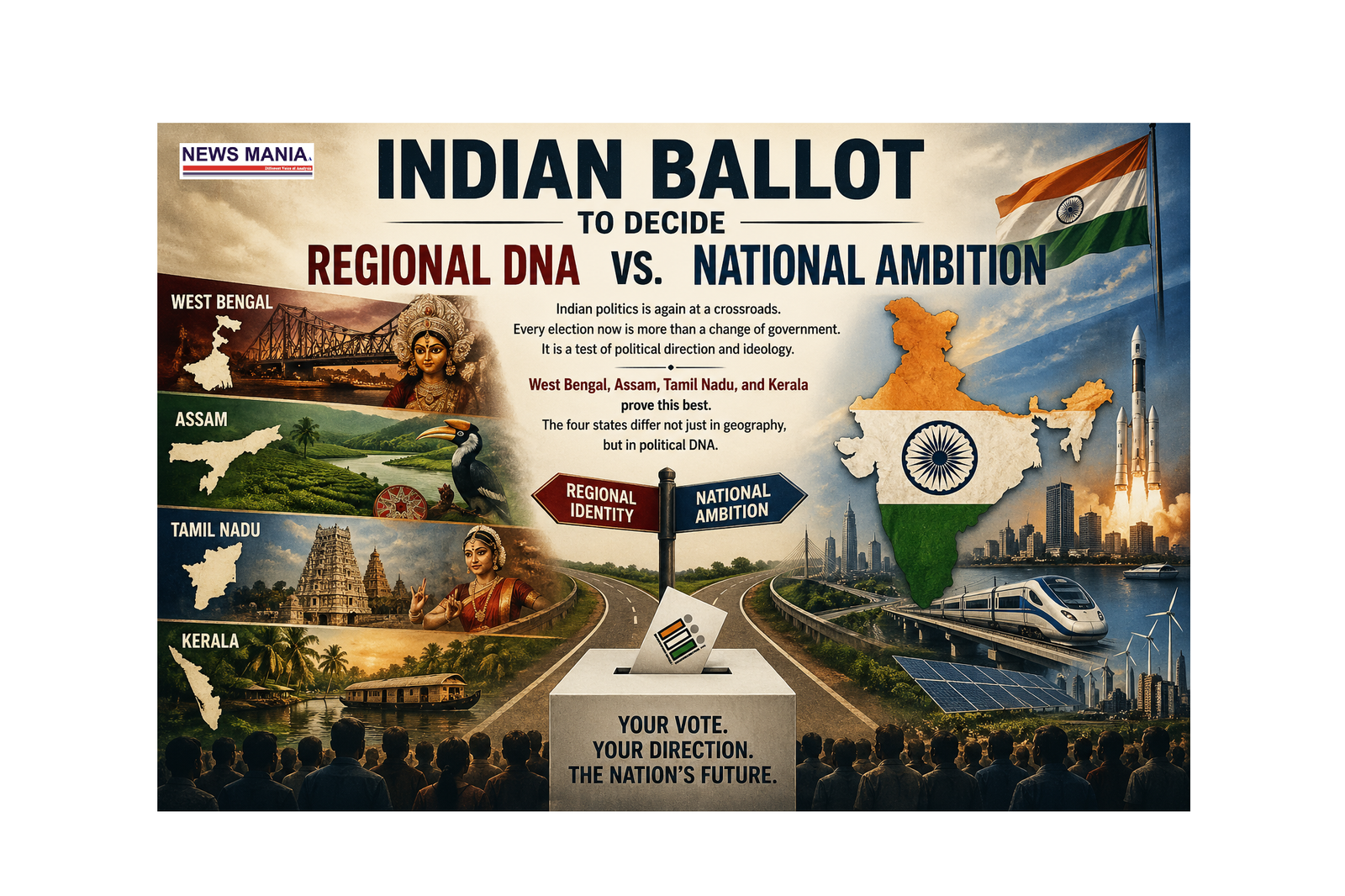
Indian politics is again at a crossroads. Every election now is more than a change of government. It is a test of political direction and ideology. West Bengal, Assam, Tamil Nadu, and Kerala prove this best. The four states differ not just in geography, but in political DNA. The upcoming results will show whether national parties can expand or regional forces will tighten their grip.In West Bengal, the Left’s long rule gave way to Mamata Banerjee’s Trinamool Congress. She built a new regional identity around Bengali pride, cultural nationalism, and Centre-state friction. In Assam, identity dominates. NRC, CAA, and Bangladeshi infiltration have driven elections for decades. The BJP combined Hindutva with Assamese identity to win, while Congress-AIUDF alliances banked on minority votes.Tamil Nadu’s politics was born from the Dravidian movement. DMK vs AIADMK is not just a power tussle. It is about social justice, language, and self-respect. National parties stay marginal here. Kerala alternates between the Left and the Congress-led UDF. Literacy, health, and welfare models, not religion or caste, frame debates.
After 2014, the BJP’s “Congress-mukt Bharat” push worked in the North, West, and Northeast. But the South and East resisted. In Tamil Nadu, the BJP-AIADMK split made its job harder. In Kerala, vote share rises but seats do not. In Bengal, the BJP became the main opposition in 2021, yet Mamata’s grassroots connect and women voters kept TMC dominant. In Assam, the BJP holds power by aligning with local identity.
Congress faces the reverse. Strong in Kerala, struggling in Assam, almost gone in Bengal, and a junior partner to DMK in Tamil Nadu. National parties are no longer “big brothers” in states. They are coalition partners.
The 2026 battle: Three layers of issues
1. Livelihood issues: Inflation, unemployment, farm distress, education, health. Post-Covid jobs lack quality. Young voters want permanent jobs, not just startups. MGNREGA and free ration still sway rural India.
2. Identity issues: Language, religion, regional pride. Hindi imposition fears in Tamil Nadu, “outsider vs son of the soil” in Bengal, “Khilonjiya” identity in Assam, and minority rights in Kerala. These emotions drive cadres.
3. Governance models: Kerala’s health model, Tamil Nadu’s social justice model, Assam’s infra push, Bengal’s welfare schemes. But caste-community math differs. Assam hinges on Assamese vs Bengali, Hindu-Muslim, and tribal votes. Bengal counts on SC, ST, OBC, and a 27% Muslim bloc. Tamil Nadu runs on backward class reservation. Kerala’s kingmakers are Christians, Muslims, and Ezhavas.
Victory depends on “who to unite, who to split.” BJP bets on tribals plus Assamese Hindus in Assam, and Matua-Namashudra plus Hindi-speaking votes in Bengal. TMC, DMK, and the Left target women through direct-benefit schemes. The women’s vote is no longer silent. It is the swing vote. Kanyashree, Magalir Urimai Thogai, and similar schemes reach the household directly.The 2024 Lok Sabha polls showed voters split national and state choices. The BJP lost ground in the Hindi belt but gained Lok Sabha seats in Assam and Bengal. DMK-INDIA swept Tamil Nadu. Congress revived in Kerala. State polls are about local factors and CM faces. Mamata vs Suvendu, Himanta vs Gaurav, Stalin vs Annamalai, Pinarayi vs Satheesan — these will be personality contests.
If regional parties hold ground, these elections will signal more than who rules for five years. They will reveal voter intent. Does India want a centralized development model or state-specific welfare? Hindutva-nationalism or linguistic-cultural diversity? Beneficiary politics or rights-based politics?The mandate from Bengal, Assam, Tamil Nadu, and Kerala will be Indian democracy’s compass. It will decide the pitch for 2029 — fought on roti, or on identity.
(The writer is a New Delhi based political commentator.)